

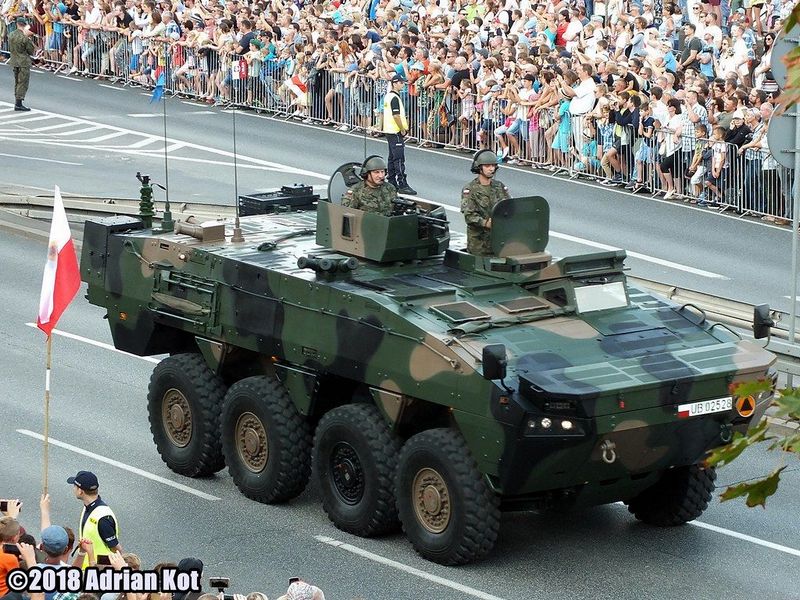


KTO Rosomak Story
KTO Rosomak ("Wolverine") is a series of eight-wheeled armoured utility vehicles currently in service with the Polish Army, originally based on a Finnish design - the Patria AMV. In the early 2000s, Polish authorities were looking for an inexpensive utility vehicle to modernize their mechanized forces and replace outdated types that served the same role on the battlefield. Rather than commit to a homegrown interior design, embrace some foreign contributions.
The Polish government agreed to the mighty Finnish Patria and in December 2002 signed a massive purchase order for hundreds of cars. The deal includes licensed production rights for the vehicle, known as Rosomak, which will be built locally and supply the changes needed by the Polish military, making Poland the first foreign operator of the Patria system.
The final order is for nearly 900 vehicles in two different forms - armed infantry fighting vehicles and basic armored vehicles that the Army can modify as needed. In total, the deal includes 313 IFVs and 377 base wheeled models.
Polish production of Rosomak is currently handled by WZM S.A. in Siemianowice Slaskie in southern Poland. Apart from Poland, Malaysia remains a potential customer for Rosomak, although no deals have been concluded as of this writing.
Vehicles like the Patria/Rosomak marked the changing direction of armored warfare, and the single-wheeled armored chassis formed the basis of many vehicles. This creates a modular product that operators can meet specific battlefield needs at cost. The Rosomak differed from the original Patria due to requests from the Polish army, but generally kept the Finnish design. Although a relatively new addition to the Polish inventory, the type has been in service as part of the Polish presence as early as the Aganistan War and has proven reliable and resilient in the face of a volatile and unforgiving theater of operations . Rosomak is also used by the EU Mission in Chad.
Such systems reward their owners by allowing changes to the basic design in the form of different weapon layouts, logistically beneficial vehicle components, and generally robust design elements.
The exterior design and interior layout of the KTO Rosomak are quite traditional by modern standards. The vehicle has eight large rubber tire wheels on one side. The hull has excellent ground clearance and is somewhat amphibious, powered by two propellers in the water. The eight-wheel arrangement features full suspension for maximum on- and off-road capability. The glass panels are well-sloped, almost horizontal, to meet the flat roof of the superstructure.
The lower front body meets the glass panel at the flat edge of the front of the vehicle, which houses the headlights. Rectangular rear-view mirrors for the driver and turret crew are mounted on the extreme corners of the forward fuselage. The sides of the body are almost vertical. When a powered base turret is installed (different weapons are placed differently), the turret is a low-profile installation with unobstructed traverse and limited height, while being centered on the superstructure roof. The turret is used with an automatic chain gun weapon system or other suitable weapon and a bank of six smoke grenade launchers to cover tactical maneuvering.
There are two armored hatches with sights on the top of the turret. The driver maintains a forward left position (famous for his own hatch and sight block) with the power pack to his right. A standard combat crew consists of three people, including the driver, commander, and gunner.
Up to eight passengers can be accommodated in relative safety in the rear troop compartment. Entry and exit from the fighting compartment was through a rectangular door in the rear of the hull, spanned by the last pair of wheels. A pair of sunroofs are also provided for passengers.
There does not appear to be a launch port on the side of the body for the occupants of the vehicle. Power for the Rosomak range is provided by a single DI 12 Scania Diesel diesel engine system. The powerplant supplies the chassis with 480 hp (up to 543 hp). That equates to a road speed of 60 miles per hour and an operating range of nearly 500 miles.
The Rosomak weighs nearly 50,000 pounds and has a barrel length of 25 feet, a height of just over 7 feet and a width of just over 9 feet.
To date, there have been several notable variants of Rosomak. The basic Infantry Fighting Vehicle (IFV) is the KTO Rosomak, identified by its Oto Melara Hitfist-30P powered turret. The turret is equipped with an ATK Mk 44 Bushmaster II series 30mm chain gun, and a coaxially mounted UKM-2000C series 7.62mm general purpose machine gun. The 30mm weapon can handle lightly armored vehicles with high-explosive (HE) and armor-piercing (AP) projectiles, as well as fortifications with hostile elements.
The 7.62mm machine gun can manage the concentration of enemy infantry as needed.
Poland's involvement in the war in Afghanistan forced the development of a theater version called the Rosomak-M1M. This version differs from the original base form by installing upgraded communications equipment, external cameras connected to internal screens, a Pilar directional fire detection system, additional armor protection, and an optional steel cage for rocket-propelled grenades (RPGs)." Net.
Repel projectile grenades and wire cutters mounted in the driver and commander hatches. As a result of all these additions the basic design is finally changed - i. H. A heavier end product was produced - the Rosomak-M1M lost its amphibious capabilities (including its water propeller system).
The KTO Rosomak-M3 became a special variant of the armored personnel carrier (APC). This design, like the M1M before it, also arose out of Poland's involvement in Afghanistan, and closely follows the changes already observed in the M1M version. However, the M3 was fitted with a lighter open-air turret and was housed in a dual-weapon station with a 40mm Mk 19 automatic grenade launcher and a 12.7mm NSV series heavy machine gun.
These weapons are designed to provide point defense for embarked and disembarked troops, as well as cover and suppress fire when needed.
The KTO Rosomak-S variant is similar to the M3 in that it was designed as an armored personnel carrier, designed to transport anti-tank infantry into battle. The KTO Rosomak-WD is being developed as a battlefield command vehicle with limited weapon options but greatly improved communications capabilities.
The KTO Rosomak-Lowcza is a well-known dedicated mobile anti-aircraft vehicle.
Specification
Basic
Roles
- Air Defense/Airspace Denial
- anti-tank/anti-tank
- Infantry Support
- Reconnaissance (RECCE)
- Troop Transport
Dimensions
25.26 ft (7.7 m)
2.8m
7.55 ft (2.3 m)
24 tons (22,000 kg; 48,502 lb)
Performance
Performance
100 km/h
497 miles (800 km)
Armor
Base IFV model:
1 x 30mm ATK Mk 44 Bushmaster II Auto Cannon
1 x 7.62 mm UKM-2000C coaxial machine gun
6 x Smoke Grenade Launchers
1 x 12.7mm heavy machine gun WKM-B (HMG)
1 x 40mm Mk 19 Automatic Grenade Launcher (AGL)
6 x Smoke Grenade
Changes
KTO Rosomak - Base infantry fighting vehicle; 30mm chain gun mounted in the turret.
KTO Rosomak-M1M - Infantry fighting vehicle; desert gear; steel composite armor; improved communications suite; anti-RPG grid and IED system.
KTO Rosomak-M3 - Infantry fighting vehicle; open tower position; equipped with 1 x 40mm grenade launcher or 1 x 12.7mm machine gun.
KTO Rosomak-WEM - medical evacuation variant; 3 x cabin space for medical waste and medical staff.
KTO Rosomak-S - armored personnel carrier, anti-tank; equipped with Spike ATGM.
KTO Rosomak-WD - command vehicle; improved communications and electronics.
KTO Rosomak-Lowcza - Anti-aircraft vehicle.
 Argentina
 Armenia
 Australia
 Austria
 Austria-Hungary
 Belgium
 Brazil
 United Kingdom
 United States
 Brunei
 Bulgaria
 Canada
 Chile
Chile China
China Colonial America
 Colombia
 Confederate States
 Croatia
 Czech
Czech Denmark
 Egypt
Egypt Finland
 France
 Georgia
 Germany
 German Imperial
 Greece
 Holland
 Hungary
 India
India Indonesia
 Iran
Iran Iraq
Iraq Ireland
 Israel
 Italy
Italy Japan
Japan Japan (1940)
 Jordan
 Kingdom of Italy
 Malaysia
 Mexico
 Myanmar
 Nazi Germany
 Netherlands
 New Zealand
 North Korea
 Norway
 Pakistan
 Peru
Peru Philippines
 Portugal
 Prussia
 Romania
 Russia
 Saudi Arabia
 Serbia
 Singapore
 Slovakia
 Slovenia
 South Africa
 South Korea
 Soviet Union
 Spain
Spain Sweden
 Switzerland
 Syria
Syria Taiwan
 Thailand
 Turkey
 UAE
UAE Ukraine
 Vietnam
 Yugoslavia