


History
Amphibious assault has been a complex, expensive but ultimately important part of warfare, beginning with naval warfare. Amphibious assault boats are also evolving to suit the changing face of warfare, from the old wooden assault units to today's self-propelled, armored and tracked vehicles. In the middle and late stages of the Cold War, when the United States and the Soviet Union had arsenals of unprecedented scale, the U.S. military relied on the LVT-5 as a reliable main force for ship-to-shore landings. The LVT-5 itself was born out of a long list of such systems that debuted in the many amphibious assaults that defined the battlefields of World War II (1939-1945) - embodied in the LVT family. The LVT-5 is more or less a continuation of this line and is designed to bring combat-ready personnel ashore for protection and fire support.
These infantry units, usually naval-type combatants, are trained for this type of attack and can board littoral attack ships, drive their vehicles to shore, and disembark ready for battle upon reaching land.
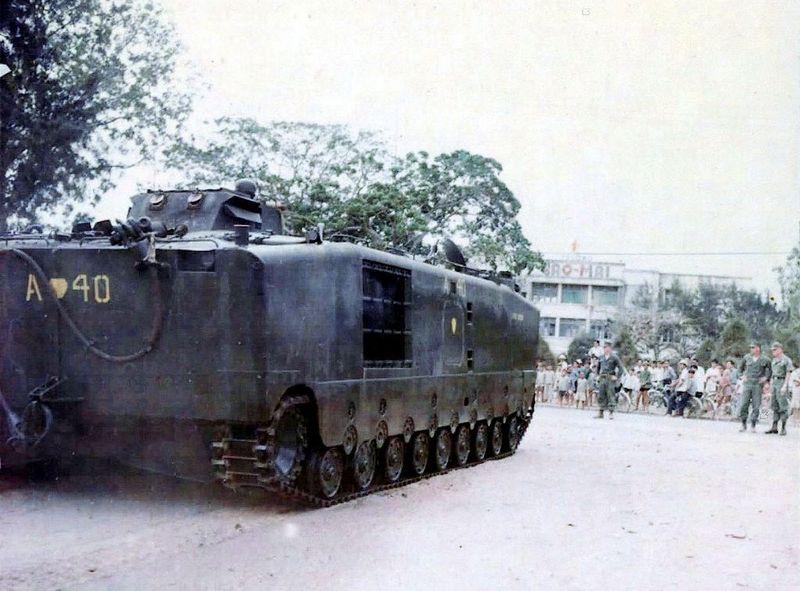
The LTV-5 entered the U.S. military stockpile in 1956, too late to be used in the Korean War (1950-1953) raids. However, they became a key component of raids during the Vietnam War (1955-1975).
The "LTVP" part of the name comes from "Landing Vehicle, Tracked, Personnel", which aptly describes the nature of LVTP-5.
Compared to previous LVTP products, the LVTP-5 series is a huge ship monster. It was given a rather simple rectangular shape with a forward sloping bow that contained a power ramp that doubled as part of the front wall.
The sides of the vehicle are vertical, as are most of the roofline and rear fuselage paneling. The tracks are mostly covered by the side armor of the vehicle, the tracks are actually only exposed under and in front of the vehicle.
The chassis features a conventional track and wheel arrangement with wheels numbered nine twin-tire units (using a torsionally elastic suspension system). The drive pinion at the rear of the vehicle and the idler at the front.
The main physical feature of the LVTP-5 is its front powered loading ramp, which allows deep access to the interior cargo area. Additional entry/entry points are found along the hull roofline in the form of circular hatches for the standard three-person operator.
The driver is housed in a dedicated station with the necessary control systems and dashboards. Another armored, covered position was fitted with a .30 caliber machine gun for support fire. The openness of the central forward hull required the engine compartment to accommodate the stern.
In all, the LVTP-5 can accommodate up to 34 combat-ready infantrymen.
The car is powered by a Continental LV-1790-1 V12 gasoline engine with an output of 700 hp. This results in a top speed on water of 7 mph and a road speed of up to 30 mph on land (assuming ideal conditions).
Finally, several special variants of the base LVT-5 personnel carrier exist. The LVTC-5 is a command vehicle variant with enhanced communications equipment, while the LVTH-6 is a fire support platform fitted with an operational 105mm howitzer. The latter produced about 210 of them. 65 LVTR-1 armored rescue vehicles were introduced, as well as 41 LVTE-1 engineering vehicles.
A proposed but ultimately abandoned air defense platform was considered the experimental "LVTAA-X1". This version is designed to mount the complete 2 x 40mm turret of the M42 "Duster" anti-aircraft tank. No production.
The total production of LVTP-5 vehicles (including all models) was 1,124 units.
The adoption of the LVT-5 extends beyond the United States, as the model also entered service with the armed forces of Chile, the Philippines and Taiwan. The LVTP-5 managed a healthy life cycle in frontline service until it was officially replaced by the LVTP-7 (now AAV-7) in U.S. inventories beginning in 1972. While maneuverability and protection have improved, the new car's passenger capacity has been reduced by 21 passengers (although three remain).
The loading ramp has also been moved to the rear of the vehicle, and firepower has been significantly enhanced.
Specification
Basic
Roles
- Amphibious
- fire support/attack/damage
- Troop Transport
- Support/Special Purpose
Dimensions
29.66 ft (9.04 m)
11.71 ft (3.57 m)
2.92m
41 tons (37,400 kg; 82,453 lbs)
Performance
Performance
48 km/h
190 miles (306 km)
for everyone else in our database)
Armor
Default:
1 x 7.62 mm (0.30 caliber) General Purpose Machine Gun (GPMG).
Variants:
1 x 105mm howitzer (fire support version)
2 x 40mm anti-aircraft guns (suggested anti-aircraft version)
2,500x7.62mm ammo
Changes
LVTP-5 (landing vehicle, tracked, personnel) - name of the basic series; armored personnel carrier.
LVTC-5 (landing vehicle, tracked, command) - command vehicle.
LVTH-6 (landing vehicle, tracked howitzer) - fire support model; for 1 x 105mm cannon; 210 copies made.
LVTR-1 (Landing Vehicle, Tracked, Recycled) - Recycled variant; 65 copies made.
LVTE-1 (landing vehicle, tracked, engineer) - minesweeper variant; 41 copies made.
LVTAA-X1 (Lander, Tracked, AA) proposed AA model; turret to match M42 Duster chainmail; single prototype example made.
 Argentina
 Armenia
 Australia
 Austria
 Austria-Hungary
 Belgium
 Brazil
 United Kingdom
 Brunei
 Bulgaria
 Canada
 Chile
Chile China
China Colonial America
 Colombia
 Confederate States
 Croatia
 Czech
Czech Denmark
 Egypt
Egypt Finland
 France
 Georgia
 Germany
 German Imperial
 Greece
 Holland
 Hungary
 India
India Indonesia
 Iran
Iran Iraq
Iraq Ireland
 Israel
 Italy
Italy Japan
Japan Japan (1940)
 Jordan
 Kingdom of Italy
 Malaysia
 Mexico
 Myanmar
 Nazi Germany
 Netherlands
 New Zealand
 North Korea
 Norway
 Pakistan
 Peru
Peru Philippines
 Poland
 Portugal
 Prussia
 Romania
 Russia
 Saudi Arabia
 Serbia
 Singapore
 Slovakia
 Slovenia
 South Africa
 South Korea
 Soviet Union
 Spain
Spain Sweden
 Switzerland
 Syria
Syria Taiwan
 Thailand
 Turkey
 UAE
UAE Ukraine
 Vietnam
 Yugoslavia