

History
Mobile Multiple Rocket Launcher Systems (MLRS) or rocket launchers have been an integral part of modern militaries since World War II (1939-1945). The use of this system by the Soviets greatly influenced the Germans, and all major parties in the conflict deployed some sort of MLRS units on these battlefields. During the Cold War decades (1947-1991), MLRS was used by more world powers, leading to a lot of development going into the pipeline.
One such system emerged from the former Yugoslavia in the 1970s as the M-77 "Oganj". Its NATO codename is "YMRL-32".
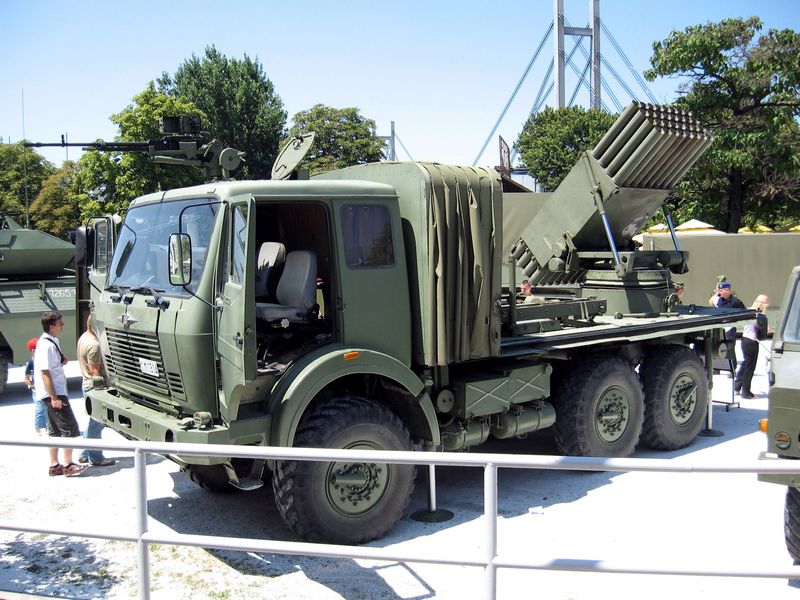
The M-77 is nothing more than a combination of a 32x128mm launcher (mounted on a learnable stand) and a Yugoslav FAP 2026 BDS/A 6x6 wheeled military truck. The resulting system proved very effective against rocket launchers, and was very similar in form and function to many Soviet-inspired truck rocket launchers that appeared during the Cold War.
Design work on the M-77 began as early as 1968, but the system was not shown to the public until 1975. Official service began in 1977 (hence the name), with hundreds of examples rolling out from production facilities. The 50,000-pound vehicle, driven by five men, measures 27.6 feet long, 8 feet wide and 10 feet high.
A FAP 8-cylinder diesel engine powers the vehicular portion of the M-77 and can reach 50 mph on paved roads. The 128mm rocket is 8.5 feet long and carries a 44-pound warhead for maximum high-explosive (HE) effect. The lethal range of the projectile is up to 12 miles from the launcher.
A 12.7mm heavy machine gun (HMG) and all personal weapons carried by the crew provide the crew with modest localized defense, while the cabin is lightly armored for minimal operator protection.
The layout of the system is the same as the traditional layout in a multiple rocket launch system (MLRS) - the truck cab and engine are fronted with a flat plate in the rear to accommodate the rocket launcher. The truck's original 6x6 suspension provides good off-road maneuverability, as well as excellent ground clearance in rough terrain and wading.
The M-77 was heavily used in the ensuing Balkan Wars (1991-2001) and was one of the few indigenous Yugoslav artillery pieces to serve in the conflict. Although the eventual disintegration of Yugoslavia meant that the existing forces were unevenly distributed among the various warring factions - Bosnia and Herzegovina, Croatia and Serbia - the vehicle launchers did an exceptionally good job of saturating known enemy positions, with Serbia retaining the lion's share.
After the war, these units continued to serve in their respective armed forces.
Today, it is known that the Serbian army has about 130 M-77 systems, while Bosnia and Herzegovina has about 36 M-77 systems. Croatia initially phased out its M-77 units, but has since revived (2015) a fleet of about a dozen cars. Later modifications to the M-77's basic design gave rise to the Oganj 2000 ER brand, which allowed the Soviet BM-21 "Grad" system's 122mm rocket to be fired from 50 launchers. Likewise, the Croatian Army modified its M-77 inventory to support 122mm rockets through the M-91 "Vulkan" brand.
Another related M-77 development - this one from Serbia - became the M-94 "Oganj C" capable of firing both types of missiles (HE and Cluster) from the same launcher. This form first appeared in 1994 (hence the name).
Specification
Basic
Roles
- fire support/attack/damage
Dimensions
11.5m
8.20 ft (2.5 m)
10.17 ft (3.1 m)
25 tons (22,400 kg; 49,384 lb)
Performance
Performance
80 km/h
373 miles (600 km)
Armor
Typical:
32 x 128 mm rockets (M-77 Oganj).
Alternative form:
50 x 122 mm rocket (M-77 Oganj 2000 ER).
32 x 128 mm rocket; reload depends on the supplied supply vehicle.
Changes
M-77 "Oganj" - Basic series designation
M-77 "Oganj 2000 ER" - an improved version that supports 50x122mm launchers (BM-21 "Grad" missiles).
M-94 "Oganj C" - 1994 Serbian built variant supporting HE and cluster warhead missile types.
M-91 "Vulkan" - Croatian variant; 122mm rocket.
YMRL-32 - NATO name
 Argentina
 Armenia
 Australia
 Austria
 Austria-Hungary
 Belgium
 Brazil
 United Kingdom
 United States
 Brunei
 Bulgaria
 Canada
 Chile
Chile China
China Colonial America
 Colombia
 Confederate States
 Croatia
 Czech
Czech Denmark
 Egypt
Egypt Finland
 France
 Georgia
 Germany
 German Imperial
 Greece
 Holland
 Hungary
 India
India Indonesia
 Iran
Iran Iraq
Iraq Ireland
 Israel
 Italy
Italy Japan
Japan Japan (1940)
 Jordan
 Kingdom of Italy
 Malaysia
 Mexico
 Myanmar
 Nazi Germany
 Netherlands
 New Zealand
 North Korea
 Norway
 Pakistan
 Peru
Peru Philippines
 Poland
 Portugal
 Prussia
 Romania
 Russia
 Saudi Arabia
 Serbia
 Singapore
 Slovakia
 Slovenia
 South Africa
 South Korea
 Soviet Union
 Spain
Spain Sweden
 Switzerland
 Syria
Syria Taiwan
 Thailand
 Turkey
 UAE
UAE Ukraine
 Vietnam