


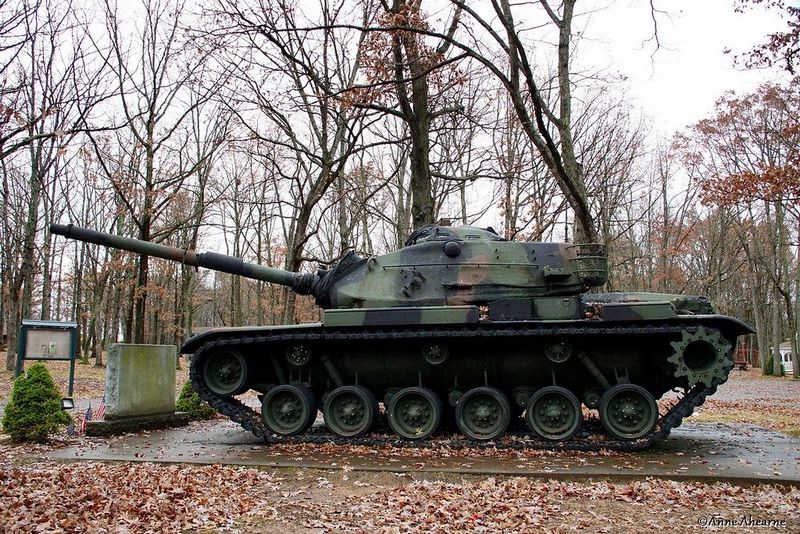
History
The M60 "Patton" MBT was developed in 1957 to disprove rumors that the Soviets were developing their own new MBT with a 115mm smoothbore gun. With this weapon, Soviet products were able to outperform the latest M48 Patton series, the workhorse of American armor at the time. The Soviet-designed "T-62" tank entered service in 1961, with more than 22,000 tanks produced for the Red Army and allied/friendly nations. Various operators and variants serving the type soon emerged, with the T-62 documenting combat operations from the Sino-Soviet border war in 1969 to the Libyan civil war in 2011.
While the M60 is not a perfect main battle tank, in its 50+ years of service it is certainly a tough and ready tank.
Considering convenience and cost, it was decided to take the existing M48 system and adapt it to the changing needs of the modern battlefield at the time. The M48 base was upgraded with a new, more powerful engine and a cross-drive transmission, and the excellent British L7 main gun was mounted to a new turret. The body has been revised with a straighter profile, and aluminum wheels replace the M48's steel wheels. The general turret shape of the M48 was more or less retained, although it was gradually changed to a more defined and distinctive shape to reduce the front and rear profile.
The resulting design was originally called "M68", but was later changed to the more familiar name "M60". Although not officially called "Patton" ("105mm Gun Full Tracked Combat Tank (M60)") in the official U.S.
Army roster, it is widely accepted as part of the Patton family, which began with the "M46" - all The Pattons (M46, M47 and M48) are all more or less related to the M26 Pershing heavy tank of the late WWII. Initial production of the M60 began in 1959 at Chrysler's Delaware Defense Plant, which built and stocked the first M60s in 1960.
Production then quickly moved to Chrysler's Detroit Tank Plant in Michigan, where it lasted until 1987, where about 15,000 were built. The M60 is known for being the U.S. Army's first "main battle tank"; the Army dropped the "light", "medium" and "heavy" tank classifications of World War II.
The first U.S. use of M60s was during the Vietnam War (1955-1975), although they were only specialized vehicles in the form of AVLB bridge erectors and M728 CEVs (Combat Engineering Vehicles). Both vehicles use the M60 chassis and hull, which expands the tactical value of the M60 combat system and has logistical and financial implications.
Other than that, no M60 main battle tanks are stationed in the area and used in warfare.
Like the Soviet T-62, the American M60 was widely sold overseas to pro-American countries - and for a while proved to be the workhorse of some NATO forces in Europe. The tank was not actually used in combat until the 1973 Yom Kippur War, and was in Israeli hands during the 1973 Yom Kippur War. The Israeli army used the M60 and M60A1 production brands in the conflict, in addition to the M48 Patton already in service. The improved shape was then used in the upcoming 1982 Lebanon War - with the introduction of Explosive Reactive Armor (ERA) blocks. The ERA acts as an additional point of protection from incoming enemy projectiles, rockets and rockets, improving overall crew survivability.
The Israelis refer to their upgraded M48 and M60 as "Magach", with Magach 1, 2, 3 and 5 covering different variants of the M48, while Magach 6 and 7 designate the upgraded M60 tank. By all accounts, the M60 performed admirably in Israeli hands, even against the T-62, a tank originally designed for many years ago.
Their main threat was Soviet anti-tank missiles fired by ambush waiting anti-tank units. Regardless, the Israeli military still has plenty of modified M60s as well as their newer, more modern Merkava main battle tanks as their main tanks.
Former US ally Iran has also been a recipient of US military hardware for many years, receiving a total of 150 production M60A1s. These were used during the bloody Iran-Iraq war in the 1980s - their current rank is still unknown.
During the 1991 Gulf War (Operation Desert Storm), the M60's next notable operation brought it to the Persian Gulf region. Members of the U.S. Marine Corps and the Royal Saudi Army used this type and its replacement, the M1 Abrams MBT.
The operation showcased the M60 against the Iraqi T-62, which proved to be the better tank - the Iraqi tanker crews were less trained and experienced compared to the Americans. Also, until 1991, the M60 was a very refined beast that was upgraded as the battlefield changed, whereas the Iraqi T-62 was not. Only one M60 was lost in the Battle of Kuwait City, with no casualties.
Even the U.S. Air Force operated a detachment of M60 tanks during the conflict that served as explosive ordnance disposal vehicles.
To date, the largest M60 combatants remain the Egyptian Army, the Turkish Army and the Israeli Army, each capable of deploying anywhere from hundreds to over 1,000 units. Other notable operators include Saudi Arabia, Iran, Thailand and Portugal.
Greece had as many as 669 M60A1/A3s but later retired these tanks in favor of the upcoming German Leopard 1 and Leopard 2 main battle tanks.
The Turkish Army currently has approximately 925 M60A1 and M60A3 models and has since undergone an extensive modernization program to the updated M60T "Sabra" standard. These feature an electrically stabilized 120mm smoothbore main gun, as well as an improved armor protection scheme and fire control system.
These can also be called Sabra Mk IIIs.
For the U.S. military, the M60 series has been officially retired and completely replaced by the M1 Abrams series. Some M60s are temporarily in reserve or storage, while others serve as outdoor displays at various military installations.
Specification
Basic
Roles
- Tank vs Tank
- Main Battle Tank (MBT)
- Frontline
- Utilities
- Support/Special Purpose
Dimensions
9.43m
11.91 ft (3.63 m)
10.73 ft (3.27 m)
54 tons (48,684 kg; 107,330 lb)
Performance
Performance
48 km/h
298 miles (480 km)
for everyone else in our database)
Armor
1 x 105 mm M68 main gun in the turret.
1 x 7.62mm M73 coaxial machine gun in the turret.
1 x 12.7mm M85 Anti-Aircraft (AA) Heavy Machine Gun (HMG) on top of turret.
2 x 6 smoke grenade launchers (M60A3) on the turret.
63 x 105mm projectile.
900x12.7mm ammo.
5,950x7.62mm ammo.
12 x Smoke Grenade.
Changes
M68 - original name.
XM60 - Development designation.
M60 - Modified basic production model; prominent searchlight above main gun; M48 turret and hull.
M60 AVLB - Bridge layer translation.
M60 AVLM - "Armored Vehicle Launches Mine Clearing Line Charge"; based on the AVLB bridge layer for demining work.
M60 "Black Panther" - Remote Control Minesweeper.
M9 - A special bulldozer variant based on the M60 hull.
M60A1 - New turret design introduced; improved suspension and armor protection.
M60A1 AOS - "Additional Stability".
M60A1 RISE - "Reliability Improvements for Selected Units".
M60A1 RISE Passive - Same as M60A1 RISE but with redesigned searchlight and passive night vision; Explosive Reactive Armor (ERA) compatible.
M60A1 AVLB - A bridge based on the M60A1 production model.
M60A1E1 - Development variant; 152mm main gun trials.
M60A1E2 - Development variant; redesigned tower; up to production brand M60A2.
M60A1E3 - Development variant; M60A1E2 105mm main gun experimental model.
M60A1E4 - Development variant; turret with remote-controlled weapon station.
M60A2 - Lower turret with new commander tower and matching 152mm Shillelagh missile compatible main gun.
M60A3 - final production model of the US Army; standardized model of the M60A1 and M60A2 production units; stabilized main gun; thermal cuff introduced along the barrel; ballistic computer; air filtration system; improved searchlight; improved engine; Improved laser rangefinder; external smoke grenade launcher.
M60A3 TTS - "Tank Thermal Scope"; for AN/VSG-2 thermal visor.
M60 "Super" / M60AX - without optical rangefinder; improved armor protection.
M60-2000 - Proposed M60/M1 Abrams combination vehicle.
M60 120 - Improved export vehicle with M1A1 Abrams turret and M60 chassis.
M728 CEV - Combat engineering vehicle (M60 chassis).
M728A1 CEV - Improved engineering combat vehicle based on M60A1 chassis and hull.
"Magach" - Israeli-produced variant with more powerful engines, passive armor package, and Matador computerized fire control system; available in "Magach-6" and "Magach-7" configurations.
M60T / "Sabra" - Upgrades provided by IMI; electrically stabilized 120mm gun; improved armor protection; improved fire control system.
E-60 - Export M60 production model.
E-60A - Export M60A1 production model.
E-60A "Bulldozer" - Export M9 bulldozer model.
E-60B - Export M60A3 production model.
M60VLPD 26 / M60VLPD 70E - Spanish Army bridge erector; based on production model M60A1.
M60CZ-10 / M60CZ25E "Alacran" - Spanish Army engineering vehicle based on the M60A1 production model.
M60 "Phoenix" - Jordanian army model; increased power and RUAG 120mm smoothbore gun; improved armor protection.
 Argentina
 Armenia
 Australia
 Austria
 Austria-Hungary
 Belgium
 Brazil
 United Kingdom
 Brunei
 Bulgaria
 Canada
 Chile
Chile China
China Colonial America
 Colombia
 Confederate States
 Croatia
 Czech
Czech Denmark
 Egypt
Egypt Finland
 France
 Georgia
 Germany
 German Imperial
 Greece
 Holland
 Hungary
 India
India Indonesia
 Iran
Iran Iraq
Iraq Ireland
 Israel
 Italy
Italy Japan
Japan Japan (1940)
 Jordan
 Kingdom of Italy
 Malaysia
 Mexico
 Myanmar
 Nazi Germany
 Netherlands
 New Zealand
 North Korea
 Norway
 Pakistan
 Peru
Peru Philippines
 Poland
 Portugal
 Prussia
 Romania
 Russia
 Saudi Arabia
 Serbia
 Singapore
 Slovakia
 Slovenia
 South Africa
 South Korea
 Soviet Union
 Spain
Spain Sweden
 Switzerland
 Syria
Syria Taiwan
 Thailand
 Turkey
 UAE
UAE Ukraine
 Vietnam
 Yugoslavia