
History
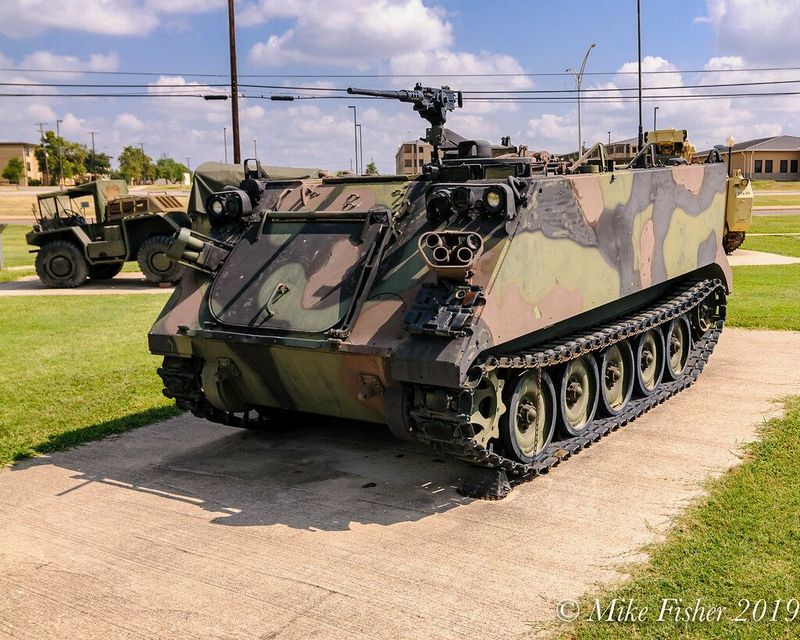
The American M113 armored personnel carrier became one of the most successful Cold War vehicles in the world, with operators in more than 60 countries and more than 80,000 produced. The car entered service in 1960 and served with the US and Australian armies during the Vietnam War (1955-1975). From there, its global reach saw the airline survive the Yom Kippur War (1973), the invasion of Panama (1989-1990), the Iran-Iraq War (1980-1988) and the Persian Gulf War (1991), the Kosovo War (1998) -1999) and more recently Afghanistan (since 2001) and Iraq (2003-2011), but also in lesser-known conflicts.
The chassis has also proven to be highly adaptable and has served as the basis for a variety of other relevant battlefield variants. Despite its 1950s design, the M113 is today (2014) a front-line competitor in many countries.
Development of the 13.5-ton tracked vehicle began in 1956 to meet the U.S. Army's requirements for an airborne armored personnel carrier (APC). The vehicle will be compact enough to fit in the cargo compartment of a Lockheed C-130 Hercules transport aircraft or similar.
FMC Corporation (Food, Machinery, and Chemical) then returned two possible vehicles - an aluminum T113 pilot vehicle and a steel T117 pilot vehicle, for which the Army chose an aluminum version. This makes it the first military armored vehicle to be made primarily of aluminum when steel is traditionally used.
Its corresponding production model later became the M113, which was standardized in US Army inventory in 1959, replacing FMC's then-in-service M59 APC inventory.
Production of the M113 originally ended in 1992, but additional orders allowed production to continue. There is also licensed local production in Italy by OTO Melara and BMF in Belgium. The U.S.
Army last purchased the M113 in 2007, for which the service maintains thousands of them, many of which are A2 and A3 variants, along with better range, firepower, performance and survivability (including the use of decal armor kits). While no immediate successor is in sight, some possible replacements have emerged, including the proposed Armoured Multi-Purpose Vehicle (AMPV).
The original request for proposals originated in early 2013.
As mentioned, the chassis (and sometimes the body) of the M113 has appeared in countless other useful forms on the battlefield. There are smoke generator vehicles M58 "Wolf" and mortar carriers M106/M125. The M150 was equipped with a TOW Anti-Tank Missile (ATGM) launcher, which was modified as the M901 ITV (Improved TOW Vehicle). The M113 made up the M163 20mm "Vulcan" anti-aircraft vehicle and the M48 "Jungle" anti-aircraft missile carrier.
M548 is a cargo transport vehicle, M577 is a dedicated command vehicle, and M579 is a maintenance vehicle. The M806 was developed as an Armoured Rescue Vehicle (ARV) and the M981 FIST-V (Fire Support Team - Vehicle) was based on the M901. The M132 series is a dedicated flame tank, while the XM734 is a proposed Infantry Fighting Vehicle (IFV) form.
Variations go well beyond this list due to operator requirements, locally produced versions and many locally modified forms. The ACV-300 is the Turkish version of the M113, while the Taiha is the Pakistani version.
The Italian version is VCC-1, Norway uses the designations NM135/NM142 as M113A1 and M113A2 respectively.
Despite its general external similarity to the M113, the subsequent (smaller) M114 vehicle was a new track system adopted by the US Army for a reconnaissance role. The M75 (1952) and M59 (1953) APCs also have the same shape. The M59 is a replacement for the M75. M59 was replaced by M113.
Specification
Basic
Roles
- Amphibious
- Technology
- Infantry Support
- Reconnaissance (RECCE)
- Troop Transport
Dimensions
2.52m
8.83 feet (2.69 m)
1.85m
13 tons (11,343 kg; 25,007 lb)
Performance
Performance
61 km/h
298 miles (480 km)
Armor
Default:
1 x 12.7mm M2 Browning Heavy Machine Gun (HMG).
8 x Smoke Grenade.
Model dependencies:
7. 62mm General Purpose Machine Gun (GPMG), 20mm or 25mm Autocannon, TOW/TOW-2 Anti-Tank Missile (ATGM) and various caliber mortars.
2,000 x 12.7mm ammo.
8 x Smoke Grenade Launchers.
Changes
M113 - first production model; Chrysler 75M gasoline engine, 209 hp; 1960 model.
M113A1 - Detroit Diesel; increased performance; 1964 model.
M113A2 - Updated suspension and cooling kit; 1979 model
M113A3 - Modernized M113; improved suspension, performance and powerplant; applied armor support; software upgrades; 1987 model.
M58 Wolf - Smoke Car
M106 - 107mm Mortar Carrier
M125A1 - 81mm Mortar Carrier
M163 Vulcan - Anti-aircraft vehicle
M548 - Cargo Ship
M667 Lance - Battlefield Missile Carrier
M730 Chaparral - Battlefield Missile Carrier
M548A1/A3 - Unarmored Cargo Ship
M577A2/A3 - Command Post Vehicle
M901A1 ITV - Improved tractor
M981 FIST-V - Fire Truck
M1059/A3 - Smoke car
M1064/A3 - Mortar Carrier
M1068/A3 - Standard Carrier for Integrated Command Post System
OPFOR Alternative Vehicle (OSV) - Against FORce Development
M113 ACAV ("Armored Cavalry Vehicle") - Additional armor protection; shielded machine gun station.
NM135 - Norwegian Army variant; 1 x 20mm gun, one-man turret; 1 x 7.62mm machine gun.
NM142 - Norwegian Army variant; 2 x TOW anti-tank missiles.
SIDAM 25 - Italian Army variant; 4 x 25mm SPAAG guns (M113 chassis).
ADATS - Canadian-made anti-aircraft anti-tank system (M113 chassis).
M113 A/A - Egyptian Army anti-aircraft variant; 2 x 23mm guns.
ADATS - Canadian Anti-Aircraft Vehicles
 Argentina
 Armenia
 Australia
 Austria
 Austria-Hungary
 Belgium
 Brazil
 United Kingdom
 Brunei
 Bulgaria
 Canada
 Chile
Chile China
China Colonial America
 Colombia
 Confederate States
 Croatia
 Czech
Czech Denmark
 Egypt
Egypt Finland
 France
 Georgia
 Germany
 German Imperial
 Greece
 Holland
 Hungary
 India
India Indonesia
 Iran
Iran Iraq
Iraq Ireland
 Israel
 Italy
Italy Japan
Japan Japan (1940)
 Jordan
 Kingdom of Italy
 Malaysia
 Mexico
 Myanmar
 Nazi Germany
 Netherlands
 New Zealand
 North Korea
 Norway
 Pakistan
 Peru
Peru Philippines
 Poland
 Portugal
 Prussia
 Romania
 Russia
 Saudi Arabia
 Serbia
 Singapore
 Slovakia
 Slovenia
 South Africa
 South Korea
 Soviet Union
 Spain
Spain Sweden
 Switzerland
 Syria
Syria Taiwan
 Thailand
 Turkey
 UAE
UAE Ukraine
 Vietnam
 Yugoslavia