
History
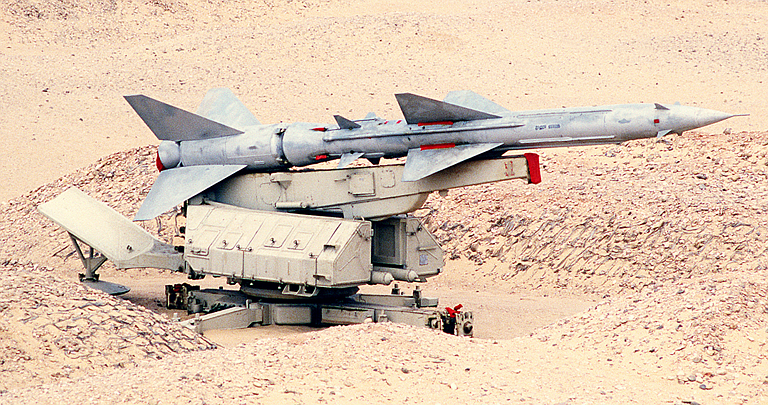
The original SA-2 guide was designed to find and destroy the less maneuverable American high-altitude bomber, and more specifically, the Air Force's most loyal B-52 Stratofortress. The function of the guidance system was so popular that all other major air defense systems (except the Moscow system) were replaced by the newer SA-2.
By 1965, no fewer than 1,000 SA-2 Guide launch sites had been established throughout the Soviet Empire and its satellite bases, with a large contingent stationed in Soviet-controlled East Germany.
The first confirmed aircraft shot down by the SA-2 system was a Taiwanese RB-57 reconnaissance aircraft destroyed over China in 1959. The system continued to have success, including the famous downing of Gary Power's U-2 spy plane, which made headlines around the world (more than one missile was actually fired, and the plane was hit several times before it crashed).
This single act led to a rethinking of military and reconnaissance programs dealing with Soviet high-altitude air defense systems.
In the conflict between Vietnam and the United States, the SA-2 supplied by the Soviet Union to North Vietnam was responsible for the attack and destruction of U.S. Navy, Air Force and Navy aircraft.
In direct response, the United States was forced to develop counter-weapon systems to counter the very serious SA-2 threat.
Despite advances in electronic countermeasures (ECM) systems and tactics, SA-2 systems have remained relatively successful during and after conflict (some are undergoing modernization programs to extend system life). Nonetheless, the SA-2 policy eventually gave way to the more advanced SA-10 family of surface-to-air missile systems.
The base system combines a fragmentation warhead with proximity, engagement and command fusion capabilities mounted on a two-stage solid rocket fuel booster system. The warhead weighs approximately 434 pounds and can be equipped with a replacement nuclear warhead if desired.
The range is said to be up to 30 miles and the missile system up to 60,000 feet.
NOTE: The specifications shown above are for the SA-2A Guideline variant of the SA-2 Guideline series of anti-aircraft missiles.
Specification
Basic
Roles
- Air Defense/Airspace Denial
Dimensions
10.6m
1.64 ft (0.5 m)
3 tons (2,287 kg; 5,042 lb)
Performance
Performance
3,000 km/h
19 miles (30 km)
Armor
1 x 35 ft, 5,041 lb surface-to-air missile (various warheads available). Radar system target detection.
1 x 35 ft, 5,041 lb surface-to-air missile (various warheads available).
Changes
SA-2 - NATO report designation
SA-2A - Equipped with Fan Song-A radar system, using V-750 or V-750V missiles.
S-75 Dvina - Russian designation for the SA-2A model.
SA-N-2A - Navy
S-75M-2 Volkhov-M - Russian designation for the SA-N-2A model.
SA-2B - Has Fan Song-B radar system and uses V-750VK or V-750VN missiles.
S-75 Desna - Russian designation for the SA-2B model.
SA-2C - Has Fan Song-C radar system and uses V-750m missiles.
S-75M Volkhov - Russian designated SA-2C variant.
SA-2D - Equipped with Fan Song-E radar system and uses V-750SM missiles.
SA-2E - Equipped with Van Song-E radar system and uses V-750AK missiles.
SA-2F - Equipped with Fan-Song-F radar system and uses V-750SM missiles.
C-75 - Russian registered name
HQ-1 - variant produced in China
HQ-2 - variant produced in China
HY-2 - Chinese-made variant of the improved SA-2 base model.
 Argentina
 Armenia
 Australia
 Austria
 Austria-Hungary
 Belgium
 Brazil
 United Kingdom
 United States
 Brunei
 Bulgaria
 Canada
 Chile
Chile China
China Colonial America
 Colombia
 Confederate States
 Croatia
 Czech
Czech Denmark
 Egypt
Egypt Finland
 France
 Georgia
 Germany
 German Imperial
 Greece
 Holland
 Hungary
 India
India Indonesia
 Iran
Iran Iraq
Iraq Ireland
 Israel
 Italy
Italy Japan
Japan Japan (1940)
 Jordan
 Kingdom of Italy
 Malaysia
 Mexico
 Myanmar
 Nazi Germany
 Netherlands
 New Zealand
 North Korea
 Norway
 Pakistan
 Peru
Peru Philippines
 Poland
 Portugal
 Prussia
 Romania
 Russia
 Saudi Arabia
 Serbia
 Singapore
 Slovakia
 Slovenia
 South Africa
 South Korea
 Spain
Spain Sweden
 Switzerland
 Syria
Syria Taiwan
 Thailand
 Turkey
 UAE
UAE Ukraine
 Vietnam
 Yugoslavia