


History
The 9K35 "Strela-10" was developed by Soviet engineers to replace the 9K31 Strela-1 series (SA-9 "Gaskin") of the mobile surface-to-air missile (SAM) systems that entered service in the 1960s for the Red Army during the Cold War. It was a budget alternative to the more tech-intensive projects of the time and therefore had limitations in terms of overall participation capacity. It lacks all-weather capability, although its more direct operator involvement (it is optically aimed and guided) makes hitting air targets less susceptible to jamming and evasive maneuvers. In 1969, the KB Tochmash Precision Engineering Design Bureau began development work and the 9K35 entered service in 1979.
In NATO, the car is known as the SA-13 "Gopher". It is still in use today (2014) and has been adopted by the militaries of Afghanistan, Angola, Ukraine and Vietnam. The former operators are Czechoslovakia (dissolution), Poland, Slovakia, USSR and Yugoslavia (dissolution).
Modern versions of the Russian military use a new type of missile.
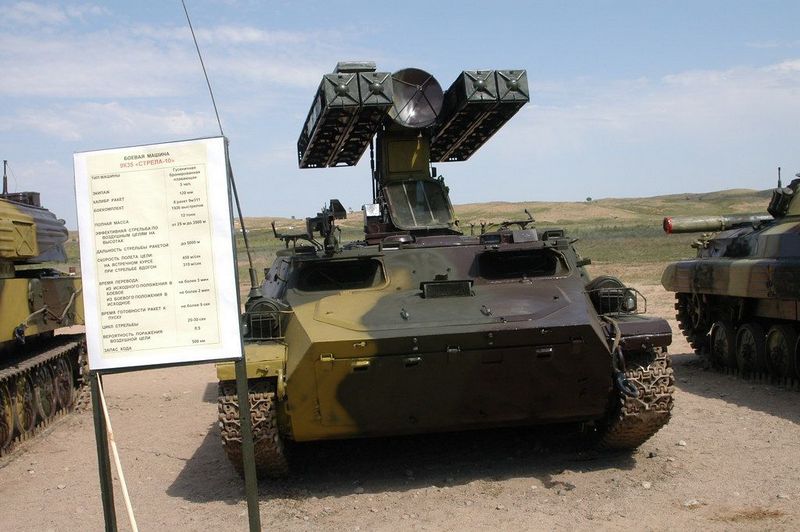
The 13.55 ton SA-13 is based on the hull and chassis of the existing MT-LB multipurpose armoured tracked carrier, thus retaining the same YaMZ-238V diesel engine with 240 hp and a performance specification of 37 per hour miles of highway speed and a range of 310 miles. The torsion bar suspension provides the necessary off-road capability, and the hull is amphibious like the original MT-LB and traverses water at 3 miles per hour.
Its three crew members - commander, driver and gunner - and the armor protection level is only for small arms fire and is 7mm thick. The main weapon is the 9M333 quadruple rocket launcher, which is located on a trainable mount on the fuselage.
The transmitters are grouped side-by-side into two transmitter pairs separated by a central radar array. Mounting hardware has full aileron and elevator controls. The launcher can also fire older Streal-1 series missiles.
The original missile was the 9M31M in 1971, which used impact and proximity fuzes. It was followed by 1976's 9M37 and its approach and impact fuze. Then came the 9M37M in 1981 and the 9M333 in 1989 - the latter introduced an eight-beam laser proximity and impact fuze.
As the missile develops, the maximum range increases gradually, while the minimum intercept height increases steadily.
Over the decades, the Strela-10 system has been continuously improved to increase its usefulness on the battlefield. This gave birth to the Strela-10M, Strela, 10M2 and Strela-10M3 brands.
Its combat service ranged from the Angola War (1975-2002) and Operation Desert Storm (1991) to the Kosovo War (1998-1999), though with mixed results.
Specification
Basic
Roles
- Air Defense/Airspace Denial
Dimensions
6.6m
2.85m
3.8m
14 tons (12,300 kg; 27,117 lb)
Performance
Performance
62 km/h
311 miles (500 km)
Armor
4 x 9M37 surface-to-air missiles on trainable launcher hardware on the ML-LB tracked fuselage.
4 x 9m37 surface-to-air missiles; supports SA-7 "Grail" and SA-14 "Gremlin" missiles.
Changes
9K35 "Strela-10" - name of the base series; original production model from 1979.
Strela-10M - Improved 9K35.
Strela-10M2 - Improved 9K35.
Strela-10M3 - Improved 9K35.
SA-13 "Gopher" - NATO designation.
 Argentina
 Armenia
 Australia
 Austria
 Austria-Hungary
 Belgium
 Brazil
 United Kingdom
 United States
 Brunei
 Bulgaria
 Canada
 Chile
Chile China
China Colonial America
 Colombia
 Confederate States
 Croatia
 Czech
Czech Denmark
 Egypt
Egypt Finland
 France
 Georgia
 Germany
 German Imperial
 Greece
 Holland
 Hungary
 India
India Indonesia
 Iran
Iran Iraq
Iraq Ireland
 Israel
 Italy
Italy Japan
Japan Japan (1940)
 Jordan
 Kingdom of Italy
 Malaysia
 Mexico
 Myanmar
 Nazi Germany
 Netherlands
 New Zealand
 North Korea
 Norway
 Pakistan
 Peru
Peru Philippines
 Poland
 Portugal
 Prussia
 Romania
 Russia
 Saudi Arabia
 Serbia
 Singapore
 Slovakia
 Slovenia
 South Africa
 South Korea
 Spain
Spain Sweden
 Switzerland
 Syria
Syria Taiwan
 Thailand
 Turkey
 UAE
UAE Ukraine
 Vietnam
 Yugoslavia