


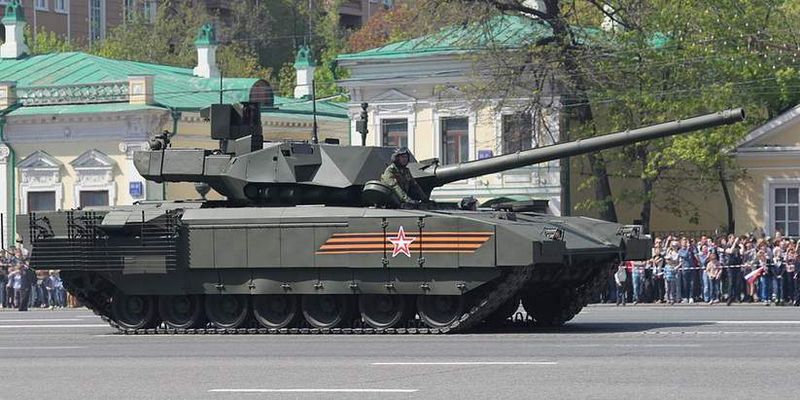
History of the T-99 Armata (Universal Combat Platform - UCP)
The current Russian frontline main battle tank (MBT) is still the third-generation T-90 introduced in 1991 (1,670 produced to date). However, Russian engineers are actively working on a completely new design for the Russian army, dubbed the "T-99 Universal Combat Platform" (UCP) and named after "Armata" (meaning "Arma" or "weapon"). ) is known. ). For now, the program foresees the production of a single common chassis, which will form the basis for a range of related armoured fighting vehicles, including MBT, armoured personnel carrier (APC), infantry fighting vehicle (IFV), armoured fighting vehicle rescue vehicle ( ARV) and similar vehicles.
The approach is expected to bring a more logistically friendly approach to the Russian Army's next-generation battlefield systems.
The T-99 Armata program shares some similarities in program scope with the now-abandoned T-95 Black Hawk program, which was cancelled in May 2010. Install unmanned turrets.
As of February 2014, the T-99 is still in its early stages and is not expected to enter service until 2016 and to reach full capacity in 2020. The T-99 program is expected to include a variety of vehicles based on unique designs - the main battle tank will become the "T-14".
Other variants include the self-propelled howitzer (SPH_ form), the TOS-2 Multiple Rocket Launch System (MLRS) and the BREM-T "T-16" Armored Rescue Vehicle (ARV). A collection of 2,300 tanks to replace a large number of obsolete types - some dating back to Soviet times.
Part of the revival of Russian tank design is a fresh rework of the T-90's tried-and-true 125mm main gun. The T-14 will be a completely new development of the same caliber and will retain the smoothbore principle of the earlier product, while also supporting the launch of anti-tank missiles (ATGM) - the latter popular among several Russians/Soviet design since the Cold War years Vehicles.
The additional firepower is expected to come from a 57mm automatic grenade launcher and 12.7mm heavy machine gun mounted coaxially in the turret. The ammunition depot is separated from the operator, which greatly increases survivability.
In addition to the new smoothbore main gun, the T-14 will feature a new approach to tank design the unmanned turret. This departure from the standard would allow for a much smaller turret footprint - resulting in the entire crew being housed within the hull itself - and promote a smaller, lower profile in combat. The current generation of Russian tanks already use manned three-man autoloaders, and the T-14 will only relocate the crew without reducing their overall number. Since the entire crew is in the hull, communication and situational awareness are improved. Survivability can also be improved as more armor can be allocated to the crew compartment and hull.
The use of unmanned turrets will also lay the foundation for the future development of fully remote-controlled tanks that do not require an actual crew.
Standard MBT facilities shall apply - crew comfort such as air conditioning and heating - and be supported by NBC (Nuclear, Biological, Chemical). Anti-missile countermeasures also represent superior survivability and have been seen on modern MBTs around the world.
Weather and tags/equipment can also be found in the T-14 design.
The vehicle is powered by a new diesel engine with a power range of 1,400 to 1,600 hp, coupled with an electronically controlled eight-speed automatic transmission. Intercity service and operations are expected to exceed existing T-90 lines (approximately 40 mph and 430 miles).
The landing gear will include a full-suspension track and wheel assembly with seven twin-tire wheels on one side of the hull.
Armor protection is not known. The control system is expected to be fully modern and fully digital, with ultra-fast processing capabilities to provide the best possible first-round hits (even while moving) and to efficiently and effectively handle incoming through the included set of countermeasures Threats - eg enemy ATGMs.
UCP lines will be linked under a secure communications system and a common Battlefield Management System (BMS).
The "T-15" BMPT is expected to be a heavy tracked armoured (AFV) derivative of the T-14 tank program, with a 30mm turret autocannon and support for the T-14 on the battlefield in "Give" reincarnation Russia When used, armored units are a powerful double whammy.
Field testing of the pilot vehicle is planned for 2014, first deliveries are planned for 2015, and mass production starts in 2016 (based on reports published in Moscow). With this schedule, however, there could be a typical delay in bringing such an optimistic design to the public.
Due to the secret early development of the program, this article - and any associated presented values ??- are expected to change accordingly.
Specification
Basic
Roles
- Technology
- fire support/attack/damage
- Infantry Support
- Tank vs Tank
- Main Battle Tank (MBT)
- Frontline
- Reconnaissance (RECCE)
- Troop Transport
- Support/Special Purpose
Dimensions
55 tons (50,000 kg; 110,231 lbs)
Performance
Performance
80 km/h
326 miles (525 km)
for everyone else in our database)
Armor
1 x 125mm smoothbore main gun (with anti-tank and missile capabilities) in the turret.
1 x 12.7mm coaxial machine gun in the turret.
1 x 57mm Automatic Grenade Launcher (AGL) in the turret.
32 x 125mm projectile.
1,500x12.7mm ammo.
600x57mm shells.
Changes
T-99 "Armata" - Base series name
T-14 - MBT with 125mm smoothbore gun
BMPT T-15 - armored personnel carrier variant
BM-2 (TOS-2) - Multiple Launch Rocket System (MLRS) variant.
2S35 "Koalitsiya-SV" - Vehicle variant of the Self-Propelled Howitzer (SPH).
BREM-T T-16 - Armored Rescue Vehicle (ARV) variant
 Argentina
 Armenia
 Australia
 Austria
 Austria-Hungary
 Belgium
 Brazil
 United Kingdom
 United States
 Brunei
 Bulgaria
 Canada
 Chile
Chile China
China Colonial America
 Colombia
 Confederate States
 Croatia
 Czech
Czech Denmark
 Egypt
Egypt Finland
 France
 Georgia
 Germany
 German Imperial
 Greece
 Holland
 Hungary
 India
India Indonesia
 Iran
Iran Iraq
Iraq Ireland
 Israel
 Italy
Italy Japan
Japan Japan (1940)
 Jordan
 Kingdom of Italy
 Malaysia
 Mexico
 Myanmar
 Nazi Germany
 Netherlands
 New Zealand
 North Korea
 Norway
 Pakistan
 Peru
Peru Philippines
 Poland
 Portugal
 Prussia
 Romania
 Saudi Arabia
 Serbia
 Singapore
 Slovakia
 Slovenia
 South Africa
 South Korea
 Soviet Union
 Spain
Spain Sweden
 Switzerland
 Syria
Syria Taiwan
 Thailand
 Turkey
 UAE
UAE Ukraine
 Vietnam
 Yugoslavia