

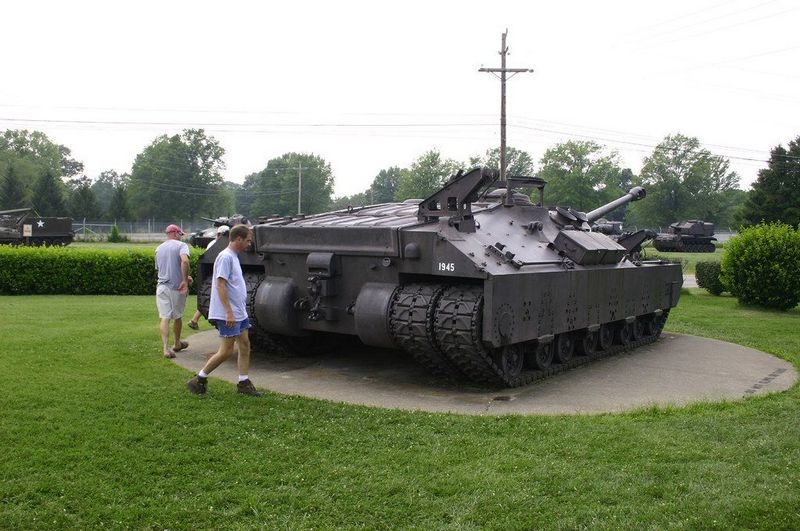
History of the T28 Super Heavy Tank (T95 Gun Cart)
The T28 heavy tank is the largest tank ever built by the US military. Built in 1945 to fight a new generation of heavy German tanks, the end of the war in Europe ensured that only two prototypes were built of the 25 originally planned (there were at least five prototypes before production).
American war planners believed that their T28s would be required to break through the mighty German defenses centered on the famous "Siegfried Line" in the European theater, and would be the main armored vanguard of the inevitable invasion of the Japanese homeland in the Pacific theater.??? . The T28 was designed and built by Pacific Car and Foundry (mainly heavy duty truck manufacturer), using the T23 body to save time.
The T-28 carries a main gun armament consisting of the 105mm T5E1. A 0.50 caliber Browning M2 anti-personnel machine gun was mounted above the crew hatch as a secondary weapon. The 105mm gun has a muzzle velocity of 1,130 m/s (3,700 ft/s) and a range of up to 19 km (12 miles). The T28 tank has few notable features compared to previous and contemporary American tank designs. For example, the crew quarters have four instead of the usual five.
But perhaps the most interesting of these features is that the main gun does not have a lateral turret, but instead moves laterally from its hull mounting location and is limited to 10 degrees to the right and 11 degrees to the left. Altitudes range from a maximum of 19.5 degrees to a minimum of -5 degrees. This restriction, combined with the flattened airfoil hull, meant that the tank should focus its fire on the target or area ahead.
It's the lack of a 360-degree swinging turret -- still common on conventional tanks today -- that classifies the T-28 as a "self-propelled artillery motor vehicle" rather than the tank itself. In 1945, the T28 was renamed "T95 Gun Motor Carriage".
However, in 1946, the T95 was again renamed the "Super Heavy Tank T28".
The T28 fuselage is 11.10 meters long, 4.39 meters wide and 2.84 meters high. If fully equipped, its total weight will be 95 tons. Compared to other tanks of the time, the armor was massive12 inches at its thickest. The lower front hull alone is covered by 5.25 inches (130 mm) of armor, while the overall thickness of the sides is a whopping 2.5 inches (64 mm). The suspension area itself is assigned 4.0 inches (100 mm) of protection.
The armor of the T28 is strong enough to repel the fabled 88mm shells used by German heavy tanks such as the Tiger II. However, the German-developed super-heavy tank Rat is equipped with a combined arrangement of a 128mm main gun and a 75mm secondary gun.
Since the T28's maximum field load is specified at 95 short tons, four separate sets of tracks are required to spread the vehicle's weight over different ground types (in contrast, conventional tanks use one set of tracks). Each set is 12.9 inches (328 mm) wide.
When driving on paved roads, if you don't have an Army support truck, you can remove the two outer tracks and actually drag them behind the tank itself. The engine was underpowered at the advertised weight ratio and consisted of a gasoline-powered Ford GAF ??V-8 family of powerplants rated up to 500 horsepower. In field testing, however, the T28 topped out at just 13 km/h, making it a liability by any measure. Conversely, the war-winning M4 Sherman could reach road speeds of 25-30 mph.
As such, the T28 will struggle to keep pace with mobile mechanized fronts - given that it is intended to be used as a spearhead for such operations. As the project progressed, their actual battlefield capabilities were clearly questioned, but this was World War I and solutions were still needed.
Until about 1947, two T28 prototypes were evaluated at the Aberdeen Proving Ground, Maryland, and the facility at Fort Knox, Kentucky. During additional testing at the Yuma Proving Ground in Arizona, one of the T28 prototypes was damaged by an engine fire and was scrapped. Needless to say, the T28 will never serve in the US Army. The main issue ended up being the engine, which was powered severely below the vehicle's operating weight, which, while directly limiting the base performance specs, also limited the T28's ability to get over obstacles - from day 1 onwards, it's any significant tank A must-have for World War. Bear in mind that the weight of the vehicle also exceeded the maximum limitations of portable and structural bridges at the time - especially many older bridges in Europe - and the T28 never really had a practical advantage.
The end of World War II more or less determined the fate of "giant tank" projects like the T28 and the German Rat, which faced similar constraints.
Later stages of T28 heavy tank development moved to T29 and T30 heavy tank designs - both of which were "true" tank designs with turrets. The T29 has the same gun as the T28, with less armor and more machine guns, while the T30 uses a larger caliber gun (155mm L/40) and a more powerful engine (air-cooled Continental AV1790-3 gasoline engine with 704 PS) . These advances culminated in the T28 program sometime in October 1947. The 70-ton T29 continued to be tested, but was never commissioned.
The 72.5-ton T30 also never came.
In 1974, a second T28 prototype was found rusting in a field at Fort Belvoir, Virginia. The only surviving example of the T-28 tank, which has been rebuilt and displayed in its best display condition, has called the Patton Museum in Kentucky home for many years.
As of this writing, the surviving T28/T95 is being relocated to its new home in Fort Benning, Georgia. A pair of developing T29s can also be found in Fort Knox, Kentucky - one in front of Marshall Bay and the other in front of the Patton Museum.
The T30 can also be found at Fort Knox in front of Marshall Hall.
In fact, all three of these oft-forgotten designs are windows into the pastthe experience of war ushered in an era of creative thinking about seemingly impossible issues when considering war. Despite their "failures" in the real world, these super heavy tanks should not be viewed as stupid, but as a source of wisdom for those involved in a true global struggle for life and death, which few today understand.
Specification
Basic
Roles
- fire support/attack/damage
- Tank vs Tank
- Support/Special Purpose
Dimensions
36.42 ft (11.1 m)
14.40 ft (4.39 m)
2.84m
105 tons (95,000 kg; 209,439 lbs)
Performance
Performance
19 km/h
99 miles (160 km)
for everyone else in our database)
Armor
1 x 105 mm T5E1 main gun
1 x HMG .50 caliber
62 x 105mm bullet
660 x .50 caliber ammo
Changes
T28 - original name
105mm Geschutzmotorwagen T95 - Official designation late 1945; two prototypes produced.
T28 Super Heavy Tank - Reorganized in 1946.
 Argentina
 Armenia
 Australia
 Austria
 Austria-Hungary
 Belgium
 Brazil
 United Kingdom
 Brunei
 Bulgaria
 Canada
 Chile
Chile China
China Colonial America
 Colombia
 Confederate States
 Croatia
 Czech
Czech Denmark
 Egypt
Egypt Finland
 France
 Georgia
 Germany
 German Imperial
 Greece
 Holland
 Hungary
 India
India Indonesia
 Iran
Iran Iraq
Iraq Ireland
 Israel
 Italy
Italy Japan
Japan Japan (1940)
 Jordan
 Kingdom of Italy
 Malaysia
 Mexico
 Myanmar
 Nazi Germany
 Netherlands
 New Zealand
 North Korea
 Norway
 Pakistan
 Peru
Peru Philippines
 Poland
 Portugal
 Prussia
 Romania
 Russia
 Saudi Arabia
 Serbia
 Singapore
 Slovakia
 Slovenia
 South Africa
 South Korea
 Soviet Union
 Spain
Spain Sweden
 Switzerland
 Syria
Syria Taiwan
 Thailand
 Turkey
 UAE
UAE Ukraine
 Vietnam
 Yugoslavia