


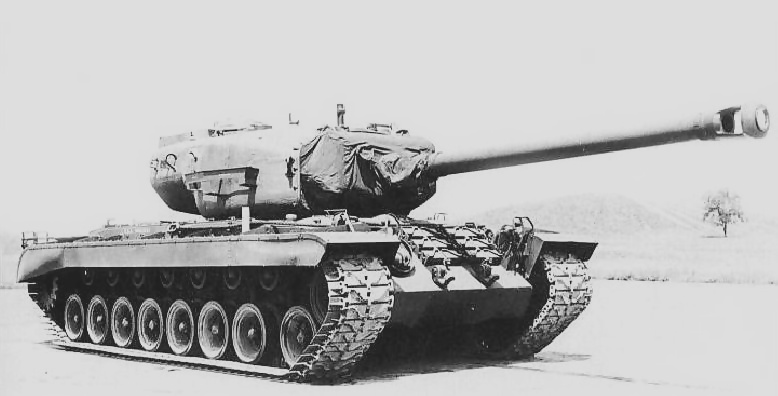
History of the T30 (heavy tank T30)
The T30 was developed for the U.S. Army in the late World War II to deal with the heavy tanks that appeared in the German army during the Nazi Germany "last gasp" in 1945. Along with the similar T29, the T30 followed the T28 in the development of a super-heavy tank. While the T28 was more of a self-propelled gun in nature, the T30 and T29 were designed with a turret layout and were significantly lighter than their four-lane predecessors - but still heavily armed and armored. A prototype of the T30 (known as the "Pilot" in World of Tanks) was designed as early as April 1945 - which proved to be the end of the war in Europe - although it was not offered in full form until 1947.
By then, the Pacific War was over, and the T28, T29, and T30 designs were in trouble. Eventually, all heavy tank projects (and countless other interesting wartime developments) were abandoned, and the surviving examples inevitably made their way into museum collections near Fort Knox, Kentucky.
The T30 uses one of the largest guns ever mounted on an American tank - this is a 155mm T7-L/40 main gun. The main gun was mounted on a fully movable turret, protected by plate side surfaces with rounded edges, giving the entire tank a rather high but necessary profile.
The barrel is locked at the muzzle by a shocking muzzle brake to meet the recoil of the main gun. The system and crew were provided with 34 rounds of 155mm ammunition projectiles, including armor-piercing (AP) and high-explosive (HE) types.
The main guns were carried by a coaxially mounted Browning HB M-2 .50 caliber machine gun and a bow-mounted Browning M1919A4 .30 caliber general purpose machine gun.
The tower is placed on a chassis of conventional arrangement, the tracked wheel arrangement is dominated by eight wheels on one side of the track. The suspension is torsion-bar oriented, and each track width is significantly wider to deal with different soil types.
A well-angled forward plate protects the front of the tank by providing an awkward angle to help deflect any incoming enemy shells. The chassis is powered by a Continental AV1790-3 air-cooled gasoline engine rated at 704 hp.
This provides speeds of up to 16.5 mph on paved surfaces, though lower off-road.
The T30 weighs approximately 145,000 pounds (72.5 tons). She is reported to be 37 feet 11.5 inches long, 12 feet 5.5 inches wide and 10 feet 6 inches tall. If she ever goes into production and operational service, a crew of six will manage her various key battlefield stations. These crew positions will include the tank commander, driver, two loaders, a gunner and a bow gunner. Two loaders are required to operate and maintain dedicated loading capabilities for large 155mm projectiles, each weighing 98 lbs.
One loader manages the integrated crane that moves each shell into place, while the other loader operates the rammer that moves the shells into the firebox. The armor protection thickness of all fairings of the tank varies from 25 mm (0.98 in) to 280 mm (11 in).
The T30 was also developed as a revision under the codename T30E1. This model adds another hatch in the rear of the turret to facilitate ejection of the large spent 155mm case after firing. There is another less detailed development that belongs to the prototype name T30E2.
Another variant, the T57, was developed with a rotatable turret housing an autoloader for the main gun - an interesting development as autoloaders eventually proved to be useful in the modern Soviet Union more popular in tank systems; instead, the Americans opted for a reliable and less complicated manual loading process as part of tank design for decades to come.
The effectiveness of the "Super Heavy Tank" design was never fully proven in WWII. The Germans continued to develop several such designs until the end of the war, but no prototypes entered production. Likewise, the British were only tested with their "Turtle" assault tanks, while the T28, T29 and T30 designed for the Americans were all abandoned in time for the war.
Many of these behemoths turned out to be either too unreliable, bulky, or heavy to properly traverse the European landscape, not to mention the rather narrow roads and bridges encountered in France and Germany. Rail transport has always been an option - although it is complex and time-consuming. It turns out that even top speed on the road is similarly limited, as many of these heavy tank designs cannot match their more mobile medium tank counterparts, making them a bit overkill for the new era of agile mechanized warfare .
If anything, this heavy tank design helps push the boundaries of future tank development, serves as a test bed for new armor configurations and optimized track and wheel arrangements, and proves useful for testing different weapon layouts. For example, the T30 was eventually used to evaluate the Continental AV1790 engine used in upgraded M26 Pershings during the Korean War (1950-1953), and it was eventually demonstrated that the powerplant could power the upcoming M46 Patton, M47 (Patton II) and M48 The power, is actually the Patton main battle tank series.
In modified diesel form, the engine continued to serve in the Cold War era M60 (Patton) main battle tanks.
At the time of writing, the T30 heavy tank can be seen outside Marshall Hall in Fort Knox, Kentucky.
Specification
Basic
Roles
- fire support/attack/damage
- Tank vs Tank
Dimensions
11.57m
3.8m
10.50 ft (3.2 m)
80 tons (72,500 kg; 159,835 lbs)
Performance
Performance
27 km/h
for everyone else in our database)
Armor
1 x 155mm T7 L/40 main gun.
1 x .50 caliber coaxially mounted heavy machine gun.
1 x .30 caliber bow mounted general purpose machine gun.
34 x 155mm projectile.
Changes
T30 Heavy Tank - Base Series Name
T30E1 - Added hatch to the rear of the turret to eject spent cartridges.
T30E2
T57 - Turret with autoloader.
 Argentina
 Armenia
 Australia
 Austria
 Austria-Hungary
 Belgium
 Brazil
 United Kingdom
 Brunei
 Bulgaria
 Canada
 Chile
Chile China
China Colonial America
 Colombia
 Confederate States
 Croatia
 Czech
Czech Denmark
 Egypt
Egypt Finland
 France
 Georgia
 Germany
 German Imperial
 Greece
 Holland
 Hungary
 India
India Indonesia
 Iran
Iran Iraq
Iraq Ireland
 Israel
 Italy
Italy Japan
Japan Japan (1940)
 Jordan
 Kingdom of Italy
 Malaysia
 Mexico
 Myanmar
 Nazi Germany
 Netherlands
 New Zealand
 North Korea
 Norway
 Pakistan
 Peru
Peru Philippines
 Poland
 Portugal
 Prussia
 Romania
 Russia
 Saudi Arabia
 Serbia
 Singapore
 Slovakia
 Slovenia
 South Africa
 South Korea
 Soviet Union
 Spain
Spain Sweden
 Switzerland
 Syria
Syria Taiwan
 Thailand
 Turkey
 UAE
UAE Ukraine
 Vietnam
 Yugoslavia