
History of the 47mm Type 1 Anti-Tank Gun
The Japanese military eventually faced some shortcomings that became apparent as World War II progressed. This limitation exists in the category of anti-tank guns. Even before the war, the Japanese army lacked a formidable indigenous tank-killing weapon, so the Type 34 gun was introduced in 1934 to correct the situation. However, the artillery system has been tested to its limits, resulting in the Type 97 - another 37mm weapon system, albeit one that originated from the well-established German 3.7cm Pak 35/36 anti-tank system. Like the Type 34, the Type 97 is still seen as an inherently limited design that lacks the required battlefield performance.
Interestingly, the Japanese authorities believe they will face an enemy with lightly armored equipment - including what the United States might provide - and are more interested in providing a product sufficient for this.
As early as 1939, a new rifled anti-tank gun was under development. By 1941, the weapon was officially introduced as the "Type 1 47mm Anti-Tank Gun", and between 1941 and 1945 at least 2,300 prototypes were produced at the Osaka Arsenal.
The weapon entered service with the Imperial Japanese Army in 1942 and first saw combat in 1943. The Type 1 was the only Japanese-designed anti-tank gun of the war, but it felt its presence on as many fronts as possible.
At the heart of the
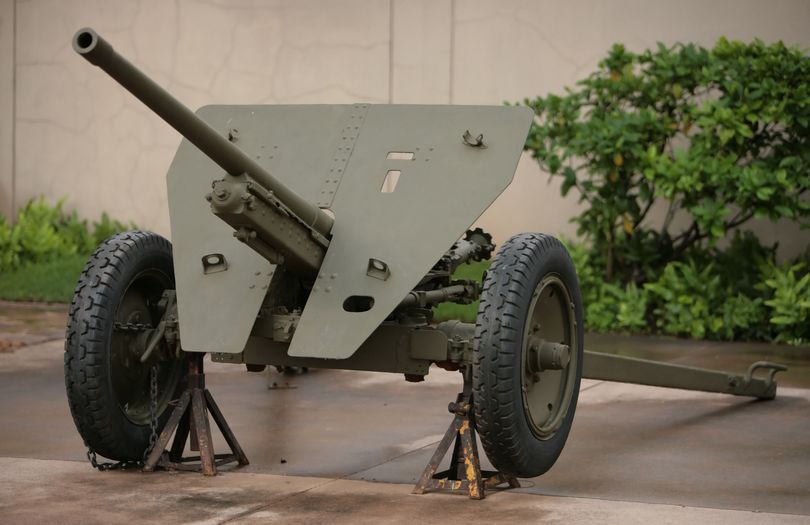
Type 1 is a very traditional design layout, using a breech block mounted barrel, two-wheel slides and one-piece fenders. The breech, inherited from the German PaK 35/36 design, is semi-automatic in nature and allows for an above-average rate of fire - a trained crew can fire about 15 projectiles in a 60-second window. The semi-automatic breech ensures that the spent case is ejected and automatically closes when a new bullet is inserted. The personal shields are well angled to deflect small arms fire and artillery "splash" and increase the surface area towards the top edge.
The weapon system is mounted on a split frame for easy portability and the crew can easily move the system from one position to another and start firing. The carrier is attached to the end of its trailing arm for transport to the vehicle.
The weapon is stabilized when firing and opens at a 60-degree angle. Steel disc wheels are simple rubber tires filled with sponge. Once deployed, the Type 1 has proven to be a very portable and reliable system - whether by vehicle or "pack beast".
The Model 1 weighed approximately 1,760 pounds and had a barrel length of 8.3 feet. The cartridge pictured is in the official caliber (1.85 inches), labeled "47 x 285mmR", and has a muzzle velocity of 2,723 feet per second. With a maximum range of 7,546 yards, aiming is achieved through a "straight" telescope.
The traverse range is +- 50 degrees, and the altitude is between -10 and +20 degrees.
Type 1 is released to fire two different projectiles, Type 1 Armor Piercing High Explosive (APHE) and Type 1 High Explosive (HE). The APHE projectile weighs 3.37 pounds and is the primary shell used against armored targets.
At a range of 500 yards, APHE shells can penetrate flat armor up to 2.75 inches thick, dropping to 1.6 inches at a distance of 1,500 yards. Conversely, HE rounds are used against "soft" targets, such as infantry positions, and weigh 3.08 pounds.
In the end, however, the production of Type 1 never reached the level needed to impress at the Pacific Theater. This was what the Allies achieved in the area, so much so that Japanese Army personnel routinely used whatever they had at their disposal to stop tanks.
Additionally, the thicker Allied tanks became heavier by the end of the war, and the arrival of the M4 Sherman quickly proved that American tanks were immune to any small-caliber anti-tank systems that Japan could deploy. Despite its shortcomings, the Type 1 barrel system was planned for production as the main gun of the Type 97 Chi-Ha light tank - the Japanese were partially "finished" by focusing production on this light armor system, the Allies apparently From early 1945 until the beginning of 1945, the apparent victory of the Japanese army became more and more doubtful month by month.
Instead, seek a "favorable surrender" before the war is over.
Specification 47mm anti-tank gun Type 1
Basic
Roles
- anti-tank/anti-tank
- fire support/attack/damage
Dimensions
1 ton (800 kg; 1,764 lb)
Performance
Performance
4 miles (7 km)
Armor
1 x 47mm main gun.
Ammo types are limited to Type 1 APHE and Type 1 HE shells.
Depends on ammunition type and carrier.
Changes
Type 1 - Base Family Name
 Argentina
 Armenia
 Australia
 Austria
 Austria-Hungary
 Belgium
 Brazil
 United Kingdom
 United States
 Brunei
 Bulgaria
 Canada
 Chile
Chile China
China Colonial America
 Colombia
 Confederate States
 Croatia
 Czech
Czech Denmark
 Egypt
Egypt Finland
 France
 Georgia
 Germany
 German Imperial
 Greece
 Holland
 Hungary
 India
India Indonesia
 Iran
Iran Iraq
Iraq Ireland
 Israel
 Italy
Italy Japan
Japan Jordan
 Kingdom of Italy
 Malaysia
 Mexico
 Myanmar
 Nazi Germany
 Netherlands
 New Zealand
 North Korea
 Norway
 Pakistan
 Peru
Peru Philippines
 Poland
 Portugal
 Prussia
 Romania
 Russia
 Saudi Arabia
 Serbia
 Singapore
 Slovakia
 Slovenia
 South Africa
 South Korea
 Soviet Union
 Spain
Spain Sweden
 Switzerland
 Syria
Syria Taiwan
 Thailand
 Turkey
 UAE
UAE Ukraine
 Vietnam
 Yugoslavia