
History
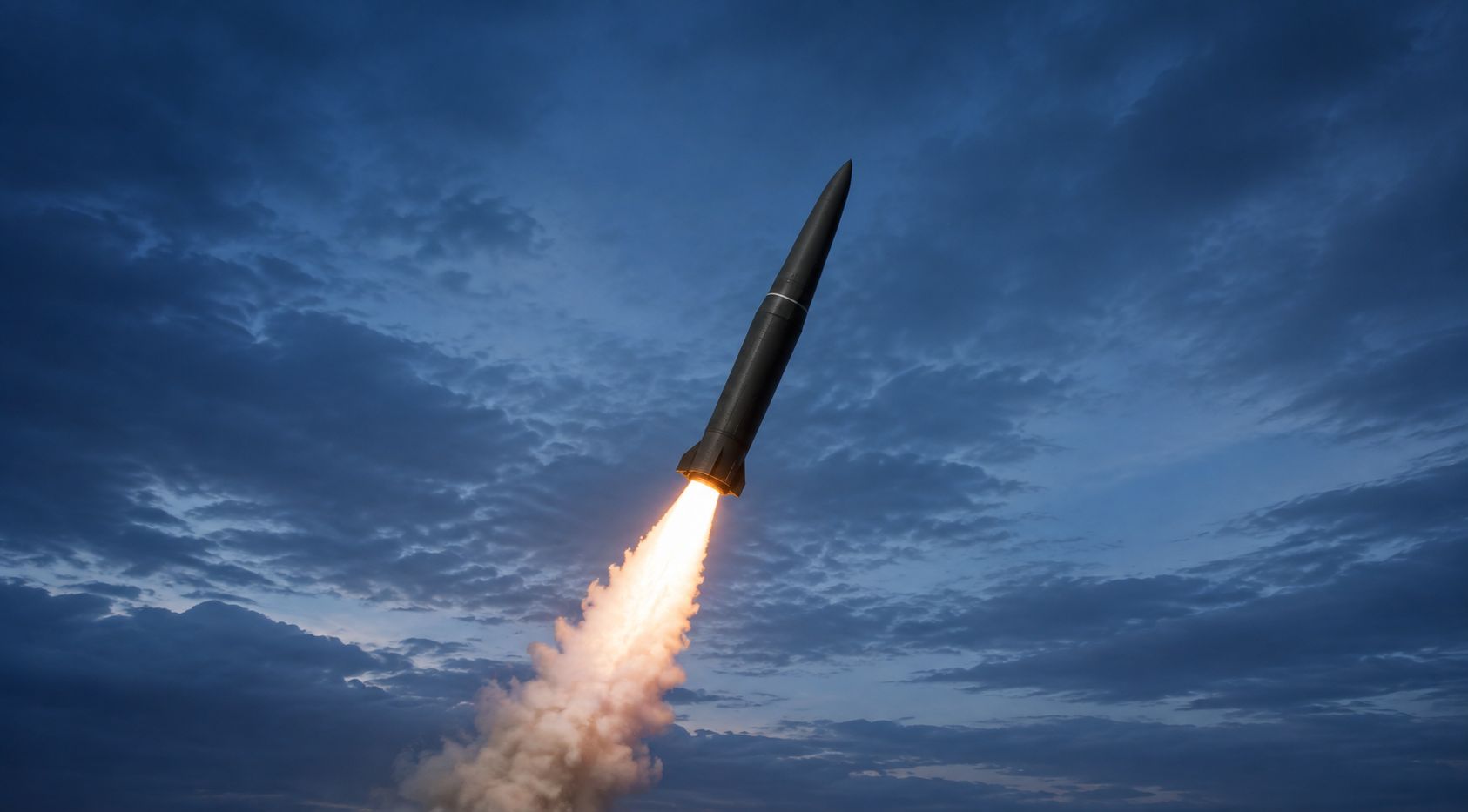
The KN-23, also identified in open sources as Hwasong-11Ga or Hwasong-11A, is a North Korean road-mobile short-range ballistic missile. It uses solid propellant and follows a low quasi-ballistic trajectory that permits maneuvering during flight.
The missile resembles the Russian 9M723 Iskander-M and the South Korean Hyunmoo-2B, but available evidence does not establish that it is a direct copy. Ukrainian examination of recovered components concluded that the KN-23 has distinctive dimensions and differs from the Russian design.
The KN-23 was developed as part of North Korea's effort to replace older short-range weapons with mobile, more capable solid-fuel systems. It has subsequently been supplied to Russia and used in attacks against Ukraine.
Development and public appearance
Sources disagree on the date of the KN-23's first public display. The Missile Defense Advocacy Alliance and Army Recognition place its first parade appearance in 2018, while the CSIS Missile Threat project dates the display to February 2019. In either account, a physically recognizable missile existed before flight testing began in May 2019.
North Korea conducted the first reported flight test near Wonsan on 4 May 2019. The missile traveled about 240 km and reached an apogee of approximately 60 km. Two additional missiles launched five days later flew about 270 km and 420 km, with apogees near 50 km. United States Forces Korea subsequently assigned the designation KN-23 to the previously unnamed weapon.
During another series in late July 2019, two missiles reportedly traveled about 430 km and 690 km. Both followed trajectories with apogees near 50 km. Two further missiles launched on 6 August flew approximately 450 km and reached an apogee of about 37 km. These tests demonstrated a considerably greater range than the first launch.
Further development
The original system was displayed with an eight-wheel transporter-erector-launcher carrying two missiles. A launcher on a tracked chassis appeared in 2020. Since 2021, North Korea has also displayed and tested a larger and heavier member of the missile family. A European nonproliferation study describes the KN-23 as part of a broader transition toward solid propellant and quasi-ballistic flight technology in North Korea's short-range arsenal.
Design
Missile configuration
The base KN-23 is a single-stage solid-propellant missile. Published estimates give a length of approximately 7.5 m, a diameter near 0.95 m, and a launch weight of about 3,415 kg. These figures are estimates because North Korea has not published a complete official specification.
Measurements derived from wreckage examined in Ukraine differ from some earlier estimates. Ukrainian specialists reported a diameter of approximately 1.1 m around the tail, narrowing to about 0.9 m toward the forward section. They also assessed the motor as substantially larger than its Russian counterpart because the North Korean propellant is less energy-efficient.
The missile's overall shape, aerodynamic surfaces, and mobile launcher arrangement resemble the Iskander family. However, differences include its proportions, external cable raceway, base geometry, and reported motor dimensions. Ukrainian investigators concluded that the missile was neither a licensed 9M723 nor a direct copy, although it may incorporate concepts associated with an earlier branch of Iskander-related development. Claims that Russia or China directly assisted development remain disputed.
Flight characteristics and guidance
The KN-23 follows a lower trajectory than a conventional ballistic missile of comparable range. Its aerodynamic fins allow it to maneuver while it remains within the atmosphere, and open-source analysis indicates that it may perform a pull-up maneuver during the terminal phase. These features complicate the prediction of its flight path and can reduce the time available to missile-defense systems.
The exact guidance architecture and accuracy have not been confirmed. Some publications describe inertial guidance with possible satellite-navigation updates and claim high precision. Other operational assessments describe North Korean missiles used in Ukraine as less accurate than the Russian Iskander. CSIS notes that it is not publicly known whether the KN-23 has guidance sophisticated enough to retain high accuracy after evasive maneuvers.
Warhead and range
Open-source estimates indicate that the base missile can carry a warhead of approximately 500 kg to around 450 km. A reduced payload may extend the range to approximately 690 km. Analysts assess the design as potentially capable of carrying conventional or nuclear warheads, but the available sources do not confirm deployment of a nuclear warhead on the system.
Launch platforms
The initial wheeled launcher has an eight-wheel chassis and carries two missiles. Published estimates describe a vehicle approximately 13 m long, 3.5 m wide, and 3.5 m high, with a crew of three. Its appearance differs from the Russian MZKT-7930 used by the Iskander system. The tracked launcher shown in 2020 also carries two missiles. Both arrangements support dispersal, rapid repositioning, and launch from locations away from permanent bases.
Operational history
North Korea's May 2019 launches were described as part of military exercises. Earlier assessments remained uncertain about formal entry into service, but subsequent displays, continued testing, and transfer to Russia demonstrate that missiles of this family became operationally available.
Russia first used North Korean KN-23 and KN-24 missiles against Ukraine near the end of 2023. A North Korean missile fell in an open area in Ukraine's Zaporizhzhia region on 30 December 2023. Another was used against Kharkiv on 2 January 2024. Recovered wreckage enabled Ukrainian engineers to examine the missiles' dimensions, propulsion, and construction.
Reports differ on the last recorded Russian use before the summer of 2026. One Ukrainian account placed it in early 2025, while a military source cited by Reuters placed it in August 2025.
During the Russian attack of 30 July 2026, radar data initially indicated flight paths characteristic of the KN-23 or KN-24 toward the Kryvyi Rih area. Ukrainian officials subsequently identified two impact locations as KN-23 strikes. One missile hit a private house in Radushne, while the crater of another was found in a field approximately 3.5 km away. The strike on the house killed six people, including three children, according to the later Ukrainian report, and injured nine others. The second impact was reported to have occurred without a potential target within 5 km, adding to concerns about the weapon's operational accuracy.
Variants
North Korea has not published a complete official nomenclature. The following designations are reported in open sources and should therefore be treated as provisional.
- Hwasong-11Ga / Hwasong-11A: Base KN-23 configuration carried by wheeled or tracked mobile launchers.
- Hwasong-11Da / Hwasong-11C: Enlarged version reportedly designed to carry a warhead weighing up to 2.5 tonnes. A heavier KN-23 version has been displayed and tested since 2021.
- Hwasong-11Ra / Hwasong-11D: Reported smaller version with reduced range.
- Hwasong-11S: Reported underwater-launched derivative of the base missile.
A summary of these reported variants is available from Army Recognition. Published dimensions and performance figures for the enlarged and underwater-launched versions should not be applied to the base KN-23.
Operators
- North Korea: Developer and original operator. The missile has appeared in military parades, exercises, and repeated flight-test programs.
- Russia: Recipient and combat user of North Korean KN-23-family missiles against Ukraine since late 2023.
Specifications (KN-23 Hwasong-11Ga base model)
General characteristics
- Type: Road-mobile short-range ballistic missile
- Length: Approximately 7.5 m
- Diameter: Approximately 0.95 m in general open-source estimates; recovered examples have been reported as approximately 1.1 m at the tail and 0.9 m toward the forward section
- Launch weight: Approximately 3,415 kg
- Stages: One
- Propellant: Solid
- Launch platform: Wheeled or tracked mobile transporter-erector-launcher carrying two missiles
Performance
- Range with estimated 500 kg payload: Approximately 450 km
- Maximum reported range with reduced payload: Approximately 690 km
- Observed test apogee: Approximately 37-60 km
- Flight profile: Low quasi-ballistic trajectory with atmospheric maneuvering and a reported terminal pull-up capability
Warhead and guidance
- Estimated warhead weight: Approximately 500 kg
- Reported warhead compatibility: Conventional or nuclear-capable design
- Guidance: Precise configuration unconfirmed; inertial navigation with possible external navigation updates has been reported
- Accuracy: Not reliably established in public sources
 Argentina
 Armenia
 Australia
 Austria
 Austria-Hungary
 Belgium
 Brazil
 United Kingdom
 United States
 Brunei
 Bulgaria
 Canada
 Chile
Chile China
China Colonial America
 Colombia
 Confederate States
 Croatia
 Czech
Czech Denmark
 Egypt
Egypt Finland
 France
 Georgia
 Germany
 German Imperial
 Greece
 Holland
 Hungary
 India
India Indonesia
 Iran
Iran Iraq
Iraq Ireland
 Israel
 Italy
Italy Japan
Japan Japan (1940)
 Jordan
 Kingdom of Italy
 Malaysia
 Mexico
 Myanmar
 Nazi Germany
 Netherlands
 New Zealand
 Norway
 Pakistan
 Peru
Peru Philippines
 Poland
 Portugal
 Prussia
 Romania
 Russia
 Saudi Arabia
 Serbia
 Singapore
 Slovakia
 Slovenia
 South Africa
 South Korea
 Soviet Union
 Spain
Spain Sweden
 Switzerland
 Syria
Syria Taiwan
 Thailand
 Turkey
 UAE
UAE Ukraine
 Vietnam
 Yugoslavia