
History
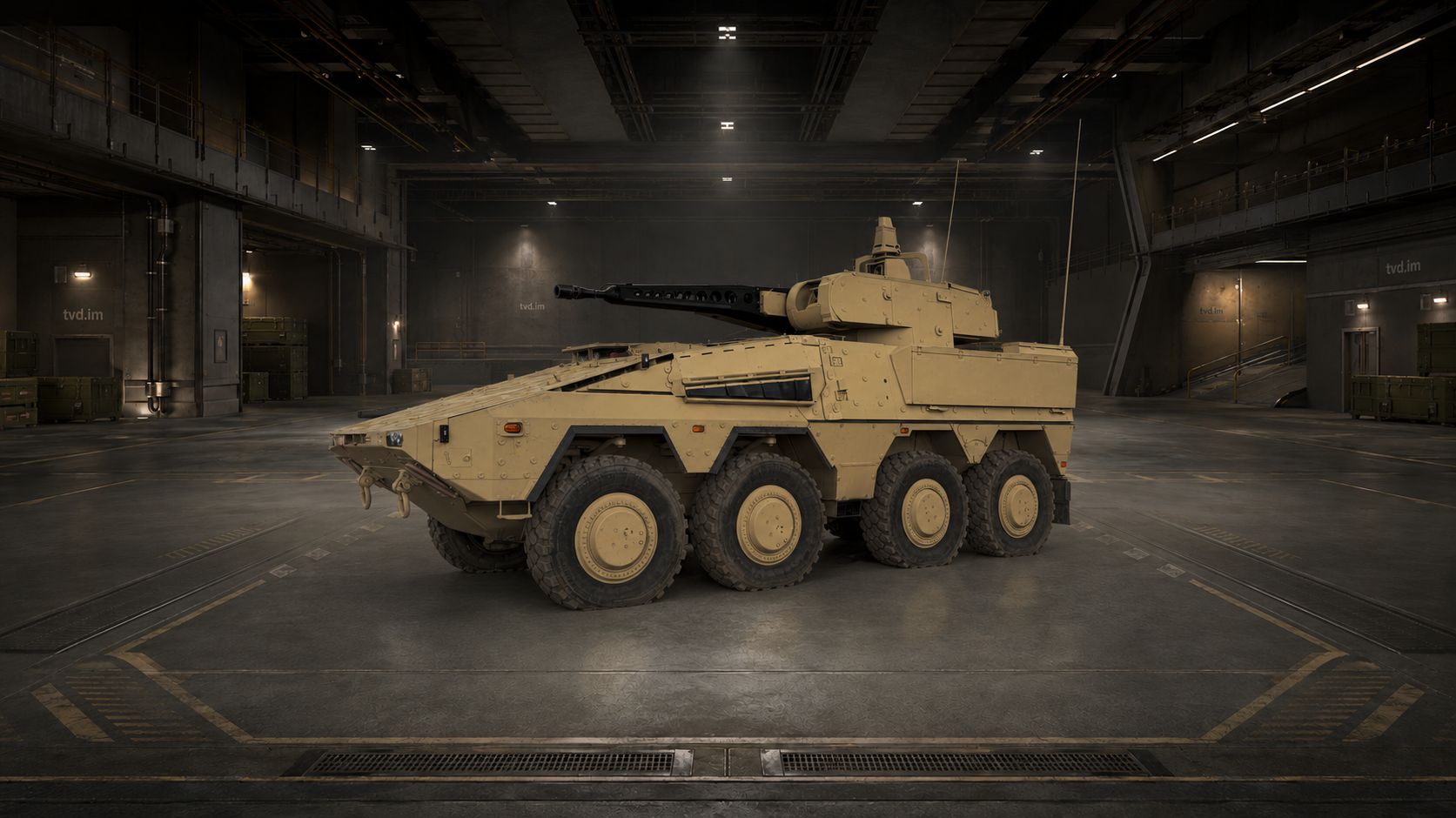
The KNDS Boxer RCT30 is an 8×8 wheeled infantry fighting vehicle that combines the Boxer vehicle platform with the remote-controlled 30 mm turret developed for the Puma infantry fighting vehicle. It is marketed through ARTEC, a joint venture between KNDS Deutschland and Rheinmetall.
The vehicle is intended to provide protected troop transport, direct fire support, anti-armour capability, and engagement of low-altitude aerial threats. Germany designates its Boxer RCT30 configuration as Schakal and plans to employ it as a principal combat system of the Bundeswehr's new Medium Forces.
The design retains the Boxer's separate drive and mission modules. This permits mission modules to be exchanged while maintaining a common automotive platform and substantial logistical compatibility with existing Boxer and Puma systems.
Development and early deliveries
The Boxer platform was initially demonstrated with the unmanned RCT30 turret used by the Puma, according to a Boxer variant history. The combination created a wheeled infantry fighting vehicle with the Boxer's mobility and protection and the Puma's stabilized cannon system.
By 2025, physical Boxer RCT30 vehicles had been delivered. A November 2025 report stated that KNDS had supplied nine vehicles configured for counter-unmanned-aircraft duties to Ukraine. The same report described a German-Dutch contract for 222 systems, comprising 150 vehicles for Germany and 72 for the Netherlands. Initial deliveries to these two customers were planned for late 2027, as reported by Armada International.
Additional German-Dutch order
In August 2026, OCCAR exercised an option for another 69 vehicles through ARTEC. The order added 35 vehicles for Germany and 34 for the Netherlands. It increased the planned German fleet to 185 vehicles and the Dutch fleet to 106. The procurement was reported in an August 2026 contract announcement.
Germany plans to use the Schakal as a central weapon system for mechanized infantry assigned to its Medium Forces. These formations are intended for rapid deployment and for mounted or dismounted combat. Joint acquisition by Germany and the Netherlands is also intended to support common training, logistics, and interoperability. As of August 2026, the Boxer RCT30 was under contract with four nations, although the supplied material did not identify every customer.
Design
Platform and protection
The Boxer RCT30 uses an eight-wheel drive module and a protected mission module. The modular structure allows the mission module to be adapted or exchanged without replacing the common drive module. Individual-wheel suspension has long spring travel and hydraulic end-stop damping for movement on roads and cross-country terrain.
The protected compartment accommodates the driver, commander, weapons-system operator, and infantry passengers. The official configuration permits six or seven dismounts, while the German Schakal procurement configuration carries six. The basic protection is intended to resist anti-personnel mines, heavy-machine-gun fire from all directions, and artillery fragments. Additional protection is available against medium-calibre ammunition and submunitions. The system also incorporates the MUSS soft-kill protection system.
Mobility
An MTU V8 diesel engine provides up to 600 kW. The vehicle can exceed 100 km/h on roads and has an official road range greater than 750 km. Steering geometry provides a 21 m turning circle, reduced to 15 m when skid steering is used.
Sensors and command systems
The remote turret carries stabilized optical and optronic sights for surveillance, detection, identification, and engagement while moving. The crew has 360-degree observation, and hunter-killer functionality allows separate target-search and engagement tasks.
The vehicle uses a C4I architecture that can connect with existing battlefield-management systems. It supports bidirectional exchange of navigation and tactical information through multiple command levels. An integrated IdZ system connects the vehicle with German infantry equipment and command networks.
Armament
The primary weapon is the fully stabilized MK30-2/ABM 30 mm automatic cannon. It has an effective combat distance of up to 3,000 m and a stated rate of fire of 200 rounds per minute. Its elevation range extends from −10 to +45 degrees, while the turret can rotate continuously through 360 degrees.
An automatic dual-belt feed allows the operator to select between two ammunition types. Available ammunition includes armour-piercing rounds and programmable airburst ammunition. The stabilized weapon can engage moving ground targets while the Boxer is moving and can also be used against drones and other low-altitude aerial targets.
Secondary armament consists of a coaxial MG5 machine gun and two SPIKE LR guided missiles. In German service, the missile installation is designated MELLS. It provides an anti-armour capability against infantry fighting vehicles and main battle tanks. Detailed manufacturer information is available on the KNDS Boxer RCT30 page.
Program status
- Germany: 185 vehicles are planned following the original order for 150 and the 2026 option for 35 more. The German configuration is named Schakal, with initial deliveries planned from late 2027.
- Netherlands: 106 vehicles are planned following the original order for 72 and the 2026 option for another 34. The vehicles are intended to support the German-Dutch Medium Forces structure.
- Ukraine: Nine Boxer RCT30 vehicles configured for counter-unmanned-aircraft duties had reportedly been supplied by 2025.
- Other customers: The Boxer RCT30 was under contract with four nations by August 2026, but the available sources did not identify every customer.
Specifications (Boxer RCT30)
The following values are taken from the official KNDS technical brochure.
General characteristics
- Configuration: 8×8 wheeled infantry fighting vehicle
- Length: 7.9 m
- Width: 2.99 m
- Height: 3.5 m
- Combat weight: 38.5 tonnes
- Crew: Three
- Infantry capacity: Six or seven soldiers, depending on configuration
- Crew-compartment volume: 14 m³
- Ground clearance: 0.50 m
- Track gauge: 2.6 m
Performance
- Engine power: Up to 600 kW
- Maximum road speed: More than 100 km/h
- Road range: More than 750 km
- Turning circle: 21 m, or 15 m with skid steering
- Maximum gradient: 60 percent
- Maximum side slope: 30 percent
- Trench crossing: 2.0 m
- Step climbing: 0.8 m
Armament
- Main armament: One stabilized 30 mm MK30-2/ABM automatic cannon
- Effective cannon distance: Up to 3,000 m
- Rate of fire: 200 rounds per minute
- Elevation: −10 to +45 degrees
- Traverse: Continuous 360 degrees
- Secondary armament: Coaxial MG5 machine gun
- Guided weapons: Two SPIKE LR missiles, designated MELLS in German service
 Argentina
 Armenia
 Australia
 Austria
 Austria-Hungary
 Belgium
 Brazil
 United Kingdom
 United States
 Brunei
 Bulgaria
 Canada
 Chile
Chile China
China Colonial America
 Colombia
 Confederate States
 Croatia
 Czech
Czech Denmark
 Egypt
Egypt Finland
 France
 Georgia
 German Imperial
 Greece
 Holland
 Hungary
 India
India Indonesia
 Iran
Iran Iraq
Iraq Ireland
 Israel
 Italy
Italy Japan
Japan Japan (1940)
 Jordan
 Kingdom of Italy
 Malaysia
 Mexico
 Myanmar
 Nazi Germany
 Netherlands
 New Zealand
 North Korea
 Norway
 Pakistan
 Peru
Peru Philippines
 Poland
 Portugal
 Prussia
 Romania
 Russia
 Saudi Arabia
 Serbia
 Singapore
 Slovakia
 Slovenia
 South Africa
 South Korea
 Soviet Union
 Spain
Spain Sweden
 Switzerland
 Syria
Syria Taiwan
 Thailand
 Turkey
 UAE
UAE Ukraine
 Vietnam
 Yugoslavia