

History
The Bastion is a Russian coastal-defense missile system developed by NPO Mashinostroenia. Its primary mission is to attack surface ships, including carrier groups, convoys, and amphibious vessels.
The system combines mobile or fixed launchers with supersonic P-800 Oniks missiles. Although designed for coastal defense, Russia has also employed Bastion against fixed land targets.
The mobile K-300P Bastion-P was developed with participation from the Belarusian company Tekhnosoyuzproekt. Available sources indicate that production began in 2010 and that the system entered Russian service around 2010–2011. It replaced older Soviet coastal-defense weapons such as the Rubezh and Redut systems. A detailed summary of its development and configuration is available in the K-300P Bastion-P reference.
Russia deployed Bastion-P systems in Crimea by 2015. In November 2016, Russian forces used the system in Syria to launch Oniks missiles against land targets, demonstrating a secondary surface-to-surface role. Additional batteries were deployed on Matua Island in 2021 and Paramushir Island in 2022.
During the Russia-Ukraine War, Bastion launchers became an important platform for strikes against Ukrainian territory, particularly targets near the Black Sea coast. Russian forces used P-800 Oniks missiles in this role during 2022 and 2023.
In 2026, Ukrainian sources reported that modified Bastion systems were also being used with 3M22 Zircon missiles. Ukrainian forces reported striking a Bastion deployment in Crimea in March. On 16 August 2026, Ukrainian Navy units attacked launch positions and a deployment site near Rezervne, southwest of Sevastopol. The Ukrainian Navy strike report stated that FP-2 drones were apparently used and that Russian equipment and personnel suffered significant losses, although final damage figures had not been confirmed.
Design
System configuration
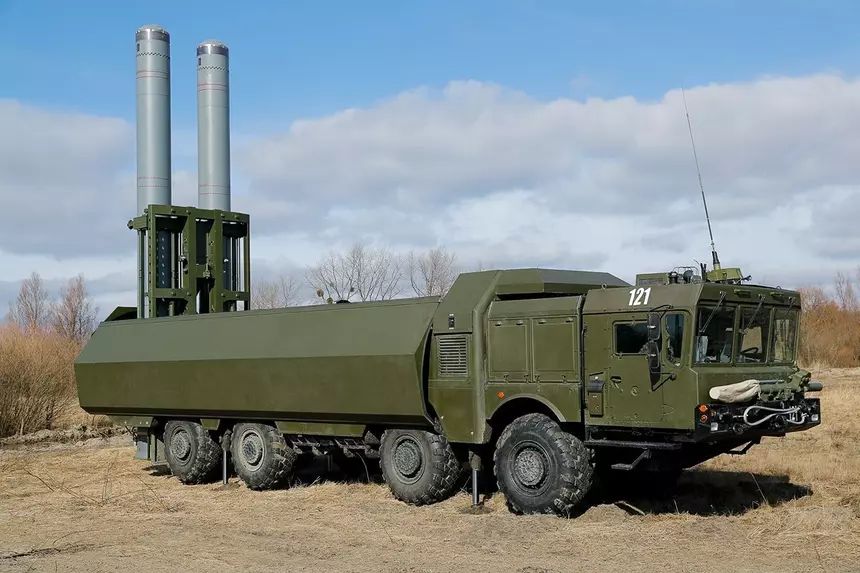
A typical Bastion-P unit includes command-and-control vehicles, launcher vehicles, transport-loader vehicles, and support equipment. One commonly described configuration has one or two command vehicles, one support vehicle, four launchers, and four loader vehicles. The launcher is based on the MZKT-7930 8×8 chassis and carries two missiles in vertical transport-launch containers.
Each launcher has a crew of three. After stopping at a firing position, the missiles can be prepared for launch within approximately five minutes. The two missiles can be fired at intervals of two to five seconds. The launcher can remain on active standby for several days, with longer periods possible when supported by a combat-duty support vehicle.
P-800 Oniks missile
The principal weapon of Bastion-P is the P-800 Oniks, known as Yakhont in its export form. The missile is launched vertically with a solid-propellant booster. A ramjet sustains its supersonic cruise after the initial acceleration phase.
The Oniks uses inertial navigation during the middle portion of its flight and an active or passive radar seeker during the terminal phase. A high-low trajectory permits greater range, while a lower flight profile reduces detection distance. During a sea-skimming terminal approach, the missile can descend to approximately 5–15 m above the surface.
Published range figures vary by missile version and flight profile. Several sources give a maximum range of about 300 km for established versions. Some later secondary references claim longer ranges against land or naval targets, but these figures are not consistently supported. The missile normally travels at approximately Mach 2.5, with some sources giving speeds as high as Mach 2.8. Technical data and differing published values are summarized by Global Defence Technology, The Defense Watch, and Weapons Parade.
Target acquisition and control
Bastion can receive target information from its own battery equipment and from external land, naval, and airborne sensors. The Monolit-BR coastal radar can provide active and passive over-the-horizon tracking. Once launched, the missile's terminal seeker enables fire-and-forget operation, allowing the launcher to leave its firing position.
Operational history
The system's first widely reported combat use against land targets occurred in Syria in November 2016. This showed that software and guidance changes allowed Oniks missiles to attack programmed coordinates rather than only moving ships.
Russia subsequently used Bastion systems during its invasion of Ukraine. Oniks missiles were employed primarily against Odesa and other coastal areas. Their high speed and low terminal altitude make detection and interception difficult, although a higher cruise phase can increase the time available to defending sensors.
Ukrainian attacks in Crimea during 2026 demonstrated the vulnerability of the land-based launch and support elements when their positions were located. Reports about the August strike did not provide independently confirmed numbers of destroyed launchers or missiles.
Variants
- K-300P Bastion-P: Mobile version mounted on MZKT-7930 8×8 launcher vehicles. Each launcher carries two missiles.
- K-300S Bastion-S: Fixed or silo-based version of the system.
- Bastion-E: Export configuration of the coastal-defense system.
Operators
- Russia: Operated by Russian naval coastal missile forces. Systems have been deployed in Crimea, the Arctic, the Kuril Islands, and Syria.
- Vietnam: The Vietnam People's Navy acquired at least two systems, which entered service with its coastal missile and artillery forces in the early 2010s.
Specifications (K-300P Bastion-P with P-800 Oniks)
General characteristics
- Manufacturer: NPO Mashinostroenia
- Role: Mobile coastal-defense, anti-ship, and surface-to-surface missile system
- Launcher chassis: MZKT-7930 8×8
- Launcher crew: Three
- Missiles per launcher: Two
- Missile length: Approximately 8.9 m
- Missile diameter: Approximately 0.7 m
- Missile launch mass: Approximately 3,000 kg
Performance
- Maximum published range: Approximately 300 km, depending on missile version and flight profile
- Maximum speed: Approximately Mach 2.5; some sources state up to Mach 2.8
- Maximum cruise altitude: Approximately 14,000 m on a high-altitude profile
- Terminal altitude: Approximately 5–15 m above the sea
- Preparation time after stopping: Approximately five minutes
- Launch interval: Two to five seconds between missiles
Armament and guidance
- Standard missile: P-800 Oniks or export Yakhont
- Warhead: High-explosive penetrating warhead; commonly reported mass of 200–250 kg
- Propulsion: Solid-propellant launch booster and ramjet sustainer
- Guidance: Inertial midcourse navigation with active or passive radar terminal homing
Related equipment
- 3K60 Bal: Russian mobile coastal-defense system using subsonic anti-ship missiles and often deployed alongside Bastion units.
- P-800 Oniks: Supersonic cruise missile that forms the standard armament of Bastion-P.
- 3M22 Zircon: Missile reported to have been adapted for use from modified Bastion launchers by 2026.
 Argentina
 Armenia
 Australia
 Austria
 Austria-Hungary
 Belgium
 Brazil
 United Kingdom
 United States
 Brunei
 Bulgaria
 Canada
 Chile
Chile China
China Colonial America
 Colombia
 Confederate States
 Croatia
 Czech
Czech Denmark
 Egypt
Egypt Finland
 France
 Georgia
 Germany
 German Imperial
 Greece
 Holland
 Hungary
 India
India Indonesia
 Iran
Iran Iraq
Iraq Ireland
 Israel
 Italy
Italy Japan
Japan Japan (1940)
 Jordan
 Kingdom of Italy
 Malaysia
 Mexico
 Myanmar
 Nazi Germany
 Netherlands
 New Zealand
 North Korea
 Norway
 Pakistan
 Peru
Peru Philippines
 Poland
 Portugal
 Prussia
 Romania
 Saudi Arabia
 Serbia
 Singapore
 Slovakia
 Slovenia
 South Africa
 South Korea
 Soviet Union
 Spain
Spain Sweden
 Switzerland
 Syria
Syria Taiwan
 Thailand
 Turkey
 UAE
UAE Ukraine
 Vietnam
 Yugoslavia