
History
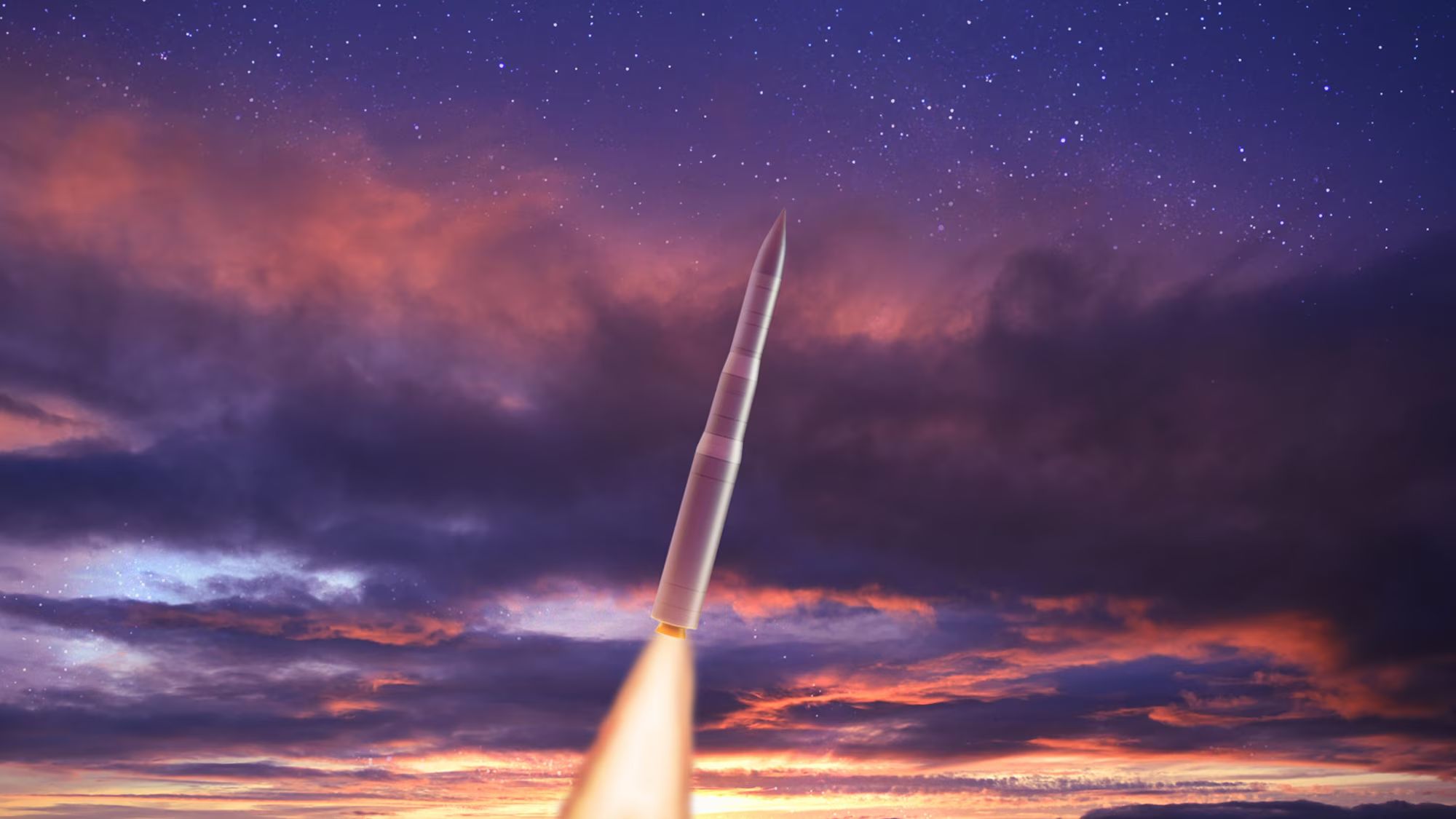
The Northrop Grumman LGM-35A Sentinel is a silo-launched intercontinental ballistic missile system under development for the United States Air Force. It is intended to replace the LGM-30G Minuteman III as the land-based component of the United States nuclear triad.
Sentinel is a replacement for the complete Minuteman III weapon system rather than only its missile. The program includes new missiles, launch silos, launch control centers, secure communications, maintenance facilities, training infrastructure, security systems, and digital command-and-control architecture.
The Air Force plans to deploy 400 Sentinel missiles and expects initial capability in the early 2030s. A first pad-launched flight test is planned for 2027, but Sentinel is not yet an operational weapon system.
Development
The Air Force began examining a replacement for Minuteman III after a 2014 analysis of alternatives. The resulting program was originally named the Ground Based Strategic Deterrent, or GBSD. Its goals included addressing the age and obsolescence of Minuteman III components and creating a modular system that could remain in service through 2075.
In July 2016, the Air Force Nuclear Weapons Center issued a request for proposals covering development and maintenance of the future ICBM system. Boeing and Northrop Grumman received competing technology-maturation and risk-reduction contracts in August 2017. Boeing withdrew from the competition in 2019, leaving Northrop Grumman as the sole bidder.
On 8 September 2020, the Department of the Air Force awarded Northrop Grumman a USD 13.3 billion engineering and manufacturing development contract. The principal team also includes companies responsible for propulsion, reentry systems, command-and-control equipment, infrastructure, and other elements of the program.
The Air Force announced the LGM-35A designation and Sentinel name in April 2022. The letters in LGM identify a silo-launched, surface-attack guided missile under the United States military designation system.
Restructuring and construction
In January 2024, the program reported a critical Nunn-McCurdy cost breach. A Department of Defense review completed in July 2024 determined that Sentinel met the statutory conditions required to continue, but the previous Milestone B approval was rescinded and the program entered restructuring. The review cited an estimated acquisition cost of approximately USD 141 billion for a modified program.
The original plan called for adapting existing Minuteman III silos. Subsequent studies indicated that extensive repair and modification would impose additional cost and schedule risks, and the Air Force decided to construct new silos. This approach is also intended to let Minuteman III missiles remain on alert until replacement facilities are ready.
Construction of a full-scale prototype silo began at Promontory, Utah, in 2026. Its digitally developed modular design is intended to test construction methods and reduce risk before production work begins. The Air Force also opened a Site Activation Task Force facility at F.E. Warren Air Force Base in Wyoming and began utility-corridor work near Kimball, Nebraska. More than 32 km (20 miles) of pilot corridors were planned to evaluate directional boring, vibratory plowing, and open-trench excavation.
The underground corridors are intended to carry fiber-optic communications among launch facilities, control centers, security systems, maintenance sites, and command nodes. They will replace parts of the legacy communications infrastructure supporting the Minuteman III missile fields.
Testing
A Minotaur II+ test rocket was launched from Vandenberg Space Force Base in July 2022 for a demonstration associated with the Mk21A reentry vehicle program, but it exploded shortly after launch. This was a supporting reentry-system test and not a flight of a complete Sentinel missile.
Northrop Grumman was producing solid rocket motors for initial Sentinel flight tests by 2026. The Air Force plans the first pad-launched Sentinel test at Vandenberg Space Force Base in 2027. Additional development activity is expected to use facilities in Utah, California, and the Marshall Islands.
Design
Sentinel is designed as a three-stage, solid-fuel intercontinental ballistic missile launched from a hardened underground silo. Publicly available information does not provide complete dimensions, launch weight, range, accuracy, or detailed performance figures for the production configuration.
The missile is one element of a distributed weapon system. Its ground segment is planned to include new launch facilities, launch control centers, wing command centers, maintenance and training facilities, security equipment, and a hardened digital communications network. Modular hardware and software are intended to support maintenance and future upgrades during the planned service life.
Propulsion
Three solid-propellant rocket stages will power the missile during the initial portion of flight. Solid-fuel propulsion permits the missile to remain stored in its silo in a launch-ready condition. Northrop Grumman leads development of the missile, while its industrial team supplies propulsion and other subsystems.
Reentry system and warhead
The Air Force plans to deploy Sentinel initially with the existing W87-0 nuclear warhead. The National Nuclear Security Administration is developing the W87-1 replacement warhead, while Lockheed Martin is developing the associated Mk21A reentry vehicle. The first W87-1 production unit is planned for fiscal year 2033.
The planned initial configuration carries one reentry vehicle and one warhead per deployed missile. Proposals to provide additional warhead capacity or alternative basing arrangements have appeared in policy discussions, but they are not confirmed operational Sentinel configurations.
Command, control, and communications
Sentinel's communications architecture is intended to connect geographically dispersed missile fields with command authorities through secure and redundant pathways. Fiber-optic links offer greater data capacity and resistance to electromagnetic interference than the copper-based infrastructure they replace. The network is also intended to support system monitoring, maintenance data, security functions, and later software upgrades.
Program status
Sentinel remained under development and program restructuring in 2026. The Air Force expected to complete the restructure and seek a renewed Milestone B decision by the end of that year. Initial capability was targeted for the early 2030s rather than the original 2029 schedule.
The acquisition plan described by the Congressional Research Service calls for 634 operational and replacement missiles, plus 25 missiles for development and testing. This inventory is intended to support 400 deployed missiles. The wider program encompasses approximately 450 launch facilities and more than 600 supporting facilities.
Deployment is planned across the missile fields associated with F.E. Warren Air Force Base in Wyoming, Malmstrom Air Force Base in Montana, and Minot Air Force Base in North Dakota. Minuteman III and Sentinel operations are expected to overlap during a lengthy transition. Current official program information is published by the Air Force Nuclear Weapons Center.
Operator
- United States Air Force: Planned operator. Sentinel is intended to replace Minuteman III and maintain a force of 400 deployed land-based ICBMs. Initial capability is targeted for the early 2030s.
Specifications (LGM-35A Sentinel planned configuration)
General characteristics
- Type: Silo-launched intercontinental ballistic missile system
- Manufacturer: Northrop Grumman
- Development authority: United States Air Force
- Launch platform: Hardened underground missile silo
- Status: Under development
- Planned initial capability: Early 2030s
- Planned service life: Through 2075
Propulsion
- Engine arrangement: Three solid-propellant rocket stages
Payload
- Initial planned warhead: One W87-0 nuclear warhead
- Future planned warhead: W87-1 nuclear warhead
- Future reentry vehicle: Mk21A
Planned force structure
- Deployed missiles: 400
- Missile procurement: 634 missiles, plus 25 for development and testing
- Launch facilities: Approximately 450 planned
- Supporting facilities: More than 600 planned
Related equipment
- LGM-30G Minuteman III: The existing United States Air Force ICBM system that Sentinel is intended to replace.
- Mk21A reentry vehicle: The reentry vehicle under development for the W87-1 warhead and future Sentinel configuration.
 Argentina
 Armenia
 Australia
 Austria
 Austria-Hungary
 Belgium
 Brazil
 United Kingdom
 Brunei
 Bulgaria
 Canada
 Chile
Chile China
China Colonial America
 Colombia
 Confederate States
 Croatia
 Czech
Czech Denmark
 Egypt
Egypt Finland
 France
 Georgia
 Germany
 German Imperial
 Greece
 Holland
 Hungary
 India
India Indonesia
 Iran
Iran Iraq
Iraq Ireland
 Israel
 Italy
Italy Japan
Japan Japan (1940)
 Jordan
 Kingdom of Italy
 Malaysia
 Mexico
 Myanmar
 Nazi Germany
 Netherlands
 New Zealand
 North Korea
 Norway
 Pakistan
 Peru
Peru Philippines
 Poland
 Portugal
 Prussia
 Romania
 Russia
 Saudi Arabia
 Serbia
 Singapore
 Slovakia
 Slovenia
 South Africa
 South Korea
 Soviet Union
 Spain
Spain Sweden
 Switzerland
 Syria
Syria Taiwan
 Thailand
 Turkey
 UAE
UAE Ukraine
 Vietnam
 Yugoslavia