
History
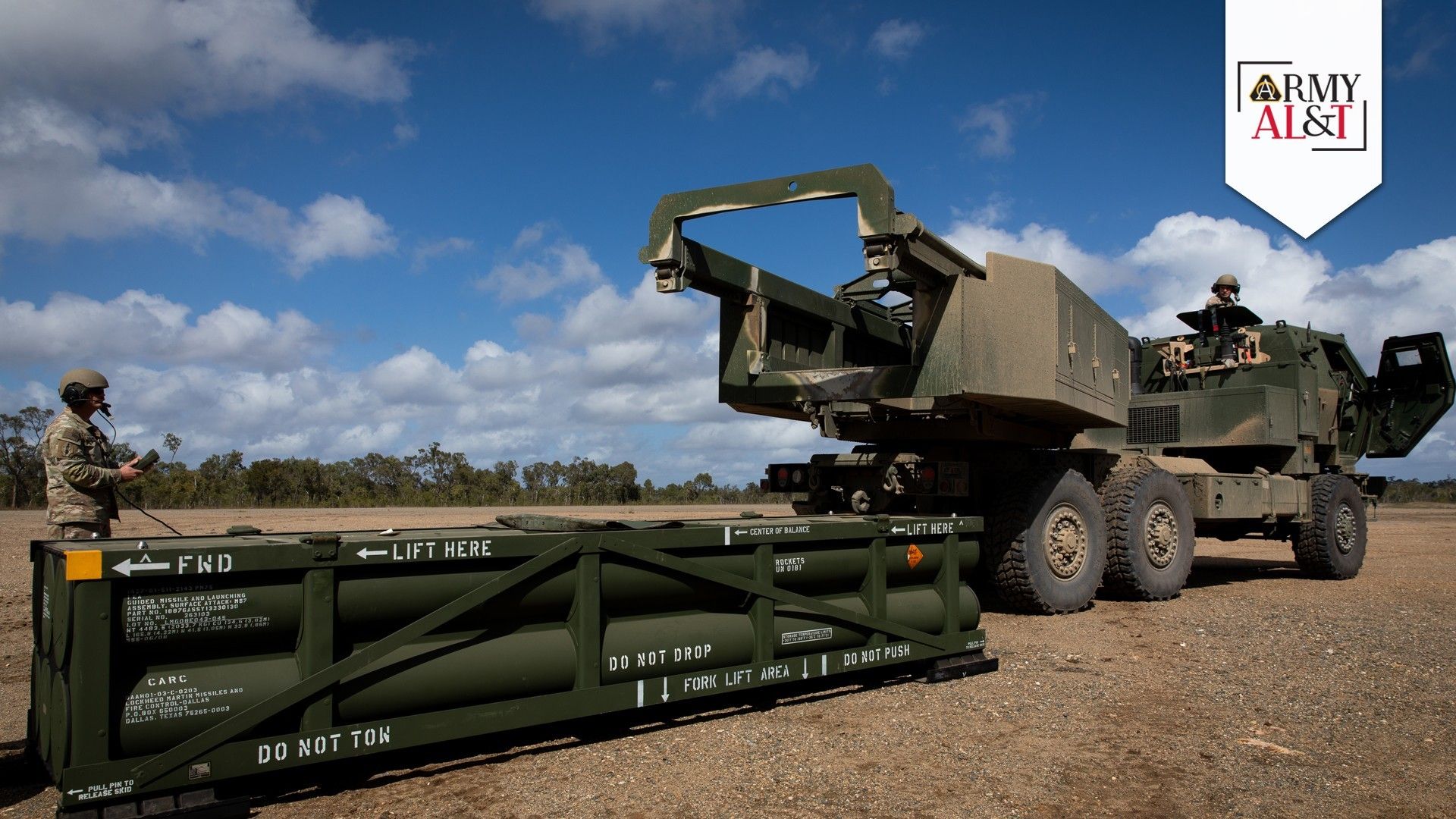
The Lockheed Martin Army Tactical Missile System (ATACMS) and Precision Strike Missile (PrSM) are related families of American road-mobile ballistic missiles. They provide long-range precision fire for ground forces and use launchers from the M270 Multiple Launch Rocket System and M142 High Mobility Artillery Rocket System families.
ATACMS entered service as a replacement for the MGM-52 Lance. PrSM is the next-generation successor to ATACMS. It offers a longer range and allows each launcher pod to carry two missiles instead of one.
The two families overlap during the transition from the older ATACMS inventory to PrSM. ATACMS variants reach up to 300 km, while PrSM Increment One has a stated range exceeding 500 km.
ATACMS development
The origins of ATACMS include the 1978 Assault Breaker technology demonstration and the US Army's requirement for a conventional missile able to attack important targets behind the front line. The Army's Corps Support Weapon System and the US Air Force's Conventional Standoff Weapon effort were combined in the Joint Tactical Missile System program during the early 1980s.
The US Air Force withdrew from the non-cruise-missile portion of the program in 1984. The remaining Army weapon subsequently became the Army Tactical Missile System. Ling-Temco-Vought won the missile design contract in March 1986, and the system received the MGM-140 designation.
The first ATACMS test launch took place in 1988. Testing of the initial Block I version was completed in December 1989, and the missile entered US Army service in 1991. It was used during the Gulf War shortly after its introduction. A detailed technical profile is available from the CSIS Missile Threat project.
ATACMS subsequently evolved through versions with different guidance systems, ranges, and payloads. The initial M39 used inertial guidance and an area-effect payload of M74 submunitions. The extended-range M39A1 added GPS-aided inertial guidance and reduced the payload to 300 submunitions. The M48 and M57 introduced a unitary high-explosive warhead for precision attacks on point targets.
The United States ended new ATACMS production in 2007. A Service Life Extension Program was later introduced to refurbish missiles, replace aging propulsion and navigation components, and convert older weapons from cluster payloads to unitary warheads. The M57E1 modernization also added a proximity sensor for airburst detonation.
PrSM development
The US Army began the Long-Range Precision Fires program in 2016 to develop an ATACMS successor. Lockheed Martin, Boeing, and Raytheon initially pursued the requirement. Boeing and Raytheon left the competition in 2020, leaving Lockheed Martin as the missile developer.
PrSM was designed with a narrower body than ATACMS. Two missiles can therefore fit in a launcher pod that accommodates one ATACMS. The original range requirement was associated with a 500 km limit, but the program pursued greater range after the United States withdrew from the Intermediate-Range Nuclear Forces Treaty.
The first PrSM test launch occurred at White Sands Missile Range on 10 December 2019. Another test in May 2021 reached approximately 400 km. Australia joined the program in 2021 and has participated in the development of later increments.
The US Army announced delivery of the first PrSM Increment One missiles in December 2023. The initial version was developed to attack stationary land targets using GPS-aided inertial guidance. Australia conducted its first launch of PrSM Increment One during Exercise Talisman Sabre in July 2025.
Development continues on versions intended to attack moving ships and relocatable land targets, carry alternative payloads, and reach approximately 1,000 km. Lockheed Martin has also described its work on a long-range maneuverable missile for the Increment Four requirement.
Design
ATACMS
ATACMS is a single-stage, solid-propellant ballistic missile with a cylindrical body, a pointed nose, and four control surfaces at the rear. The missile is transported and fired in a sealed launcher pod. An M270 launcher can carry two ATACMS missiles, while an M142 HIMARS carries one.
The original M39 uses inertial guidance. The M39A1 and later precision-strike versions combine inertial navigation with GPS updates. ATACMS follows a ballistic flight path and attacks targets such as air-defense positions, command facilities, artillery units, airfields, and logistics sites.
Payloads differ substantially between versions. The M39 carries 950 M74 anti-personnel and anti-materiel submunitions for area targets. The extended-range M39A1 carries 300 M74 submunitions. The M48, M57, and modernized M57E1 use a unitary high-explosive blast-fragmentation warhead for point targets.
PrSM
PrSM is also powered by a solid-propellant rocket motor. Its approximately 430 mm diameter is smaller than the 610 mm diameter of ATACMS. This allows an M142 HIMARS to carry two PrSM missiles and an M270 to carry four.
Increment One uses inertial navigation and GPS to attack fixed land targets. The missile carries a high-explosive fragmentation warhead and has a stated range of more than 500 km. Its guidance remains active during flight, with control surfaces correcting the trajectory.
Increment Two adds a multi-mode seeker combining radio-frequency and imaging-infrared sensors. It is intended to engage moving maritime targets and relocatable targets on land. Later increments remain development programs and must not be treated as operational versions.
Operational history
US forces fired 32 ATACMS missiles from M270 launchers during Operation Desert Storm in 1991. More than 450 were fired during Operation Iraqi Freedom in 2003. ATACMS was also used during operations in Afghanistan.
Ukraine began using short-range ATACMS versions against Russian forces in October 2023. Longer-range variants were subsequently employed against military targets in occupied Ukrainian territory. In November 2024, Ukraine first used ATACMS against a target within the internationally recognized territory of Russia.
PrSM had its first confirmed combat use by the United States during the 2026 war with Iran. ATACMS was also employed in the conflict. Reports published after the first five months stated that the US Army had used nearly all of its prewar stocks of the two missile families. Exact remaining quantities were not disclosed, and the White House rejected the broader characterization that US ammunition holdings were inadequate.
The reported expenditure highlighted the limited early inventory of PrSM and the continuing transition away from ATACMS. A large PrSM order was planned for 2027, with an intended annual production rate of 400 missiles.
Variants
ATACMS
- M39 Block I: Initial production version with inertial guidance, a range of 25–165 km, and 950 M74 submunitions.
- M39A1 Block IA: Extended-range version with GPS-aided inertial guidance, a range of 20–300 km, and 300 M74 submunitions.
- M39A2 Block II: Version carrying 13 Brilliant Anti-Armor Technology submunitions. The program was terminated.
- M48: GPS-aided unitary-warhead version with a range of 70–300 km.
- M57: Lower-cost unitary version derived from the M39A1 and fitted with the same warhead section as the M48. Its range is 70–300 km.
- M57E1: Service-life-extension conversion with a refurbished motor, updated navigation and guidance equipment, a unitary warhead, and a proximity sensor.
- NATACMS: Experimental ship-launched version tested during the 1990s and subsequently cancelled.
PrSM
- Increment One: Initial operational version for stationary land targets, using inertial and GPS guidance with a range exceeding 500 km.
- Increment Two: Development version with radio-frequency and imaging-infrared seekers for moving ships and relocatable land targets. Initial operational capability is scheduled for fiscal year 2028.
- Increment Three: Proposed modular-payload version intended to provide alternative effects, including improved capability against fortified targets.
- Increment Four: Long-range development program targeting a range of approximately 1,000 km through new propulsion and aerodynamic technologies.
Operators
- United States: The US Army operates ATACMS and PrSM Increment One and is replacing ATACMS progressively with PrSM.
- Australia: The Australian Army operates ATACMS and PrSM Increment One and participates in the development of later PrSM increments.
- Bahrain: The Royal Bahraini Army operates M39-series and M57 ATACMS missiles.
- Estonia: ATACMS deliveries were completed by 2025.
- Greece: Operator of ATACMS.
- Morocco: Operator of ATACMS.
- Poland: The Polish Land Forces operate M57 ATACMS missiles.
- Romania: The Romanian Land Forces operate M57 ATACMS missiles.
- South Korea: The South Korean Army operates Block I and Block IA ATACMS missiles.
- Taiwan: Operator of ATACMS.
- Turkey: Operator of ATACMS.
- Ukraine: Combat operator of several ATACMS variants.
- United Arab Emirates: Operator of ATACMS.
Specifications (ATACMS M39 Block I)
General characteristics
- Type: Road-mobile short-range ballistic missile
- Length: 3.98 m
- Diameter: 0.61 m
- Launch weight: 1,673 kg
- Propulsion: Single-stage solid-propellant rocket motor
- Guidance: Inertial navigation
- Launch platforms: M270 MLRS and M142 HIMARS
Performance
- Range: 25–165 km
Warhead
- Payload: 560 kg warhead containing 950 M74 submunitions
Specifications (PrSM Increment One)
General characteristics
- Type: Road-mobile precision-strike ballistic missile
- Length: Approximately 4.0 m
- Diameter: Approximately 430 mm
- Propulsion: Solid-propellant rocket motor
- Guidance: Inertial navigation with GPS
- Launch platforms: M270 MLRS and M142 HIMARS
Performance
- Range: More than 500 km
Warhead
- Type: High-explosive fragmentation warhead
- Weight: Approximately 91 kg
Related equipment
- MGM-52 Lance: Tactical missile whose conventional battlefield role was replaced by ATACMS.
- M270 MLRS: Tracked launcher able to carry two ATACMS missiles or four PrSM missiles.
- M142 HIMARS: Wheeled launcher able to carry one ATACMS missile or two PrSM missiles.
 Argentina
 Armenia
 Australia
 Austria
 Austria-Hungary
 Belgium
 Brazil
 United Kingdom
 Brunei
 Bulgaria
 Canada
 Chile
Chile China
China Colonial America
 Colombia
 Confederate States
 Croatia
 Czech
Czech Denmark
 Egypt
Egypt Finland
 France
 Georgia
 Germany
 German Imperial
 Greece
 Holland
 Hungary
 India
India Indonesia
 Iran
Iran Iraq
Iraq Ireland
 Israel
 Italy
Italy Japan
Japan Japan (1940)
 Jordan
 Kingdom of Italy
 Malaysia
 Mexico
 Myanmar
 Nazi Germany
 Netherlands
 New Zealand
 North Korea
 Norway
 Pakistan
 Peru
Peru Philippines
 Poland
 Portugal
 Prussia
 Romania
 Russia
 Saudi Arabia
 Serbia
 Singapore
 Slovakia
 Slovenia
 South Africa
 South Korea
 Soviet Union
 Spain
Spain Sweden
 Switzerland
 Syria
Syria Taiwan
 Thailand
 Turkey
 UAE
UAE Ukraine
 Vietnam
 Yugoslavia