
History
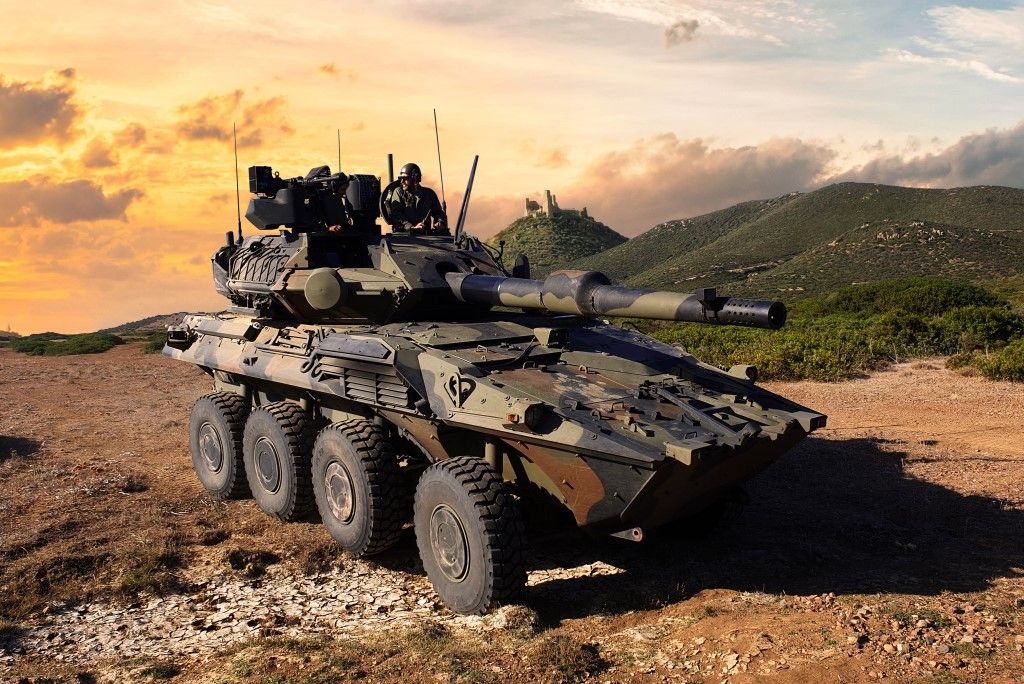
The CIO Centauro II BR is the Brazilian configuration of the Centauro II 8×8 wheeled armored combat vehicle developed in Italy by the Iveco-Oto Melara consortium, now represented by IDV and Leonardo. Brazil selected the vehicle for its VBC CAV-MSR program as a mobile direct-fire system armed with a 120 mm smoothbore cannon.
The Brazilian configuration combines the Centauro II chassis and HITFACT MkII turret with Brazilian-specific protection, communications and loading arrangements. Unlike the Italian configuration described in available sources, the Centauro II BR uses a four-person crew and manual loading of its 120 mm ammunition.
Brazil contracted two initial vehicles for evaluation and later ordered seven production vehicles for doctrinal experimentation. The current program objective is 98 Centauro II vehicles for 14 mechanized cavalry squadrons, with progressive industrial participation in Brazil planned as procurement continues.
Selection and prototypes
The Brazilian Army began a competition in 2021 for a new 8×8 armored combat vehicle. The process involved 55 companies and 28 vehicle models before being reduced to six formal proposals. On October 7, 2022, three finalists were identified: the CIO Centauro II, the General Dynamics Land Systems-Canada LAV 700 AG and the NORINCO ST1/T1-BR. The Centauro II was the only finalist offered with a 120 mm main gun, while the other finalists were configured with 105 mm weapons.
Brazil announced the selection of the Centauro II on November 25, 2022. A contract for two vehicles was signed on December 15, 2022 after a temporary legal delay. Contemporary reporting by EDR Magazine stated that the Brazilian configuration would remain close to the Italian model but would use a different add-on armor package, manual ammunition handling and Brazilian-selected communications equipment.
The two Centauro II BR evaluation vehicles arrived in Brazil on August 17 and September 2, 2024. They subsequently completed evaluation activity in Italy and Brazil covering more than 600 attributes across five phases. The vehicles were approved at the end of 2024.
Testing and production order
Brazilian qualification included live firing at Campo de Instrução de Saicã with 120 mm APFSDS and HEAT ammunition. A decommissioned EE-11 Urutu 6×6 was used as a target. The vehicles also participated in tactical employment during Operação Punhos de Aço 2025 at Santa Maria.
On August 31, 2026, the Brazilian Army signed contracts worth approximately R$420 million with CIO for seven serial-production Centauro II BR vehicles and an associated support package. The seven vehicles form the Lote de Experimentação Doutrinária, or LED, intended to expand evaluation from two qualification vehicles to a unit-sized group for developing organization, crew procedures, maintenance practices and tactical employment.
The order increased Brazil's contracted total to nine vehicles. Delivery of the seven production vehicles is contractually scheduled for completion by October 31, 2028, with the first vehicles expected in early 2028. The associated agreement includes tooling, spare parts, training and first- and second-echelon maintenance support.
The Brazilian requirement originally covered 221 vehicles but the current program objective is 98, including the two prototypes. Procurement is planned through annual lots to equip 14 mechanized cavalry squadrons. Initial vehicles are to be produced in Italy, while local assembly is planned to begin from the fifth lot at IDV's Sete Lagoas facility in Minas Gerais. If the full current procurement plan is completed, the program calls for progressively greater Brazilian industrial participation, technology transfer and nationalized subsystems.
Design
The Centauro II BR is an 8×8 wheeled direct-fire vehicle with a high-hardness monocoque steel hull and modular add-on armor. Its design combines a tank-caliber weapon with road mobility intended for mechanized cavalry operations across widely separated areas.
Armament and fire control
The Brazilian configuration is armed with a manually loaded 120 mm smoothbore cannon. The standard configuration described for the Brazilian vehicles carries 31 rounds. Brazilian qualification has included APFSDS kinetic-energy ammunition and HEAT shaped-charge ammunition.
Secondary armament consists of a coaxial FN MAG58 7.62×51 mm machine gun and a second MAG58 installed on an external pintle. Eight 76 mm smoke-grenade launchers are also fitted. Later Brazilian vehicles may receive the REMAX 4 remotely controlled weapon station with either a 7.62 mm or 12.7 mm weapon.
The commander and gunner have stabilized day and thermal electro-optical sights, laser rangefinding and digital fire control. These systems allow observation, ranging, ballistic calculation and engagement while the vehicle is moving. The Brazilian Army specifies engagement capability at up to 5 km, while Brazilian personnel have also described a useful engagement distance of as much as approximately 4 km compared with roughly 2 km for the older EE-9 Cascavel.
Crew and ammunition arrangement
The Centauro II BR prototypes use a four-person crew. Brazil did not adopt the semi-automatic ammunition loading arrangement associated with the Italian Centauro II configuration, so the main gun is loaded manually. Reserve 120 mm ammunition is separated from occupied crew spaces.
Powertrain and mobility
At close to 30 tonnes, the Centauro II BR is powered by an Iveco Vector V8 diesel engine rated at 525 kW, approximately 720 hp. The engine is connected to a 7HP902 automatic transmission with seven forward gears and one reverse gear.
The vehicle uses an H-drive 8×8 drivetrain, independent hydropneumatic suspension and a central tire-inflation system. Maximum road speed exceeds 105 km/h and road range is approximately 800 km. These characteristics allow mechanized cavalry units to make long road movements without systematically relying on heavy transporters.
Protection and electronic systems
Protection features described for the Brazilian configuration include a high-hardness steel monocoque hull, modular add-on armor, mine and improvised explosive device protection, anti-RC-IED equipment and NBC/CBRN protection. The Brazilian add-on armor package differs from that of the Italian configuration, although available sources do not disclose its protection level.
The Brazilian prototypes combine the fire-control equipment with an L3Harris Falcon III VHF radio, identified in earlier program reporting as the RF-7800V, a Thales SOTAS M3 intercom and the SGB battle management system. Future production vehicles may introduce Brazilian multiband software-defined radios and other progressively nationalized equipment.
Program status
The Centauro II BR remains in a procurement and force-development phase. Two evaluation vehicles have completed qualification activity, while seven serial vehicles are contracted for the LED doctrinal experimentation lot. The seven vehicles are scheduled for delivery by October 31, 2028.
The current objective of 98 vehicles is intended to support 14 mechanized cavalry squadrons. Procurement is expected to proceed through annual lots, and Brazilian authorities have indicated that later lots may be contracted while doctrinal experimentation continues.
Brazilian industrial participation is linked to the continuation of the procurement program. Assembly is planned to move to IDV's Sete Lagoas facility from the fifth lot. Program information also associates Brazilian participation with the HITFACT MkII turret, vehicle components, maintenance capabilities and eventual domestic production of 120 mm ammunition, beginning with training ammunition before expansion to live rounds under a separate arrangement.
Specifications (Centauro II BR)
General characteristics
- Configuration: 8×8 wheeled armored direct-fire vehicle
- Crew: 4
- Combat weight: Close to 30 tonnes
- Engine: Iveco Vector V8 diesel
- Engine power: 525 kW, approximately 720 hp
- Transmission: 7HP902 automatic, seven forward gears and one reverse
- Drivetrain: H-drive 8×8
- Suspension: Independent hydropneumatic
- Tire system: Central tire-inflation system
Performance
- Maximum road speed: More than 105 km/h
- Road range: Approximately 800 km
- Specified engagement capability: Up to 5 km
Armament
- Main armament: Manually loaded 120 mm smoothbore cannon
- Main-gun ammunition: 31 rounds in the described standard configuration
- Tested ammunition types: APFSDS and HEAT
- Coaxial weapon: FN MAG58 7.62×51 mm machine gun
- External weapon: FN MAG58 7.62×51 mm machine gun on pintle mount
- Smoke launchers: Eight 76 mm launchers
- Planned optional weapon station: REMAX 4 with 7.62 mm or 12.7 mm weapon
Related equipment
- Centauro II: Italian baseline vehicle from which the Brazilian Centauro II BR configuration is derived.
- EE-9 Cascavel: Older Brazilian wheeled reconnaissance and direct-fire vehicle that the Centauro II BR procurement is intended to replace progressively in mechanized cavalry service.
 Argentina
 Armenia
 Australia
 Austria
 Austria-Hungary
 Belgium
 Brazil
 United Kingdom
 United States
 Brunei
 Bulgaria
 Canada
 Chile
Chile China
China Colonial America
 Colombia
 Confederate States
 Croatia
 Czech
Czech Denmark
 Egypt
Egypt Finland
 France
 Georgia
 Germany
 German Imperial
 Greece
 Holland
 Hungary
 India
India Indonesia
 Iran
Iran Iraq
Iraq Ireland
 Israel
 Japan
Japan Japan (1940)
 Jordan
 Kingdom of Italy
 Malaysia
 Mexico
 Myanmar
 Nazi Germany
 Netherlands
 New Zealand
 North Korea
 Norway
 Pakistan
 Peru
Peru Philippines
 Poland
 Portugal
 Prussia
 Romania
 Russia
 Saudi Arabia
 Serbia
 Singapore
 Slovakia
 Slovenia
 South Africa
 South Korea
 Soviet Union
 Spain
Spain Sweden
 Switzerland
 Syria
Syria Taiwan
 Thailand
 Turkey
 UAE
UAE Ukraine
 Vietnam
 Yugoslavia