
History
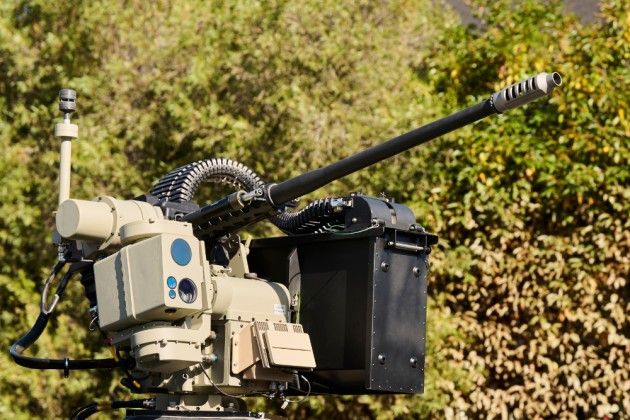
The Electro Optic Systems Slinger is an Australian counter-unmanned-aircraft system built around a remotely operated 30 mm weapon station. It combines a Bushmaster M230LF automatic cannon with radar and electro-optical sensors for detecting, tracking and engaging small aerial targets.
Slinger was introduced in 2023 as a relatively lightweight counter-UAS system intended for integration on several types of vehicle. The original turret weighs about 355 kg and can be installed on platforms ranging from pickup trucks to armored vehicles.
Ukraine became the first confirmed operational recipient. A total of 160 systems were associated with Ukrainian requirements, including installations planned for M113 armored personnel carriers and vehicles integrated by the Ukrainian company Practika.
Development and deliveries
Electro Optic Systems developed Slinger in Australia for counter-UAS engagements. The system was introduced in May 2023. Its design emphasized a comparatively compact remote weapon station that could combine detection sensors, automatic target tracking and a cannon capable of firing specialized ammunition against drones.
In September 2023, plans were disclosed for 160 Slinger systems for Ukraine. Of these, 110 were intended for installation on M113 armored personnel carriers, while another 50 were ordered for integration by Practika on 4x4 protected vehicles.
By October 2023, the first batch had been prepared for shipment to Ukraine. Ten systems from this initial batch were planned for transfer before the end of the year.
By September 2026, Ukrainian military personnel had received Slinger systems and were using them in the counter-drone role. Photographs showed deployed systems in Ukraine, including installations on pickup trucks used by mobile air-defense groups.
Design
Slinger is a remotely controlled weapon station optimized for counter-UAS work. The original system is based on the 30 mm Bushmaster M230LF automatic cannon and incorporates both radar and an electro-optical sighting system. These sensors allow the weapon station to detect and track small aerial targets before engagement.
The turret weighs approximately 355 kg and is about 0.9 m high. Its relatively low mass permits installation on several classes of vehicle. Confirmed integration concepts include pickup trucks, light armored vehicles and armored personnel carriers.
The weapon can elevate to approximately +70 degrees and depress to -10 degrees. An operator controls the station with a joystick from inside the host vehicle. The system can automatically track a selected target while leaving the engagement decision to the operator.
Counter-UAS armament
The original Slinger uses the M230LF 30 mm automatic cannon. Specialized 30 mm ammunition with a radio proximity fuze can be used against aerial targets such as reconnaissance UAVs and one-way attack drones. The documented effective engagement distance is more than 800 m.
Sensors and fire control
Slinger combines radar with an electro-optical sighting system. The sensor package supports target detection and tracking for the remote weapon station, allowing the operator to engage small airborne targets without exposing personnel at the weapon mount.
An enhanced Slinger configuration unveiled in 2025 retained the counter-UAS role but incorporated a 30×113 mm cannon, improved fragmentation ammunition, a day and thermal sight, a four-dimensional electronically scanned radar and assisted target recognition. This later configuration was listed at approximately 376 kg and should not be confused with the 355 kg specification of the original system supplied for Ukrainian requirements.
Operational history
Slinger systems were supplied to Ukraine for use during the Russia-Ukraine war. The equipment was intended to strengthen short-range defenses against small unmanned aircraft, including reconnaissance drones and one-way attack UAVs.
Ukrainian installations include pickup-truck-mounted systems used by mobile fire groups. This arrangement allows the counter-UAS weapon station to be moved rapidly between defensive positions. Slinger was also planned for integration on M113 armored personnel carriers and Practika-built protected vehicles.
By September 2026, deployed systems had been photographed in Ukraine and Ukrainian personnel were confirmed to be using Slinger equipment.
Variants
- Slinger C-UAS: Original Australian counter-UAS remote weapon station introduced in 2023, using the M230LF 30 mm cannon, radar and an electro-optical sensor package.
- Enhanced Slinger: Later configuration unveiled in 2025 with a 30×113 mm cannon, improved fragmentation ammunition, day and thermal optics, a four-dimensional electronically scanned radar and assisted target recognition.
Operators
- Ukraine: Received Slinger counter-UAS systems for operational use. Plans covered 160 systems, including 110 intended for M113 armored personnel carriers and 50 associated with Practika vehicle integration.
Specifications (Slinger C-UAS)
General characteristics
- Type: Counter-UAS remote weapon station
- Manufacturer: Electro Optic Systems
- Turret mass: Approximately 355 kg
- Height: Approximately 0.9 m
- Control: Remote operation by joystick from inside the host vehicle
- Weapon elevation: Up to +70 degrees
- Weapon depression: Down to -10 degrees
Engagement system
- Primary weapon: 30 mm Bushmaster M230LF automatic cannon
- Counter-UAS ammunition: Specialized 30 mm ammunition with radio proximity fuze
- Effective engagement distance: More than 800 m against supported aerial targets
- Sensors: Radar and electro-optical sighting system
- Target tracking: Automatic tracking with operator-controlled engagement
 Argentina
 Armenia
 Austria
 Austria-Hungary
 Belgium
 Brazil
 United Kingdom
 United States
 Brunei
 Bulgaria
 Canada
 Chile
Chile China
China Colonial America
 Colombia
 Confederate States
 Croatia
 Czech
Czech Denmark
 Egypt
Egypt Finland
 France
 Georgia
 Germany
 German Imperial
 Greece
 Holland
 Hungary
 India
India Indonesia
 Iran
Iran Iraq
Iraq Ireland
 Israel
 Italy
Italy Japan
Japan Japan (1940)
 Jordan
 Kingdom of Italy
 Malaysia
 Mexico
 Myanmar
 Nazi Germany
 Netherlands
 New Zealand
 North Korea
 Norway
 Pakistan
 Peru
Peru Philippines
 Poland
 Portugal
 Prussia
 Romania
 Russia
 Saudi Arabia
 Serbia
 Singapore
 Slovakia
 Slovenia
 South Africa
 South Korea
 Soviet Union
 Spain
Spain Sweden
 Switzerland
 Syria
Syria Taiwan
 Thailand
 Turkey
 UAE
UAE Ukraine
 Vietnam
 Yugoslavia