History
The Vulcano family of extended-range artillery projectiles was initiated at Leonardo in 1999 in response to requirements from the Italian Navy (Marina Militare) and the Royal Netherlands Navy. The 155 mm variant for land-based artillery was developed subsequently in cooperation with Diehl Defence and was declared combat-ready in 2019. The name derives from the Italian island of Vulcano, which in Roman mythology was considered the forge of the god Vulcanus. The family is available in 76 mm, 120 mm, 127 mm, and 155 mm calibres; the 155 mm projectiles are produced in an unguided BER (Ballistic Extended Range) variant and a guided GLR (Guided Long Range) variant. Both use a sub-calibre design that extends range without a rocket motor. The 155 mm GLR was jointly developed by Italy and Germany for integration into the German PzH 2000 self-propelled howitzer and was also tested with the French CAESAR truck-mounted howitzer.
In 2022, Germany announced the purchase of 255 Vulcano projectiles for Ukraine; the first batch was delivered to Ukrainian forces in March 2023. In October 2026, Ukraine's Ministry of Defence signed three memoranda of understanding with Diehl Defence covering IRIS-T air defence systems, missiles, and precision-guided artillery ammunition, the last of which may provide for the purchase of Vulcano projectiles. A defence-industry source estimated that, under favourable conditions, the first batch of several hundred projectiles could be delivered by the end of 2026.
Specifications
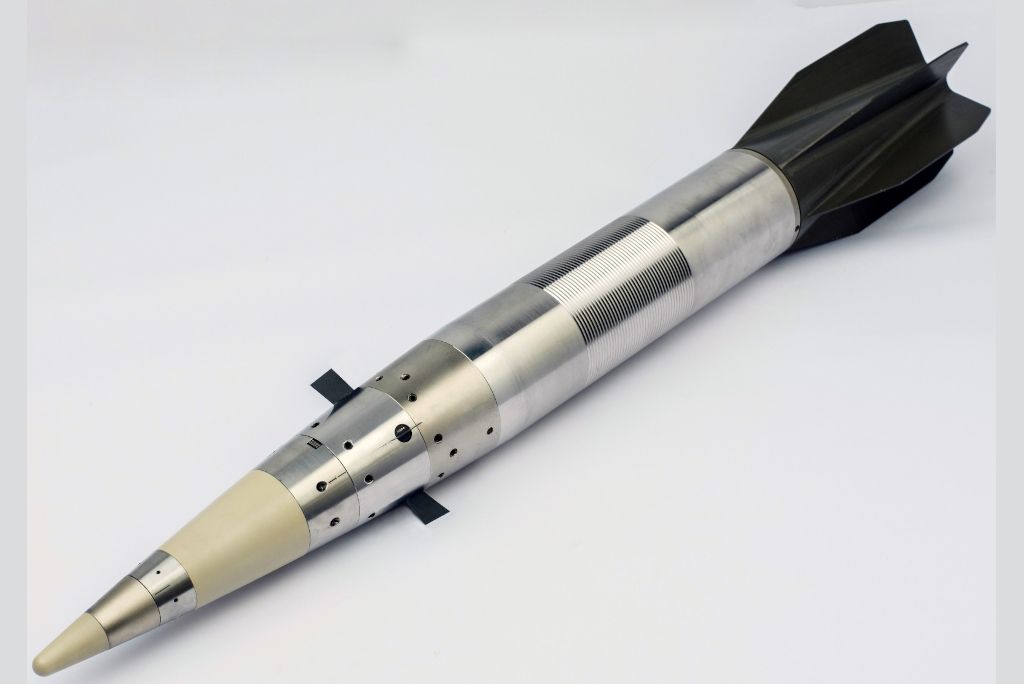
The Vulcano 155 GLR has a length of 950 mm and a mass of approximately 36 kg. The warhead contains approximately 7.5 kg of explosive in the unguided BER variant; the guided GLR variant carries approximately 30 percent less. Tungsten fragmentation elements are distributed around the casing for additional target damage. The projectile is externally compatible with in-service NATO propelling charges and 155 mm barrels, and the manufacturer states that firing Vulcano GLR does not affect barrel life.
With 52-calibre barrels such as the PzH 2000 and RCH 155, the GLR variant reaches a range of approximately up to 70 km; with 39-calibre systems such as the M777, the range is up to 55 km. Other published data cite a maximum range of up to 80 km for the 155 mm Vulcano. The circular error probable (CEP) is stated as no more than 5 m under pre-programmed coordinate guidance, decreasing to 3 m in semi-active laser guidance mode; manufacturer materials also cite approximately 1 m precision in laser target-search mode. A general CEP of 5 to 20 m applies to GNSS-guided flight regardless of range, provided the GNSS signal is not jammed. A special fire-control device is used to programme the projectile before launch. In flight, an inertial measurement unit corrects dispersion after leaving the barrel, and once the projectile passes apogee, GNSS position data are compared with the target coordinates; the projectile then departs the ballistic trajectory and steers via control surfaces, using extended tail fins to sustain a glide phase to the target.
Operational history
The first combat use of Vulcano 155 projectiles occurred during the Russian invasion of Ukraine. According to Ukrainian reports, Ukrainian forces employed the projectiles with the AHS Krab self-propelled howitzer, achieving reported firing distances of approximately 70 km. Video footage also recorded the use of the unguided Vulcano 155 BER variant with a German PzH 2000 operating in the 43rd Artillery Brigade.
 Argentina
 Armenia
 Australia
 Austria
 Austria-Hungary
 Belgium
 Brazil
 United Kingdom
 United States
 Brunei
 Bulgaria
 Canada
 Chile
Chile China
China Colonial America
 Colombia
 Confederate States
 Croatia
 Czech
Czech Denmark
 Egypt
Egypt Finland
 France
 Georgia
 Germany
 German Imperial
 Greece
 Holland
 Hungary
 India
India Indonesia
 Iran
Iran Iraq
Iraq Ireland
 Israel
 Italy
Italy Japan
Japan Japan (1940)
 Jordan
 Kingdom of Italy
 Malaysia
 Mexico
 Myanmar
 Nazi Germany
 Netherlands
 New Zealand
 North Korea
 Norway
 Pakistan
 Peru
Peru Philippines
 Poland
 Portugal
 Prussia
 Romania
 Russia
 Saudi Arabia
 Serbia
 Singapore
 Slovakia
 Slovenia
 South Africa
 South Korea
 Soviet Union
 Spain
Spain Sweden
 Switzerland
 Syria
Syria Taiwan
 Thailand
 Turkey
 UAE
UAE Ukraine
 Vietnam
 Yugoslavia