
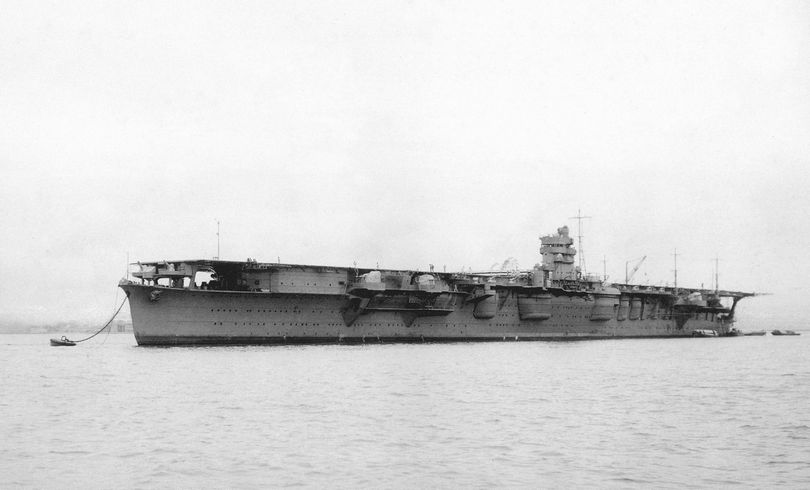
IJN Dragon Story
The aircraft carrier made its combat debut during World War I (1914-1918), but its real impact was not felt until World War II (1939-1945). On the eve of World War II, various aircraft carrier designs were developed, sometimes constrained by various naval treaties after World War I, while other times, designs took an entirely new approach, demonstrating greater displacement and aircraft carrying capacity ability. Regardless, aircraft carriers are sure to quickly become the mainstay of naval firepower, especially as naval aircraft designs begin to match or surpass land-based aircraft.
By the end of World War II, aircraft carriers would replace the mighty battleships as kings of the seaswith lethality and tactical value rivaled only by the postwar nuclear-powered ballistic missile submarines.
IJN Hiryu was originally built to the same design as her sister IJN Soryu (described in detail elsewhere on this page), but was heavily modified with a longer hull, wider beams, larger displacement and increased forecastle section , you become your own "unique" class. Construction on the Yokosuka Naval Arsenal began on July 8, 1936, which led to her launching on November 16, 1937. She officially commissioned the IJN on July 5, 1939.
Her translation name is "Flying Dragon".
Upon completion, Hiryu drained 17,300 long tons under standard load, with an overall length of 746 feet, a beam of 73.1 feet, and a draft of up to 25.6 feet. Power comes from 8 x Kampon water tube boiler units with 4 x geared steam turbines producing 153,000 shaft horsepower on 4 x shafts. Top speed (under ideal conditions) is 34 knots, with a range of 10,330 miles at 18 knots steam. Her crew totaled 1,100 men, with armor protection reaching 6 inches at the waterline and more than 2 inches along the deck. Her onboard load and supply space allows up to 64 fighters to be transported, and up to 9 or 10 spare airframes can be retained.
Supported aircraft types include Mitsubishi A6M fighter jets, Aichi D3A dive bombers, and Nakajima B5N torpedo bombers giving the warship a broad tactical range against many target types, including land-based, incoming air threats and enemy warships.
In general, her profile was consistent with the design of the time - perhaps with the exception of her exposed and raised port island layout - pre-war designs usually had the upper deck cleared to allow for complete unobstructed access Landing/Taking off. The ground surface of a fighter jet.
Her hull looks much like part of a traditional cruiser, but the flight deck eliminates the irregular silhouette. Three hangar lifts were used to move the aircraft, and nine lightning conductors were strung on the flight deck to recover the aircraft.
This weapon, although primarily defensive, is led by the 6 x 127mm twin-gun Type 89 Dual Purpose (DP) gun. She also carries 7 triple Type 96 25mm anti-aircraft guns and 5 twin guns x 25mm turrets for close range defense.
With this artillery array, the Dragon was easily defended when WWII battleships were driven back - especially the all-important aircraft carriers.
During her career, Hiryu participated in the Japanese surprise attack on Pearl Harbor, Hawaii (1941), which marked the entry of the United States into the war, and the Battle of Wake Island (December 1941), which marked the 1942 Dutch The East Indies campaign included raids on Darwin, Australia and Indian Ocean raids. Her most high-profile post-pearl action was the Battle of Midway (June 1942), which was finally over - she took off planes from USS Enterprise, USS Hornet and USS Yorktown The bomb sank on June 5. The American victory at Midway marked the first turning point in the Pacific War against Imperial Japan, a battle that marked the loss of four large IJN aircraft carriers.
As a result of these losses, the Japanese Navy developed a 16-man aircraft carrier program to compensate for the losses. These are further modified versions based on Hiryu. However, only three were drafted in time for the war, which ended with Japan's surrender in August 1945.
Specification
Basic
Roles
- Aircraft/Sea Support
- Blue Water Operations
- Fleet Support
- Hunter
- direct attack
Dimensions
728.4 ft (222.02 m)
73.1 ft (22.28 m)
25.4 ft (7.74 m)
Weight
17,300 tons
Performance
Performance
35 kn (40 mph)
7,670 nautical miles (8,826 mi; 14,204 km)
Armor
12 x 5" (127 mm) Type 89 Dual Purpose (DP) gun in twin turrets.
31 x 25mm anti-aircraft guns (AA) in seven three-gun turrets and five two-gun turrets.
Wing
64 fighter jets of various types, including fighter jets, torpedo bombers and dive bombers. Typical loads are Mitsubishi A6M, Nakajima B5N and Aichi D3A aircraft. About nine additional airframes were carried as spares.
 Argentina
 Armenia
 Australia
 Austria
 Austria-Hungary
 Belgium
 Brazil
 United Kingdom
 United States
 Brunei
 Bulgaria
 Canada
 Chile
Chile China
China Colonial America
 Colombia
 Confederate States
 Croatia
 Czech
Czech Denmark
 Egypt
Egypt Finland
 France
 Georgia
 Germany
 German Imperial
 Greece
 Holland
 Hungary
 India
India Indonesia
 Iran
Iran Iraq
Iraq Ireland
 Israel
 Italy
Italy Japan
Japan Jordan
 Kingdom of Italy
 Malaysia
 Mexico
 Myanmar
 Nazi Germany
 Netherlands
 New Zealand
 North Korea
 Norway
 Pakistan
 Peru
Peru Philippines
 Poland
 Portugal
 Prussia
 Romania
 Russia
 Saudi Arabia
 Serbia
 Singapore
 Slovakia
 Slovenia
 South Africa
 South Korea
 Soviet Union
 Spain
Spain Sweden
 Switzerland
 Syria
Syria Taiwan
 Thailand
 Turkey
 UAE
UAE Ukraine
 Vietnam
 Yugoslavia