
History
At the time of their completion, the I-400-class submarines in service with the Imperial Japanese Navy were the largest submarines built during World War II. Unique to her design was the ability to accommodate three seaplanes, launch and recovery aircraft, which were kept in pressurized hangars for reconnaissance and limited bombardment. In addition to using these aircraft, the I-400's submarine attack capabilities were also intact, meaning the large submarine could still "hunt" allied surface ships after launching the aircraft. Of the 18 I-400-class ships planned starting in 1943, only three were completed, and none were commissioned by the end of the wareach living a rather shady life, to say the least.
The first I-400 submarine was commissioned in 1944 and the last in 1945. Construction lasted from January 1943 to July 1945. The Japanese Empire's war ended in August 1945, and its wartime capabilities were quickly exhausted.
Frustrated at their inability to hit US targets on US soil. The Japanese also faced a reduction in the combat range due to the Allied gains. The IJN authorities (led by Admiral Yamamoto himself) came up with the idea of ??a "submarine aircraft carrier".
The idea was to build a submarine big enough to hold two seaplanes, which could then be transported underwater (and undetected) to a range of targets on the US coast. These planes could then be released and sent to bomb those targets or scout the area before other Japanese attack.
The ship had to be designed to last long in rough seas and be able to get anywhere in the world on its own. The idea would bring war directly into American cities and interestsa prospect that has seemed unrealistic since Pearl Harbor in December 1941.
Japanese authorities face a direct blow to key interests such as U.S. shipyards, refineries, cities and the Panama Canal, which supplies the U.S. Navy with new warships, submarines and supplies from its east coast.
The ships entered Pacific waters through the English Channel, then docked at ports on the U.S. west coast, before reaching Hawaii and beyond.
1942 Design work on this new type of ship officially began in early 1943. Kure, Hiroshima and Sasebo's shipyards were designated to build large submarines. Initially, 18 such ships were planned. However, the order was cut in half due to rising IJN casualties (Yamamoto himself was killed on a voyage to the Solomon Islands), shortages of war materiel, and waning interest in the project itself.
Then it went from 9 orders to 5, of which only three were ever completed, available in the form. The three were designated I-400 (lead ship of the class) and sisters I-401 and I-402.
The I-400 class is forged into a massive submarine designed for the rigors of high seas sailing and diving to depths of 328 feet. As a result, the ship was highly pressurized, including the integral hangar needed to accommodate seaplanes.
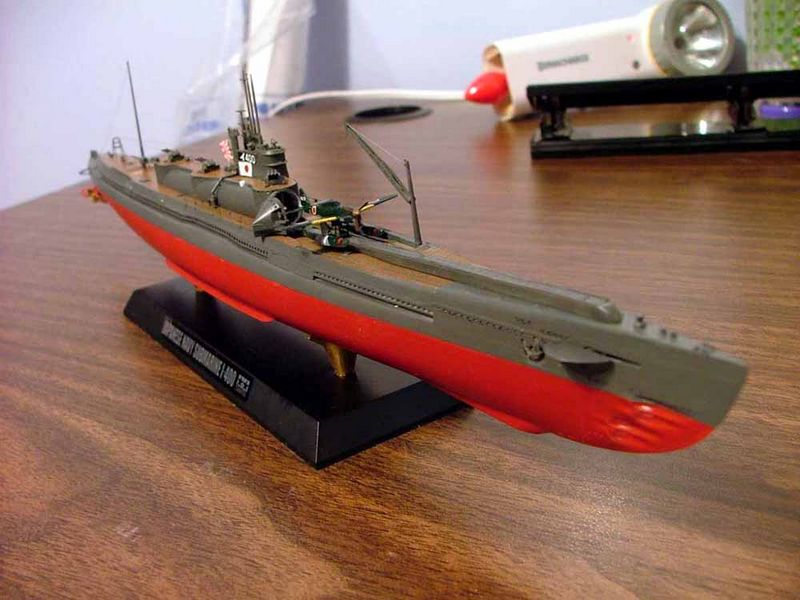
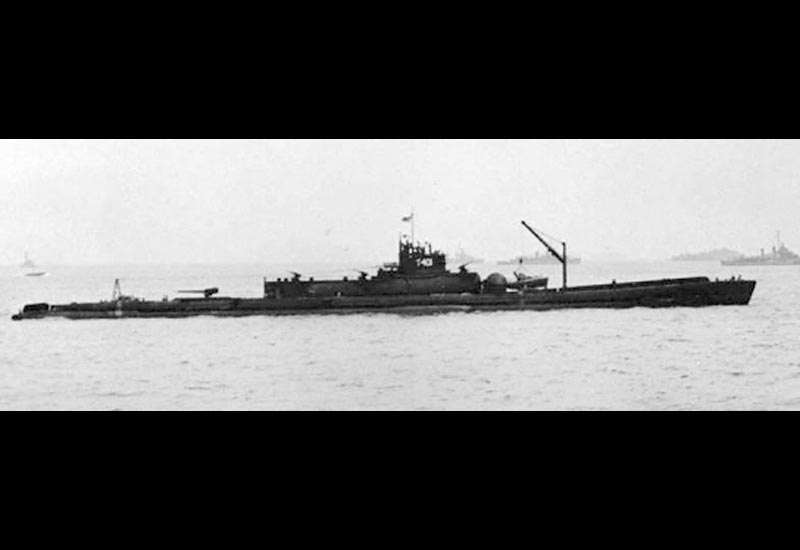
While the original plan called for two of these aircraft, the I-400 class was designed for three - these are the Aichi M6A1 "Seiran" series seaplanes. Externally, this submarine has a rather conventional appearance, with a smooth profile from bow to stern. With the exception of the upper fairing, it is traditionally cylindrical, traditionally kept flat, as a convenient platform for the vessel to surface. The propeller system is located at the rear of the boat and is powered by four diesel engines when surfaced and two powerful electric motors when underwater. The engine is connected to a gearbox that drives a pair of propeller shafts.
At the end of the boat is an oar for turning.
The design resulted in a barrel length of nearly 400 feet, with a beam wide enough to accommodate the desired aircraft over 39 feet. The I-400 has a draft of 23 feet and a displacement of 6,500 tons.
The pressurized hangers are installed amidships and require the bridge superstructure to be moved from the centreline to port. The hangar can be accessed from the ship itself or from outside along the deck.
The foredeck is dominated by the catapult launch system, which extends from the bridge superstructure to the bow and slopes slightly upwards to facilitate short-range launches of seaplanes. A foldable crane arm has also been installed in front of the bridge to be used to recover the seaplane if necessary.
The I-400 was defended by 1 x 140 mm (5.5 in) deck gun and 4 x 25 mm Type 96 anti-aircraft guns. Mounted guns are placed behind the actual turret along the build platform. The remaining triple 25mm guns were mounted in front of the turret along the same platform. A single 25mm gun was mounted on a pedestal aft of the bridge. The network is designed to repel all low-flying aircraft.
Seaplanes provided their own ammunition supply in the form of conventional bombs and torpedoes. The I-400 also retains the characteristics of an attack submarine, equipped with 8 x 533mm torpedo tubes, all pointed to the bow, and loaded with 20 torpedo reloads, designed to counter Allied surface ships.
Her uniqueness in design also required a different approach to her hull structure. Rather than a basic cylindrical section shape, the I-400 stage is completed with a horizontally adjusted "figure-eight" section (viewed from the front), which requires its generous construction and pressure to withstand its intended operating depth.
The vessel also uses typical U-boat installations such as day and night periscopes (originated in Germany), radar warning receivers and aircraft/surface vessel detection radars.
Performance specifications for the I-400 class include a maximum surface speed of 19 knots and a subsea speed of 7 knots. Japanese submarines always fell short of the latter category, never matching their contemporaries elsewhere. The range on the water is an impressive 4,350 miles, although when underwater the battery is significantly reduced to just 68 miles.
Like other diesel-electric submarines of the time, the I-400 had to surface to charge and supply its batteries with oxygen - making this the most vulnerable period for the ship and crew. A fixed snorkel allows the vessel to perform covert shore work below the waterline at periscope depth, while also recharging the battery.
Despite their ambitious designs, the I-400 class was never of little value to the Japanese Empire, which was soon discovered by the war. The three completed ships were never commissioned, although two were commissioned.
I-400 was built by Wu Naval Arsenal, laid on January 18, 1943, launched on January 18, 1944, and officially completed on December 30, 1944. She was subsequently captured by the USS Blue on August 19, 1945.
I-401 was built by the Sasebo Naval Arsenal, laid on April 26, 1943, launched March 11, 1944, and completed January 8, 1945. She was subsequently captured by USS Segundo on August 29, 1945. [ /p]
I-402 was built by the Sasebo Naval Arsenal, laid on October 20, 1943, launched on September 5, 1944, and completed on July 24, 1945. Not officially commissioned, she was eventually converted from a submarine aircraft carrier to a submarine tanker support ship.
She officially retired on November 15, 1945.
I-400 and I-401 were moved by Americans to the Hawaiian Islands to study and eventually sank off the coast of Oahu on June 4, 1946 - I-400 and I-401 respectively preceded her on June 31 sink. , 1946. I-402 sank off the coast of the Goto Islands off Japan on April 1, 1946.
All of this was done after the Allies inspected their technology to avoid having Soviet engineers do their own first-hand assessment.
I-403, I-406, I-407, I-408, and I-409 were all cancelled in October 1943. When Allied bombing damaged I-404 beyond repair, I-404 was about 95% complete. She was then sunk and scrapped after the war in 1952.
Construction of I-405 began, but the effort came to a complete halt sometime in 1944, before she herself was eventually scrapped in 1945.
Thus, the success of the I-400 class in its intended role is left to the reader's imagination.
Specification
Basic
Roles
- Aircraft/Sea Support
- Blue Water Operations
- Fleet Support
- Hunter
- direct attack
Dimensions
400 feet (121.92 m)
39.4 ft (12.01 m)
23 feet (7.01 m)
Weight
6,670 tons
Performance
Performance
19 kn (22 mph)
12 knots (13.81 miles)
Armor
8 x 533mm torpedo tubes (bow side)
1 x 140 mm /40 caliber deck gun
3 x 25mm anti-aircraft triple guns
1 x 25mm single anti-aircraft gun
Wing
3 x Aichi M6A1 Seiran Retrievable Seaplane.
 Argentina
 Armenia
 Australia
 Austria
 Austria-Hungary
 Belgium
 Brazil
 United Kingdom
 United States
 Brunei
 Bulgaria
 Canada
 Chile
Chile China
China Colonial America
 Colombia
 Confederate States
 Croatia
 Czech
Czech Denmark
 Egypt
Egypt Finland
 France
 Georgia
 Germany
 German Imperial
 Greece
 Holland
 Hungary
 India
India Indonesia
 Iran
Iran Iraq
Iraq Ireland
 Israel
 Italy
Italy Japan
Japan Jordan
 Kingdom of Italy
 Malaysia
 Mexico
 Myanmar
 Nazi Germany
 Netherlands
 New Zealand
 North Korea
 Norway
 Pakistan
 Peru
Peru Philippines
 Poland
 Portugal
 Prussia
 Romania
 Russia
 Saudi Arabia
 Serbia
 Singapore
 Slovakia
 Slovenia
 South Africa
 South Korea
 Soviet Union
 Spain
Spain Sweden
 Switzerland
 Syria
Syria Taiwan
 Thailand
 Turkey
 UAE
UAE Ukraine
 Vietnam
 Yugoslavia