
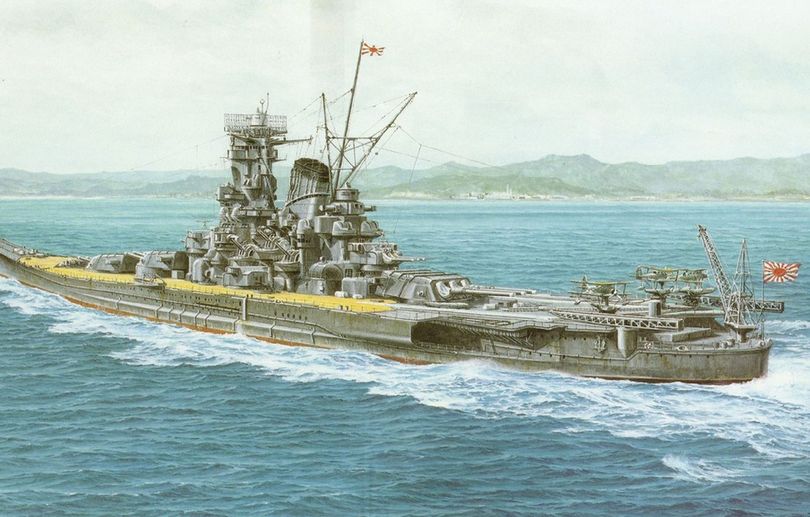
IJN Musashi Story
Japan's expansion in the Pacific required a powerful Imperial Japanese Navy to command a large naval force before and throughout World War II (1939-1945). Knowing that the service cannot compete quantitatively with the U.S. Navya major threat to its dreams of expansion in the regionthe Japanese Navy pursues a policy of quality over quantity.
This led to the design and development of a new surface fighter that would eventually lead to the Japanese Navy having the most powerful battleship in the world, the Yamato-class.
Background
Both ships were built to strictly confidential standards as Imperial Japan still signed naval treaties after World War I (1914-1918). The treaties largely restricted participants to ships of limited tonnage in an effort to prevent another naval arms race similar to the one that preceded World War I. Work on the Yamato class began as early as 1934, and the engineers were challenged to build a battleship that was unrivaled at the time - with powerful main guns, clever use of armor plates for protection, and unrivaled performance in pursuit of excellence.
In this way, the originally planned five mighty warships will be able to cross the Pacific Empire without any scruples, outflanking and defeating any opponent who dares to stand in the way.
In addition to the technical challenges of developing these steel beasts, there are also political challenges. These treaties are designed to make this kind of thinking difficult, but if the participants don't care about the consequences of a breach, the agreements are meaningless in the first place. Beyond that, however, the task of building such a large warship is to do so without drawing the attention (and the ensuing anger) of the US and UK, both of whom have a keen interest in their respective assets in the Pacific. There are plans to deny or delay ratification of the forthcoming 1936 Naval Treaty to give the Japanese navy enough time to build large ships in response to the expiration of tonnage limits in 1940.
The IJN also believes that the Americans will have to commit to widening and deepening the Panama Canal into Pacific waters in order to try to match such warships and build similar types of warships at their famous East Coast shipyards - which seems to be the case in this way. Not too possible.
Of the five planned Yamato ships, only three were eventually named - the main ship Yamato and sister ships Musashi and Shinano. The last two were cancelled, the first was completed in 1942, about 30% complete, and the second was still in the planning stages.
Notably, the Shinano was converted into an aircraft carrier to compensate for the loss of the Japanese Navy's aircraft carrier fleet. None of the active battleships Yamato survived (Yamato was killed in Operation Ten in 1945, Musashi was sunk in the Sibuyan Sea in 1944, and the aircraft carrier Shinano was hit by a U.S. submarine in 1944 Shen).
In 1937, Imperial Japan drew up a third reinforcement plan aimed at strengthening the fleet as it headed toward the inevitable war with the United States. Yamato was built by Wu Naval Arsenal in November 1937 and launched in August 1940. She entered service in December 1941. Her sister IJN Musashi (the subject of this article) was formulated by Mitsubishi Heavy Industries in Nagasaki in March 1938 and launched on November 1, 1940.
Officially commissioned on August 5, 1942.
Musashi Walking Tour
Upon completion, IJN Musashi displaces 65,000 tons under standard load and a whopping 72,810 tons under full load. She has an overall length of 800.5 feet, a beam of 121 feet, and a draft of up to 35.7 feet. Power comes from 12 x Kanpon water tube boilers feeding 4 x 150,000hp steam turbines on 4 x shafts below the stern. This gives the vessel a top speed of 27.5 knots and a range of up to 7,200 nautical miles.
There are 2,500 crew members on board. Two catapults powered six or seven Nakajima seaplanes, which could be recovered with onboard cranes. Also carried a Type 21 air search radar and a Type 0 hydrophone system.
Weapons and Armor
The armament became a 9 x 460 mm (18 in) Type 94 main gun arranged in three three-armed turrets. These are supported by 12 x 155 mm (6 in) Year 3 Dual Purpose (DP) auxiliary guns mounted in four triple gun turrets.
The 12 x 127mm Type 89 guns were housed in 6 twin gun turrets, providing a heavy blow to attacking enemy aircraft, and the 36 x 25mm Type 96 guns were housed in 12 triple gun emplacements for similar reasons. The weapon is armed with two or more heavy 13.2mm Type 93 machine guns for close range defense against air targets.
Armor protection includes 15.7 inches at waterline, 9.1 inches at deck, 25.6 inches at turret, 22 inches at turret, 19.7 inches at command turret, and 13.4 inches at bulkhead thick.
IJN Musashi and her sister are fast, well-armored, and fully armed, just what the IJN authorities envisioned. After commissioning in August 1942, the warship joined Yamato, Nagato and Mutsu as part of the 1st Battleship Division.
The end of Musashi
Musashi's role in World War II came to an abrupt end at the Battle of Leyte Gulf. The battle involved IJN forces fighting the Australian and US navies for control of Leyte Gulf and the Philippines. Outnumbered, the IJN forces suffered a crushing defeat in this crucial Allied war victory.
Musashi, Yamato, and Nagato were part of Lieutenant General Kurita's Force-A Task Force in the melee. In the ensuing Japanese retreat, the Musashi was one of the victims of the attack on U.S. Navy aircraft - directly sunk by approximately 19 torpedoes and another 17 aerial bombs (the entire estimated total). The warship entered the water, hit the bow and sank. It was sent to the locker of Davy Jones, and her crew abandoned the ship after the battle.
The ship sank in more than 4,400 feet of water and 1,376 of its 2,399 crew members were rescued. Her remains were not found and identified by U.S. researchers until March 2015.
Specification
Basic
Roles
- Blue Water Operations
- Fleet Support
- Hunter
- direct attack
Dimensions
800.5 ft (243.99 m)
121 feet (36.88 m)
35.7 ft (10.88 m)
Weight
65,000 tons
Performance
Performance
28 kn (32 mph)
7,212 nautical miles (8,300 mi; 13,358 km)
Armor
9 x 460 mm Type 94 guns, three triple turrets.
12 x 155 mm 3rd Year secondary guns, mounted in four three-armed turrets.
12 x 127 mm Type 89 gun, six turrets and two guns.
36 x 25 mm Type 96 anti-aircraft (AA) automatic cannon in 12 three-arm positions.
4 x 13.2mm Type 93 AA heavy machine guns.
Wing
Up yo 7 x Nakajima E4N or Nakajima E8N Retrievable Seaplane.
 Argentina
 Armenia
 Australia
 Austria
 Austria-Hungary
 Belgium
 Brazil
 United Kingdom
 United States
 Brunei
 Bulgaria
 Canada
 Chile
Chile China
China Colonial America
 Colombia
 Confederate States
 Croatia
 Czech
Czech Denmark
 Egypt
Egypt Finland
 France
 Georgia
 Germany
 German Imperial
 Greece
 Holland
 Hungary
 India
India Indonesia
 Iran
Iran Iraq
Iraq Ireland
 Israel
 Italy
Italy Japan
Japan Jordan
 Kingdom of Italy
 Malaysia
 Mexico
 Myanmar
 Nazi Germany
 Netherlands
 New Zealand
 North Korea
 Norway
 Pakistan
 Peru
Peru Philippines
 Poland
 Portugal
 Prussia
 Romania
 Russia
 Saudi Arabia
 Serbia
 Singapore
 Slovakia
 Slovenia
 South Africa
 South Korea
 Soviet Union
 Spain
Spain Sweden
 Switzerland
 Syria
Syria Taiwan
 Thailand
 Turkey
 UAE
UAE Ukraine
 Vietnam
 Yugoslavia