



History
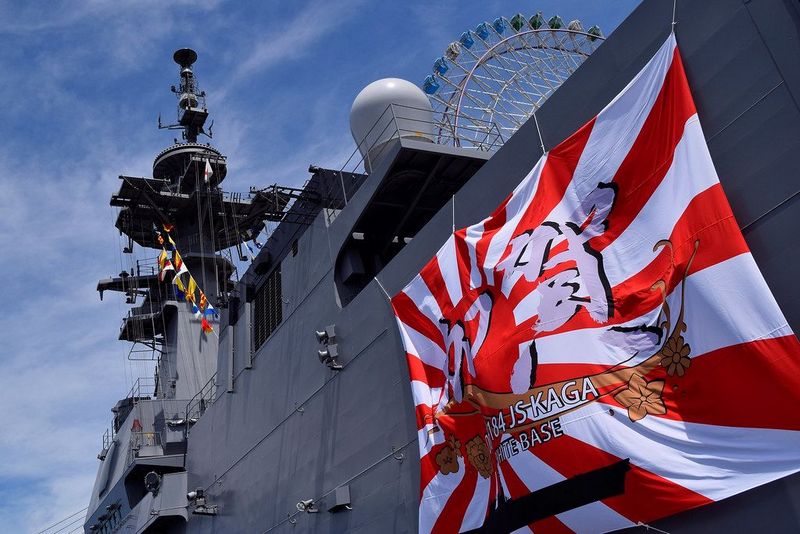
The modern Japan Maritime Self-Defense Force (JMSDF) uses two equally modern conventionally powered helicopter carriers, built to Izumo-class standards. These are JS Izumo (DDH-183) and JS Kaga (DDH-184).
Both are designed to operate up to 28 aircraft, typically deploying 9 helicopters, with dedicated mission equipment for anti-submarine warfare (ASW) and search and rescue (SAR) missions. Both are in service at the time of writing.
This class was developed at the turn of the century to provide naval service with regional deterrence in the face of the rise of neighboring China and the continued belligerence of North Korea. Construction spanned from 2012 to 2017, and Kaga's keel was laid on October 7, 2013 at Kure Shipyard in Hiroshima by builder Nippon Marine United.
The ship was launched on August 27, 2015 and officially commissioned on March 22, 2017.
The pair represent the largest surface combatants available to the Japan Maritime Self-Defense Force. Kaga was named after the aircraft carrier Kaga of World War II (1939-1945). The ship launched the plane toward the U.S. port of Pearl Harbor, Hawaii, on December 7, 1941.
In June 1942, the aircraft carrier was sunk in the Battle of Midway, and the Americans got their revenge.
The Kaga has an empty displacement of 21,500 tons (US short) and a full-load displacement of 27,800 tons. The bow to stern measures 814 feet, the beam is 125 feet, and the draft is 25 feet.
Internally, power is provided by a combined gas and gas unit (COGAG), allowing the vessel to achieve straight ahead speeds in excess of 30 knots in ideal conditions. Propulsion consists of 4 IHI (General Electric) LM2500IEC marine gas turbines driving 2 shafts under the stern.
Kaga carries the OYQ-12 Combat Control System and the FCS-3 Series OPS-50 Active Radar, Electronically Scanned Array (AESA) and Fire Control System (FCS). The OPS-28 unit acts as a surface search radar, and the OQQ-23 is a bow-mounted sonar. NOLQ-3D-1 is an installed electronic warfare (EW) kit.
Also on board are Mark 36 SRBOC decoys, "Floating Acoustic Jammers" (FAJs) and Anti-torpedo maneuver decoys (MODs).
The weapon is purely self-defense in nature and consists of 2 SeaRAMs and 2 20mm Phalanx Close-In Weapon Systems (CIWS). SeaRAM is a further development of Phalanx, carrying an 11-cell surface-to-air missile (SAM) package.
The shape of the boat is traditional, the island layout is skewed to starboard. This leaves port, stern and bow sections free of obstructions, facilitating the launch and recovery of medium lift helicopters. The flight deck can support up to five active helicopters simultaneously (in-line).
The internal structure of the aircraft carrier enables it to provide continuous support for offshore amphibious operations: up to 50 military trucks (or the equivalent in armored Deploy a beach meet (landing craft) nearby. In addition, the ship can perform its designated anti-submarine warfare and search and rescue missions as needed, and participate in humanitarian and deterrence operations.
Kaga and their sister Izumo are key figures in the battle with China for control of the strategic waterway in the South China Sea.
Specification
Basic
Roles
- Aircraft/Sea Support
- Blue Water Operations
- Fleet Support
- Hunter
- direct attack
Dimensions
815 feet (248.41 m)
125 feet (38.10 m)
25 feet (7.62 m)
Weight
20,000 tons
Performance
Performance
32 kts (37 mph)
ARMAMENT
2 x SeaRAM Close-In Weapon Systems (CIWSs).
2 x 20mm Phalanx CIWSs.
AIR WING
Up to 28 total aircraft. 9 x Navy helicopters outfitted for the Anti-Submarine Warfare (ASW) and Search And Rescue (SAR) roles has been typical.
 Argentina
 Armenia
 Australia
 Austria
 Austria-Hungary
 Belgium
 Brazil
 United Kingdom
 United States
 Brunei
 Bulgaria
 Canada
 Chile
Chile China
China Colonial America
 Colombia
 Confederate States
 Croatia
 Czech
Czech Denmark
 Egypt
Egypt Finland
 France
 Georgia
 Germany
 German Imperial
 Greece
 Holland
 Hungary
 India
India Indonesia
 Iran
Iran Iraq
Iraq Ireland
 Israel
 Italy
Italy Japan (1940)
 Jordan
 Kingdom of Italy
 Malaysia
 Mexico
 Myanmar
 Nazi Germany
 Netherlands
 New Zealand
 North Korea
 Norway
 Pakistan
 Peru
Peru Philippines
 Poland
 Portugal
 Prussia
 Romania
 Russia
 Saudi Arabia
 Serbia
 Singapore
 Slovakia
 Slovenia
 South Africa
 South Korea
 Soviet Union
 Spain
Spain Sweden
 Switzerland
 Syria
Syria Taiwan
 Thailand
 Turkey
 UAE
UAE Ukraine
 Vietnam
 Yugoslavia