
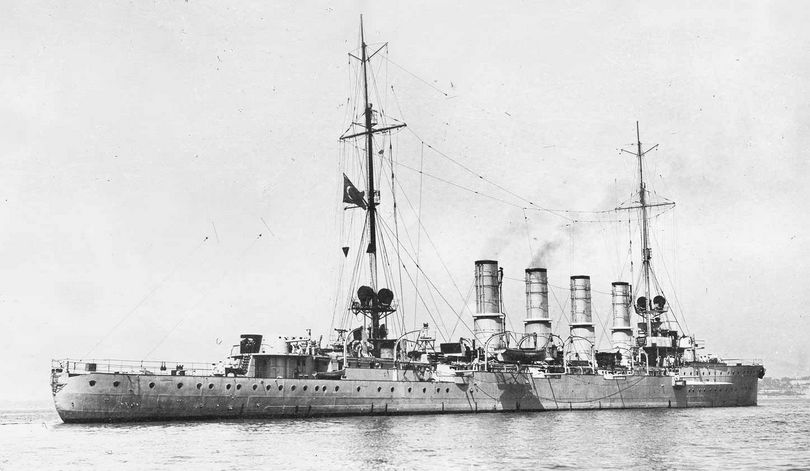
SMS Wroclaw (Midilli) History
Before the First World War (1914-1918), the German Empire engaged in a naval arms race with Great Britain. This includes increasing the naval budget and completing a canal through Kiel, giving the country access to the North Sea.
Work began in 1910 on a new four-person class of light cruisers, known as the Magdeburg class. This group eventually includes SMS Magdeburg itself and the sister companies SMS Breslau, SMS Stra?burg and SMS Stralsund.
SMS Breslau was built by A.G. Vulcan and laid in 1910. She was launched on May 16, 1911, and officially commissioned on May 10, 1912. SMS Breslau was named after the then German city of Breslau (now Breslau, Poland) and served under the Ottoman flag until early 1918.
SMS Breslau was built with a displacement of 4,570 tons (short), a length of 455 feet, a beam of 44.2 feet, and a draft of 14.4 feet. Power comes from 16 water tube boilers feeding 2 25,000 hp AEG Vulcan steam turbines on 2 shafts. The vessel can sail at speeds in excess of 27 knots and has a range of up to 5,820 nautical miles. There are 336 crew members and 18 officers on board.
Armor protection ranges from 2.4 inches on the conveyor belt to 3.9 inches on the conning tower.
Their initial weapons plan featured a 12 x 10.5 cm (105 mm) SK L/45 main gun supported by 2 x 500 mm torpedo tubes. She also carried around 120 mines for laying mines.
Her first post was assigned to Mediterranean waters in response to two Balkan wars fought by several factions. Both Germany and Austria-Hungary became interested in the outcome of these wars, which began to rewrite the geographic and political landscape of Europe and bring the continent closer to war.
From there, World War I broke out in the summer of 1914, and Breslau continued to fight in the theater, i.e. to prevent any French naval movement between North Africa (Algeria) and the French mainland. On 3 August 1914, the warship together with SMS Goeben shelled Bone and Philippeville, although little damage was reported.
From there, the pair were chased by British warships and forced to seek relative safety in Ottoman waters. In order to influence the Ottoman Empire to join the war on the Allied side, both SMS Breslau and SMS Goben were placed in service with the Ottoman Navy, when they were renamed "Midilli" and "Yavuz Sultan Selim" respectively.
During their service in the Ottoman Navy, these two powerful cruisers were accused of taking action against the Russian Empire in the Black Sea. The ships performed a variety of offensive missions, some of which involved mining strategically important waterways, such as the mouth of the Danube. By the end of 1916, the Ottoman Navy lacked the necessary coal reserves to keep the two warships active, thus reducing offensive engagements. In 1917, the warship lost four 150mm main guns.
Finally, in May 1917, the dismantling of the Danube Estuary by the Midili required a Russian destroyer. The last recorded action by warships and Russians was in June 1917.
In the Battle of Imbros on January 20, 1918, combined Turkish and German forces faced off against combined British and Greek forces near the Dardanelles in the Aegean Sea. The engagement ended in a strategic victory for the Allies, who captured Midili when it was damaged by five mines.
The damage was so severe that it was almost impossible to save the ship and most of her crew - 330 people died.
Specification
Basic
Roles
- Blue Water Operations
- Fleet Support
- Hunter
- direct attack
Dimensions
455 feet (138.68 m)
44.2 ft (13.47 m)
14.4 feet (4.39 m)
Weight
4,570 tons
Performance
PERFORMANCE
28 kts (32 mph)
5,822 nm (6,700 miles; 10,783 km)
ARMAMENT
As Built:
12 x 10. 5cm (105mm) SK L/45 main guns
2 x 50cm (500mm) torpedo tubes
120 x Naval mines.
Post-1917:
8 x 15cm (150mm) SK /45 main guns.
2 x 50cm (500mm) torpedo tubes
120 x Naval mines.
AIR WING
None.
 Argentina
 Armenia
 Australia
 Austria
 Austria-Hungary
 Belgium
 Brazil
 United Kingdom
 United States
 Brunei
 Bulgaria
 Canada
 Chile
Chile China
China Colonial America
 Colombia
 Confederate States
 Croatia
 Czech
Czech Denmark
 Egypt
Egypt Finland
 France
 Georgia
 Germany
 Greece
 Holland
 Hungary
 India
India Indonesia
 Iran
Iran Iraq
Iraq Ireland
 Israel
 Italy
Italy Japan
Japan Japan (1940)
 Jordan
 Kingdom of Italy
 Malaysia
 Mexico
 Myanmar
 Nazi Germany
 Netherlands
 New Zealand
 North Korea
 Norway
 Pakistan
 Peru
Peru Philippines
 Poland
 Portugal
 Prussia
 Romania
 Russia
 Saudi Arabia
 Serbia
 Singapore
 Slovakia
 Slovenia
 South Africa
 South Korea
 Soviet Union
 Spain
Spain Sweden
 Switzerland
 Syria
Syria Taiwan
 Thailand
 Turkey
 UAE
UAE Ukraine
 Vietnam
 Yugoslavia