
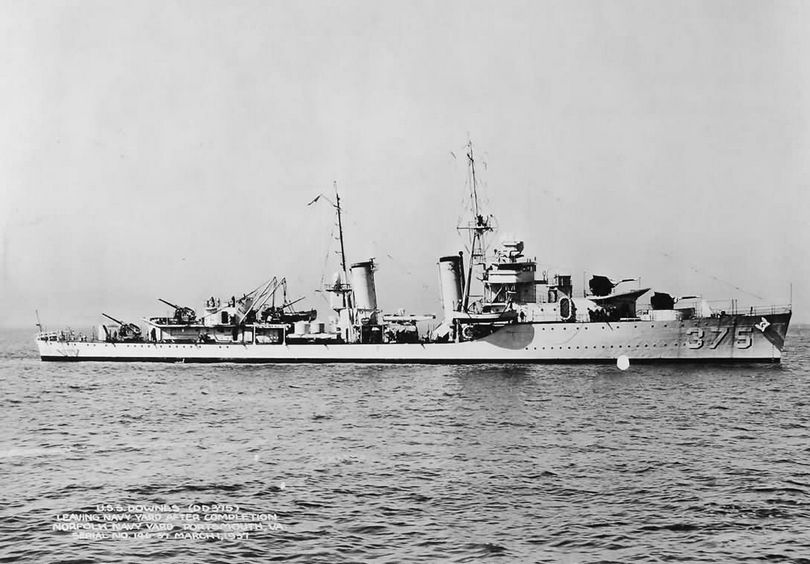
History of the USS Downs (DD-375)
World War II (1939-1945) turned many battleships and their crews into veterans. USS Downes (DD-375) was one such conflict participant and survived the entire war, earning four Battle Stars in the process.
She was (initially) laid by the Norfolk Naval Yard and launched on 22 April 1936 and then commissioned (first) on 15 January 1937. With Japan's attack on Pearl Harbor, Hawaii, in December 1941, the United States formally committed to a full-scale war against the Axis powers.
The USS Downes was built to Mahan class destroyer standards - a group of eighteen ships. The ships have a length of 341.2 feet, a beam of 35.5 feet, a draft of 10.6 feet, and a full-load displacement of 2,100 tons.
As built, armament consisted of a 5 x 5"/38 caliber (127 mm) main gun, 12 x 21" torpedo tubes, a 4.50 caliber heavy machine gun and 2 depth charges (above the stern). Propulsion power comes from 4 boilers feeding 2 GE 46,000 hp steam turbines driving 2 shafts.
The USS Downs completed standard maneuvers in Caribbean waters before passing through the Panama Canal to Pearl Harbor, which became her home port in April 1940. As such, she was present during the Japanese attack on December 7, 1941, but was dry docked with the others during the attack.
Despite fires, floods and constant fire from enemy fighter jets, her crew fought the enemy using airborne anti-aircraft weapons. Despite heroic efforts to repel the attackers, the port remained in ruins and the Downs was badly damaged - so much so that it was written off on June 20, 1942.
Her repairable machinery has been reorganized in a new warship laid out as USS Downes from Mare Island Naval Shipyard. This bloodline has clear access to the Pacific theater, where its skills would be greatly appreciated in the war against Imperial Japan, and its first notable operations were escort, blockade, and patrolespecially against enemy submarines . She participated in the Battle of Mariana (again as an escort) and was used on patrol whenever and wherever necessary. During the Tinian landing, her cannons were used angrily, and she then proceeded to shell enemy positions on Marcus.
Then there was support for the Wright (Philippines) amphibious landings, which she overhauled at Pearl by the end of 1944. During this period, the ship was equipped with the Mk 37 artillery fire control system (FCS) and two Mk 51 artillery command systems, while losing a 5-inch unit.
4 x 20mm Oerlikon anti-aircraft guns have been added to increase defenses against aircraft, and four K-gun depth shot launchers complement the existing dual depth shot racks.
In March 1945, she was re-commissioned and reassigned to the escort and participated in the Guam initiative before heading to Iwo Jima. This marked her final action in the war, as she was recalled to the United States and used for the last time as transport for service members to return home.
She completed her sailing day in Norfolk, Virginia in November 1945 and was discharged from the U.S. Navy on December 17 of that year. Her dismantled hull was sold as scrap in November 1947, bringing an official, rather unceremonious end to the legendary warship.
Specification
Basic
Roles
- Support for amphibious operations
- Blue Water Operations
- Fleet Support
- Hunter
- direct attack
Dimensions
341.3 ft (104.03 m)
35 feet (10.67 m)
3.02m
Weight
1,500 tons
Performance
Performance
37kn (43mph)
6,517 nautical miles (7,500 miles; 12,070 km)
Armor
1937:
5 x 5" (127mm) /38 caliber Dual-Purpose (DP) main guns.
12 x 21" (533mm) Torpedo Tubes
4 x 0. 50 caliber Brownning heavy machine guns
2 x Depth Charge Racks
1944:
4 x 5" (127mm) /38 caliber Dual-Purpose (DP) guns
12 x 21" (533mm) Torpedo Tubes
4 x 40mm Bofors air defense guns
6 x 20mm Oerlikon air defense guns
4 x K-Gun rocket launchers
2 x Depth Charge Racks
AIR WING
None.
 Argentina
 Armenia
 Australia
 Austria
 Austria-Hungary
 Belgium
 Brazil
 United Kingdom
 Brunei
 Bulgaria
 Canada
 Chile
Chile China
China Colonial America
 Colombia
 Confederate States
 Croatia
 Czech
Czech Denmark
 Egypt
Egypt Finland
 France
 Georgia
 Germany
 German Imperial
 Greece
 Holland
 Hungary
 India
India Indonesia
 Iran
Iran Iraq
Iraq Ireland
 Israel
 Italy
Italy Japan
Japan Japan (1940)
 Jordan
 Kingdom of Italy
 Malaysia
 Mexico
 Myanmar
 Nazi Germany
 Netherlands
 New Zealand
 North Korea
 Norway
 Pakistan
 Peru
Peru Philippines
 Poland
 Portugal
 Prussia
 Romania
 Russia
 Saudi Arabia
 Serbia
 Singapore
 Slovakia
 Slovenia
 South Africa
 South Korea
 Soviet Union
 Spain
Spain Sweden
 Switzerland
 Syria
Syria Taiwan
 Thailand
 Turkey
 UAE
UAE Ukraine
 Vietnam
 Yugoslavia