

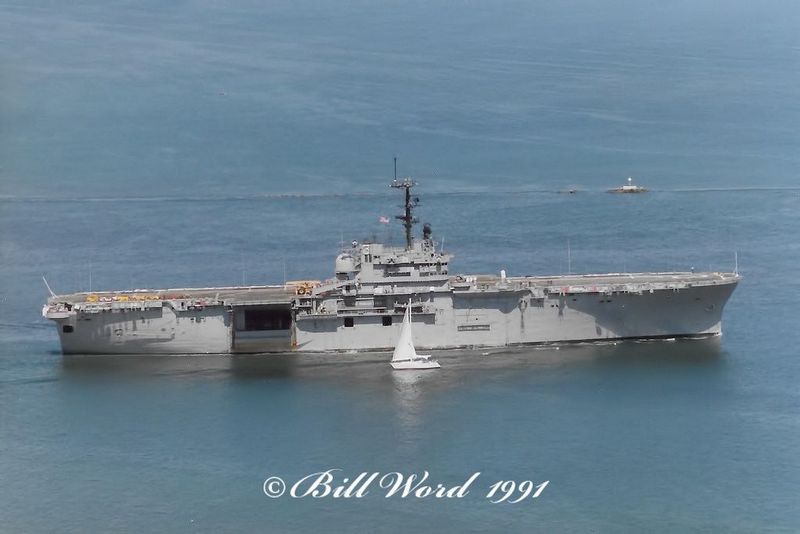
History of the battleship Okinawa (LPH-3)
The history of the LPH ship "Landing Platform Helicopter" begins in the Pacific theater during World War II, when small escort carriers were produced to augment first-line aircraft carriers. These escort carriers can also provide support and air cover to troop ships and landing craft during amphibious landing activities in the region. Sometimes they provide additional landing decks for front-line carriers and provide backup pilots and aircraft to cover combat losses.
After World War II, many escort carriers were scrapped to allow military budgets to keep front-line carriers in service. During the Korean War, the "helicopter" began to gain a foothold in the U.S. Navy's inventory. Aircraft carriers use helicopters to search and rescue downed pilots at sea and on land. During the Battle of Chosion Reservoir in November 1950, the 6th Marine Observation Squadron (VMO-6) used HO35-1 helicopters to rescue 154 wounded Marines from the battlefield.
This was the first time a planned "vertical operation" had been used in warfare, underscoring the value of this military helicopter tactic.
Battleship Okinawa (LPH-3) at the Philadelphia Navy Yard in Philadelphia, Pennsylvania on the 15th anniversary of the Okinawa landing and commissioned on April 14, 1962, with Captain William E. Lemos at the helm. Okinawa is the second ship of the Iwo Jima-class LPH. The original title landing platform was then replaced with "Amphibious Assault Ship (Helicopter)". The LPH is designed and built for amphibious assault, using a vertical encirclement approach. The ship is designed to carry 25 helicopters according to mission parameters, and the number of helicopters is increasing with the introduction of new and improved models.
The main mission of the ship is to transport a naval battalion and its full set of weapons and support equipment to the theater of operations by helicopter. Beach obstacles, flooded fields and harsh terrain can now be negotiated vertically without delaying ground troops for dayssome delays requiring specialized engineers to help traverse an area or clear it entirely.
The U.S. Navy, a big proponent of "multi-mission" capabilities, now has the perfect platform to combine fleet missions with those that used to require the use of its own ships. Since combat always involves casualties, the LPH also acts as a Medical Watch Ship (MDS) with medical personnel.
As the largest and best equipped ship in its class, the LPH-3 becomes the (ATFCS) Amphibious Task Force Control Ship for the mission commander to manage the entire operation.
The Iwo Jima-class engine consisted of two boilers and a geared turbine, spinning a single shaft at 22,000 shaft horsepower. Its armament includes a twin-barreled 3-inch cannon, a 20mm Vulcan/Phalanx Close-In Weapon System (CIWS), and several .50-caliber heavy machine guns.
The crew consists of 50 officers and approximately 650 soldiers to support the operation.
The U.S. Marine Corps Assault Battalion formed the ship's "Big Dog" detachment. To keep this well-oiled fighting machine running, a full-service headquarters and appropriate support units are deployed on board, just as they are on land. The commander is a colonel or lieutenant colonel with the second rank of major. A sergeant major plus staff make up the rest of the headquarters company.
There were also two artillery companies supporting the commandos. In total, between 1,200 and 2,000 Marines can make up the USMC component on board, although this varies by mission.
USS Okinawa's participation in the Vietnam War including Vietnam Counteroffensive - Phase II (18-19 April 1967, 18-31 May 1967), Vietnam Counteroffensive - Phase III (1 September 1967) 1st November), Vietnam Counteroffensive - Phase VI (8th December 1968 to 26th January 1969, 12th to 22nd February 1969), Tet/69 Counteroffensive (23rd February 1969) to 30 March, 14 to 27 April 1969), Sanctuary Counteroffensive (25 to 28 June 1970), Vietnam Counteroffensive - Phase 7 (15 to 18 July 1970, 23-27 July 1970, 9-12 August 1970, 10-10 September 1970, 12-15 September 1970, 4-9 October 1970, 5 November 1970-June, 23-27 May 1971) and the Vietnam Armistice Agreement (27 April-30 May). 1972, June 9-July 2, 1972, July 9-August 25, 1972, September 29-October 1, 1972, October 5-20, 1972 21-22 November 2019).
On April 4, 1968, Okinawa took a break from combat operations in Vietnam to begin special training with NASA personnel to restore the Apollo VI unmanned spacecraft. The mission was designed to be the last test before the crewed Apollo mission. The spacecraft consists of three stages - Saturn V booster, Command and Service Module (CSM) and Lund Module (LM). Problems arose during the flight re-entering Okinawa from the station 380 miles north of Kauai, Hawaii.
The LM was recovered by US Navy SEALs and lifted to the deck in Okinawa by an MH-53E Sea Stallion helicopter using special harnesses.
History shows that at least one Iwo Jima-class battleship has been involved in every major conflict since the Vietnam War. The LPH proved to be a malleable ship, and the Navy saw the need for long-range amphibious assault ships with greater helicopter capacity and began phasing out the current generation of LPHs. As a result, Okinawa was decommissioned and removed from the Naval Ship Register on December 17, 1992. The ship was immediately sunk as a floating target during the COMSUBPAC Shipwreck Exercise (SINKEX) at 2,020 fathoms off the coast of Southern California on June 6, 2002.
She was hit by a Mk 48 torpedo from SSN-707 Portsmouth. Incidentally, June 6 is also the anniversary of the Normandy landings in northern France to open the Western Front.
The aircraft carrier Okinawa received various military awards during her heroic service to the United States of America. These include 2 Combat Action Medals, 5 Naval Unit Commendations, 3 Naval Merit Unit Commendations, a Naval Combat "E" Medal, and Naval Expedition Medals (1 Cuban, 2 Iran/Indian Ocean).
In addition, she was awarded the National Defense Service Medal, Armed Forces Expeditionary Medal (1 Cuba, 1 Dominican Republic, 1 Operation Eagle Pull, 1 Operation Frequent Wind, 2 Persian Gulf), Vietnam Service Medal (7), Southwest Asia Service Medal, Humanitarian Viet Nam Service Medal (1 eagle pull, 1 frequent wind), Philippine Presidential Unit Medal, Republic of Vietnam Brave Cross Unit Medal (5), Republic of Vietnam Movement Ribbon and Kuwait Liberation Medal.
Specification
Basic
Roles
- Support for amphibious operations
- Blue Water Operations
- Fleet Support
- Hunter
- direct attack
Dimensions
592 feet (180.44 m)
25.60m
27 feet (8.23 m)
Weight
18,474 tons
Performance
Performance
22 kn (25 mph)
Armor
Original:
4 x 3" (76 mm) (4x2) guns
Later:
2 x 20mm Vulcan Close-In Weapon System (CIWS) anti-aircraft guns.
6 x 12.7mm anti-aircraft machine guns
Wing
Mission-specific aircraft may include:
20 x UH-46D Sea Knight helicopters
10 x MH-53E Sea Stallion helicopters
 Argentina
 Armenia
 Australia
 Austria
 Austria-Hungary
 Belgium
 Brazil
 United Kingdom
 Brunei
 Bulgaria
 Canada
 Chile
Chile China
China Colonial America
 Colombia
 Confederate States
 Croatia
 Czech
Czech Denmark
 Egypt
Egypt Finland
 France
 Georgia
 Germany
 German Imperial
 Greece
 Holland
 Hungary
 India
India Indonesia
 Iran
Iran Iraq
Iraq Ireland
 Israel
 Italy
Italy Japan
Japan Japan (1940)
 Jordan
 Kingdom of Italy
 Malaysia
 Mexico
 Myanmar
 Nazi Germany
 Netherlands
 New Zealand
 North Korea
 Norway
 Pakistan
 Peru
Peru Philippines
 Poland
 Portugal
 Prussia
 Romania
 Russia
 Saudi Arabia
 Serbia
 Singapore
 Slovakia
 Slovenia
 South Africa
 South Korea
 Soviet Union
 Spain
Spain Sweden
 Switzerland
 Syria
Syria Taiwan
 Thailand
 Turkey
 UAE
UAE Ukraine
 Vietnam
 Yugoslavia