
History
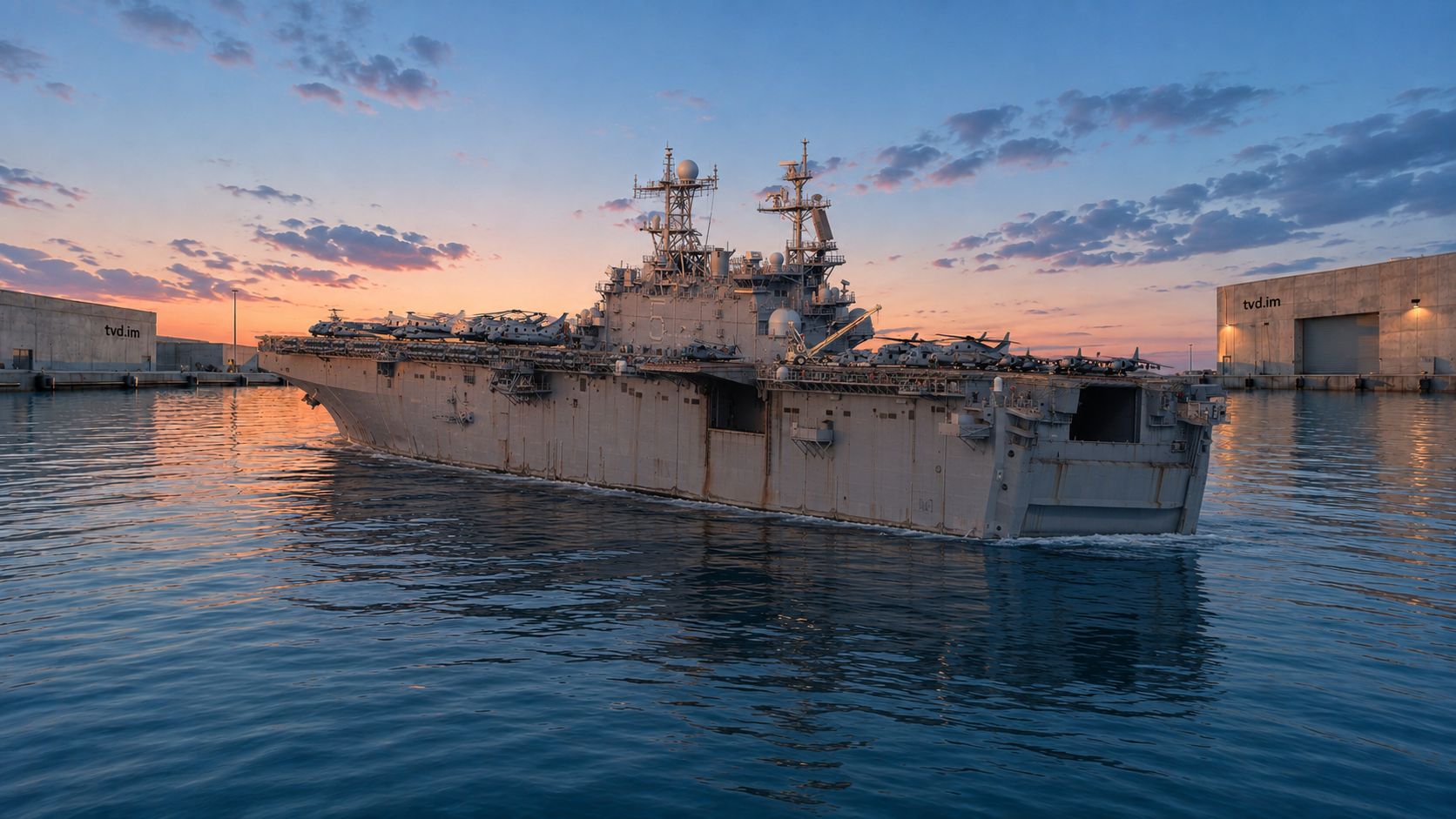
USS Peleliu (LHA-5) was a Tarawa-class amphibious assault ship built by Ingalls Shipbuilding for the United States Navy. The ship combined a large flight deck, an aircraft hangar, and a well deck for landing craft, allowing it to transport and support a Marine landing force.
Peleliu entered service in 1980 and completed almost 35 years of operations in the Pacific, Middle East, and other regions. Its missions included amphibious deployments, combat support, evacuations, peacekeeping support, and humanitarian assistance.
After decommissioning in 2015, the ship remained in reserve at Pearl Harbor. It was sunk as a target during the Rim of the Pacific 2026 exercise.
Construction and commissioning
The ship was initially assigned the name Da Nang on 8 April 1974. It was renamed Peleliu on 15 February 1978 to commemorate the 1944 Battle of Peleliu. Sources give different dates for the laying of the keel: the Naval History and Heritage Command records 26 November 1976, while NavSource and other references give 12 November 1976.
Ingalls Shipbuilding constructed the ship at Pascagoula, Mississippi. Peleliu was launched on 25 November 1978 and sponsored by Peggy Hayward, wife of Admiral Thomas B. Hayward. It was commissioned on 3 May 1980 with Captain Thomas P. Scott in command. Peleliu was the fifth and final ship of the Tarawa class.
Name and insignia
The name honored the United States forces that fought to capture Peleliu in the Palau Islands during World War II. The ship's insignia included a Roman numeral V representing its hull number and eight stars commemorating the eight Medal of Honor recipients associated with the battle. Its motto was Pax per Potens, meaning Peace through power.
Design
Peleliu was designed to carry a Marine landing force, its aircraft, and landing craft in one ship. The continuous flight deck supported helicopters and AV-8B Harrier vertical or short takeoff and landing aircraft. A hangar deck and two aircraft elevators supported aviation operations.
The well deck could accommodate four Landing Craft Utility vessels. An alternative load consisted of two Landing Craft Utility vessels and one Landing Craft Air Cushion. This arrangement allowed personnel, vehicles, and equipment to move from the ship to shore without requiring established port facilities.
The propulsion system used two boilers connected to two geared steam turbines and two propellers. The ship could reach 24 knots. Its defensive armament in its later configuration included Rolling Airframe Missile launchers, Phalanx close-in weapon systems, 25 mm Mk 38 guns, and heavy machine guns.
Operational history
Peleliu served with the United States Pacific Fleet and was homeported first at Long Beach and later at San Diego. In 1991, it assisted with the evacuation from Naval Base Subic Bay after the eruption of Mount Pinatubo in the Philippines.
From April to August 1994, the Peleliu Amphibious Ready Group participated in Operation Distant Runner and Operation Support Hope during the international response to the crisis in Rwanda. In April and May 1997, the group operated in the Persian Gulf in support of United Nations disarmament inspections in Iraq.
Peleliu reached East Timor on 26 October 1999. It provided communications and logistics support to the International Force for East Timor during Operation Stabilize until 29 November.
The ship departed the United States West Coast with the 15th Marine Expeditionary Unit in August 2001. Following the attacks of 11 September, the group moved into the United States Central Command area. Peleliu supported Operation Enduring Freedom and became the first ship to deploy United States Marines into Afghanistan. The amphibious ready group returned to San Diego on 4 March 2002.
On 22 August 2003, Peleliu departed San Diego for a deployment supporting Operation Iraqi Freedom. Later deployments included humanitarian and security missions. The ship also supported relief operations after severe flooding in Pakistan in 2010.
Peleliu was decommissioned at Naval Base San Diego on 31 March 2015 and placed in reserve at Pearl Harbor. It was removed from the Naval Vessel Register on 30 April 2024.
RIMPAC 2026 sinking exercise
On 17 July 2026, the former Peleliu was sunk approximately 50 nautical miles north of Kauai during a sinking exercise conducted as part of Rim of the Pacific 2026. The weapons used against the retired ship included Harpoon, Spike, and Long Range Anti-Ship Missiles. Two expendable unmanned surface vessels subsequently approached and detonated near the waterline.
Operator
- United States Navy: Operated USS Peleliu from its commissioning in 1980 until its decommissioning in 2015.
Specifications (USS Peleliu, LHA-5)
General characteristics
- Type: Tarawa-class amphibious assault ship
- Builder: Ingalls Shipbuilding, Pascagoula, Mississippi
- Light displacement: 26,255 tons
- Full displacement: 39,925 tons
- Length: 250 m (820 ft)
- Beam: 32.3 m (106 ft)
- Draft: 8.2 m (27 ft)
- Ship's complement: 964
- Troop capacity: More than 1,900
Propulsion and performance
- Propulsion: Two boilers, two geared steam turbines, and two propellers
- Maximum speed: 24 knots (44 km/h)
Aircraft and landing craft
- Representative aircraft complement: Twelve CH-46 Sea Knight helicopters, four CH-53E Sea Stallion helicopters, six AV-8B Harrier aircraft, three UH-1N Huey helicopters, and four AH-1W Super Cobra helicopters
- Landing craft: Four Landing Craft Utility vessels, or two Landing Craft Utility vessels and one Landing Craft Air Cushion
- Aviation facilities: Flight deck, hangar deck, and two aircraft elevators
Armament
- Missile systems: Two Rolling Airframe Missile launchers
- Close-in defense: Two 20 mm Phalanx close-in weapon systems
- Guns: Four 25 mm Mk 38 mounts
- Machine guns: Three .50-caliber machine guns
 Argentina
 Armenia
 Australia
 Austria
 Austria-Hungary
 Belgium
 Brazil
 United Kingdom
 Brunei
 Bulgaria
 Canada
 Chile
Chile China
China Colonial America
 Colombia
 Confederate States
 Croatia
 Czech
Czech Denmark
 Egypt
Egypt Finland
 France
 Georgia
 Germany
 German Imperial
 Greece
 Holland
 Hungary
 India
India Indonesia
 Iran
Iran Iraq
Iraq Ireland
 Israel
 Italy
Italy Japan
Japan Japan (1940)
 Jordan
 Kingdom of Italy
 Malaysia
 Mexico
 Myanmar
 Nazi Germany
 Netherlands
 New Zealand
 North Korea
 Norway
 Pakistan
 Peru
Peru Philippines
 Poland
 Portugal
 Prussia
 Romania
 Russia
 Saudi Arabia
 Serbia
 Singapore
 Slovakia
 Slovenia
 South Africa
 South Korea
 Soviet Union
 Spain
Spain Sweden
 Switzerland
 Syria
Syria Taiwan
 Thailand
 Turkey
 UAE
UAE Ukraine
 Vietnam
 Yugoslavia