
History
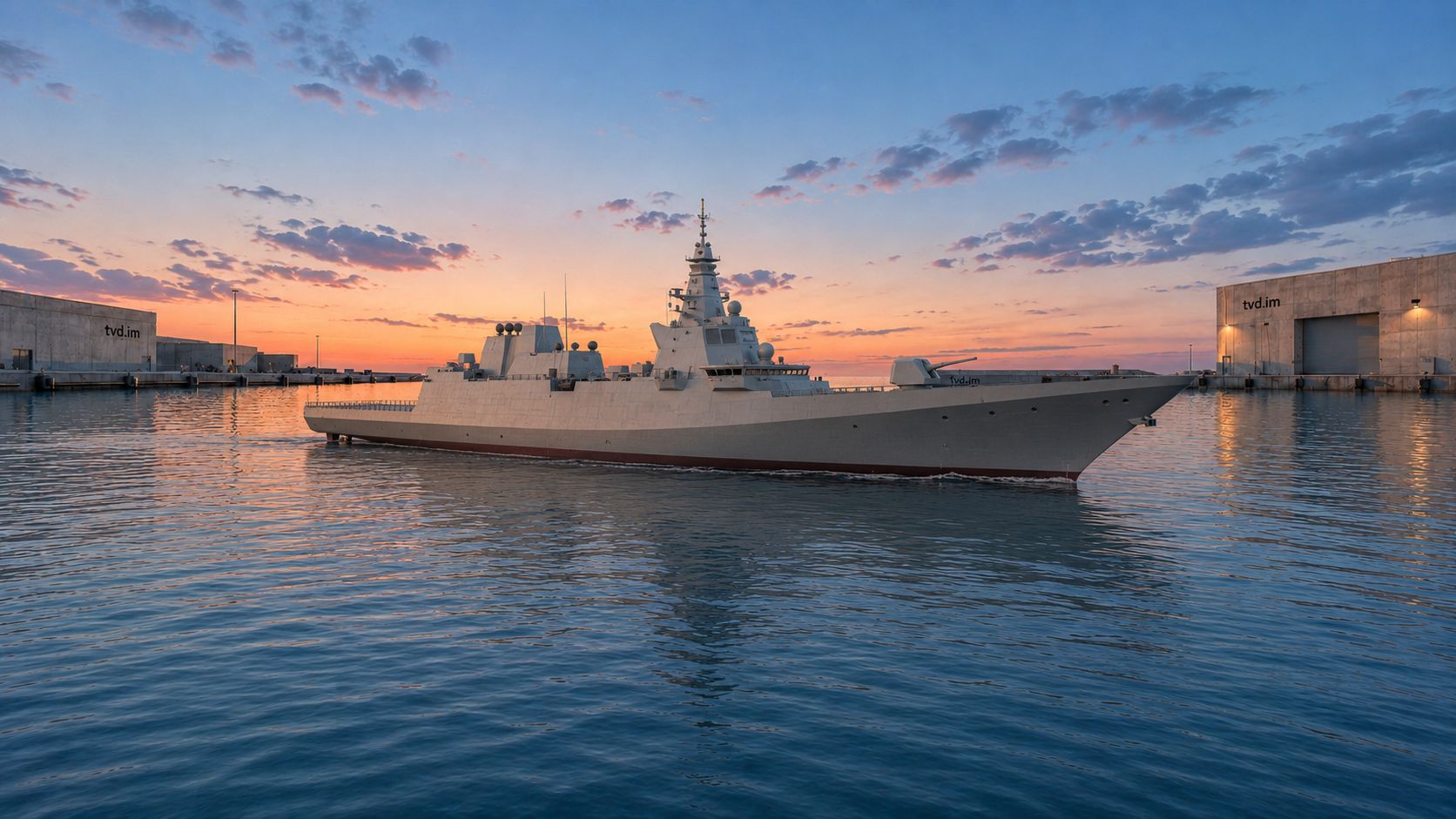
The FREMM EVO is an evolved version of the Italian FREMM frigate developed for the Italian Navy by Orizzonte Sistemi Navali, a joint venture owned by Fincantieri and Leonardo. It retains the established FREMM hull and propulsion architecture while introducing redesigned superstructures, new sensors, cyber-resilient control systems, and improved defenses against missiles and unmanned aircraft.
Italy ordered two FREMM EVO frigates through an amendment to the multinational FREMM contract in July 2024. The ships are named Bersagliere and Aviere, with delivery scheduled for 2029 and 2030.
Portugal subsequently agreed to acquire three FREMM EVO frigates with associated logistic support. These ships are also planned for delivery between 2029 and 2030, expanding the programme beyond its original Italian order.
Development
The original Franco-Italian FREMM programme began in 2002, and its initial production contract was awarded in 2006. The EVO configuration was created to address equipment obsolescence and incorporate technologies developed for newer Italian naval programmes, particularly the PPA multi-purpose combat ships and the amphibious assault ship Trieste.
OCCAR awarded a feasibility and initial risk-reduction contract in December 2023. The Italian Navy and Ministry of Defence issued the operational requirements in March 2024. OCCAR and Orizzonte Sistemi Navali signed the main contract amendment on 31 July 2024. The industrial contract for two ships was reported at approximately EUR 1.5 billion, while the wider programme allocation, including extended logistic support, was reported at approximately EUR 2 billion.
The System Design Review was completed in May 2025. A Critical Design Review covering the platform, combat system, integrated logistic support, and complete ship followed in December 2025. According to OCCAR, this review confirmed the design's maturity and authorized the transition to production.
Construction
Published accounts differ over the earliest construction event. One Naval News report described a keel-laying event for the first ship in July 2025. Later reporting from Janes identified steel cutting for Bersagliere in April 2026 as its initial construction milestone.
Steel was cut for the second Italian ship, Aviere, at Fincantieri's Riva Trigoso shipyard on 23 July 2026. Construction involves Fincantieri's Riva Trigoso and Muggiano facilities. The two completed frigates are scheduled for delivery in June 2029 and June 2030.
On 20 July 2026, Portugal signed a government-to-government agreement covering three FREMM EVO frigates and logistic support. Portugal's participation was also represented at the July 2026 construction ceremony. The Portuguese ships are planned for delivery during 2029–2030.
Design
Hull and propulsion
The FREMM EVO retains the hull form, propulsion system, and acoustic characteristics of the Italian anti-submarine warfare FREMM design. Its redesigned aluminium-alloy superstructures accommodate fixed radar arrays and other equipment derived from Italy's newer naval platforms. The antennas are divided between forward and aft superstructure blocks to provide full coverage and distribute their weight.
The CODLAG propulsion arrangement combines a 32 MW General Electric LM2500+ gas turbine with electric motors. Electric propulsion supports quieter movement during anti-submarine operations. Published figures for the retained FREMM platform include a maximum speed of approximately 27 knots and a range of about 6,000 nautical miles at 15 knots. An azimuth thruster assists low-speed manoeuvring.
New electrical-distribution and air-conditioning systems support the expanded combat equipment. The platform also receives the cyber-resilient Seasnavy Ship Management System with damage-control functions. The standard complement is expected to include 145 crew members and aviation personnel, with accommodation for up to 179 people.
Combat management and communications
The combat system is built around Leonardo's cyber-resilient SADOC Mk 4 Combat Management System. It uses large-screen consoles, distributed data processing, and software intended to coordinate the ship's sensors, weapons, electronic-warfare equipment, and unmanned vehicles.
Fincantieri's Unmanned Management System is intended to control vehicles operating in the air, on the surface, and underwater. Proposed deployment arrangements include aerial vehicles operated from the flight deck and unmanned surface vehicles launched from the side boat stations. Some elements of this unmanned-vehicle capability were described as options requiring separate funding.
The communications suite is planned to include software-defined V/UHF and HF radios, satellite communications in several frequency bands, and an evolved Multi Data Link Processor supporting Link 16, Link 22, VMF, and JREAP.
Radar and electronic warfare
The main sensor complex is the Leonardo Kronos Dual-Band Radar. It combines four fixed C-band Kronos Quad AESA faces with four fixed X-band Kronos StarFire AESA faces. The C-band component supports long-range surveillance and tracking, including defense against tactical ballistic missiles. The X-band component is optimized for shorter-range air and missile threats.
The radar manager integrates the two radar bands with the electronic-warfare suite. Reported functions include area and point air defense, missile guidance, gunfire control, coastal surveillance, electronic attack, and detection or tracking of ballistic-missile threats. Leonardo has stated that the system can independently detect and track tactical ballistic missiles in the 600 km range class and track missiles in the 1,300 km class when externally cued.
The integrated electronic-warfare system includes radar and communications support measures, radar and communications countermeasures, and conformal antennas. It is intended to combine passive detection with electronic attack while coordinating emissions from the ship's radar and electronic-warfare equipment.
Counter-unmanned-aircraft capability
FREMM EVO is planned to receive a dedicated counter-unmanned-aircraft system combining radar, electronic-warfare, electro-optical, and combat-management inputs. The system is intended to detect, classify, identify, and disrupt unmanned aircraft. Artificial-intelligence algorithms are planned to assist data fusion and threat assessment.
The soft-kill element includes communications-electronic countermeasures. Hard-kill defenses are expected to include 30 mm remotely operated guns with airburst ammunition and 76 mm Strales guns firing guided DART ammunition. Reporting available during development indicated that the dedicated four-face counter-drone radar had not yet been selected.
Anti-submarine systems
The anti-submarine suite is derived from Italian FREMM ASW ships. It includes a Thales 4110 BlueMaster bow-mounted sonar, a Thales 4249 CAPTAS-4C variable-depth sonar, a towed multifunction array, and Leonardo Thesan mine and collision-avoidance sonars. Embarked helicopters and MU90 lightweight torpedoes extend the ship's detection and engagement range.
Program status
As of July 2026, both Italian FREMM EVO frigates were in construction, but none had entered service. The programme remained aligned with planned deliveries in 2029 and 2030. The 2029 year associated with this article is therefore a planned delivery and service-entry milestone, not an accomplished introduction date.
Italy has two ships under contract. Portugal has signed an agreement for three additional ships with logistic support. Neither navy had an operational FREMM EVO at the time covered by the available sources.
Planned customers
- Italy: Two frigates for the Italian Navy, named Bersagliere and Aviere. Delivery is scheduled for June 2029 and June 2030.
- Portugal: Three frigates for the Portuguese Navy under a government-to-government agreement signed in July 2026. Delivery is planned during 2029–2030.
Specifications (FREMM EVO)
General characteristics
- Type: Multi-mission frigate
- Length: 144.6 m
- Full displacement: Approximately 6,500 tonnes
- Complement: 145 crew and aviation personnel
- Accommodation: Up to 179 people
- Propulsion: CODLAG arrangement with one 32 MW General Electric LM2500+ gas turbine and electric motors
Performance
- Maximum speed: Approximately 27 knots
- Range: Approximately 6,000 nautical miles at 15 knots
Sensors and systems
- Combat management: Leonardo SADOC Mk 4 cyber-resilient Combat Management System
- Main radar: Leonardo Kronos Dual-Band Radar with four C-band and four X-band fixed AESA faces
- Fire control: Two NA-30S Mk 2 radar and electro-optical fire-control systems
- Infrared surveillance: DSS-IRST distributed infrared search-and-track suite
- Navigation: Two GEM Elettronica Gemini X/Ka-band radars
- Sonar: Thales 4110 BlueMaster bow sonar, Thales 4249 CAPTAS-4C variable-depth sonar, towed multifunction array, and Leonardo Thesan mine and collision-avoidance sonars
- Electronic warfare: Integrated suite with radar and communications support and countermeasure functions
- Unmanned systems: Fincantieri Unmanned Management System
Armament
- Surface-to-air missiles: Aster-family missiles, including planned Aster Block 1NT compatibility, in two eight-cell Sylver A50 vertical launch systems
- Anti-ship and land-attack missiles: Eight MBDA Italia Teseo Mk2/E launchers
- Main guns: Two Leonardo 76/62 mm Super Rapido guns in Strales configuration
- Remote weapon stations: Two Leonardo Lionfish 30 mm systems with airburst ammunition
- Torpedoes: Two triple launchers for MU90 lightweight torpedoes
- Growth provision: Reserved bow space for additional vertical launch systems; possible A70 or CAMM-ER installations remained under study
 Argentina
 Armenia
 Australia
 Austria
 Austria-Hungary
 Belgium
 Brazil
 United Kingdom
 United States
 Brunei
 Bulgaria
 Canada
 Chile
Chile China
China Colonial America
 Colombia
 Confederate States
 Croatia
 Czech
Czech Denmark
 Egypt
Egypt Finland
 France
 Georgia
 Germany
 German Imperial
 Greece
 Holland
 Hungary
 India
India Indonesia
 Iran
Iran Iraq
Iraq Ireland
 Israel
 Japan
Japan Japan (1940)
 Jordan
 Kingdom of Italy
 Malaysia
 Mexico
 Myanmar
 Nazi Germany
 Netherlands
 New Zealand
 North Korea
 Norway
 Pakistan
 Peru
Peru Philippines
 Poland
 Portugal
 Prussia
 Romania
 Russia
 Saudi Arabia
 Serbia
 Singapore
 Slovakia
 Slovenia
 South Africa
 South Korea
 Soviet Union
 Spain
Spain Sweden
 Switzerland
 Syria
Syria Taiwan
 Thailand
 Turkey
 UAE
UAE Ukraine
 Vietnam
 Yugoslavia