
History
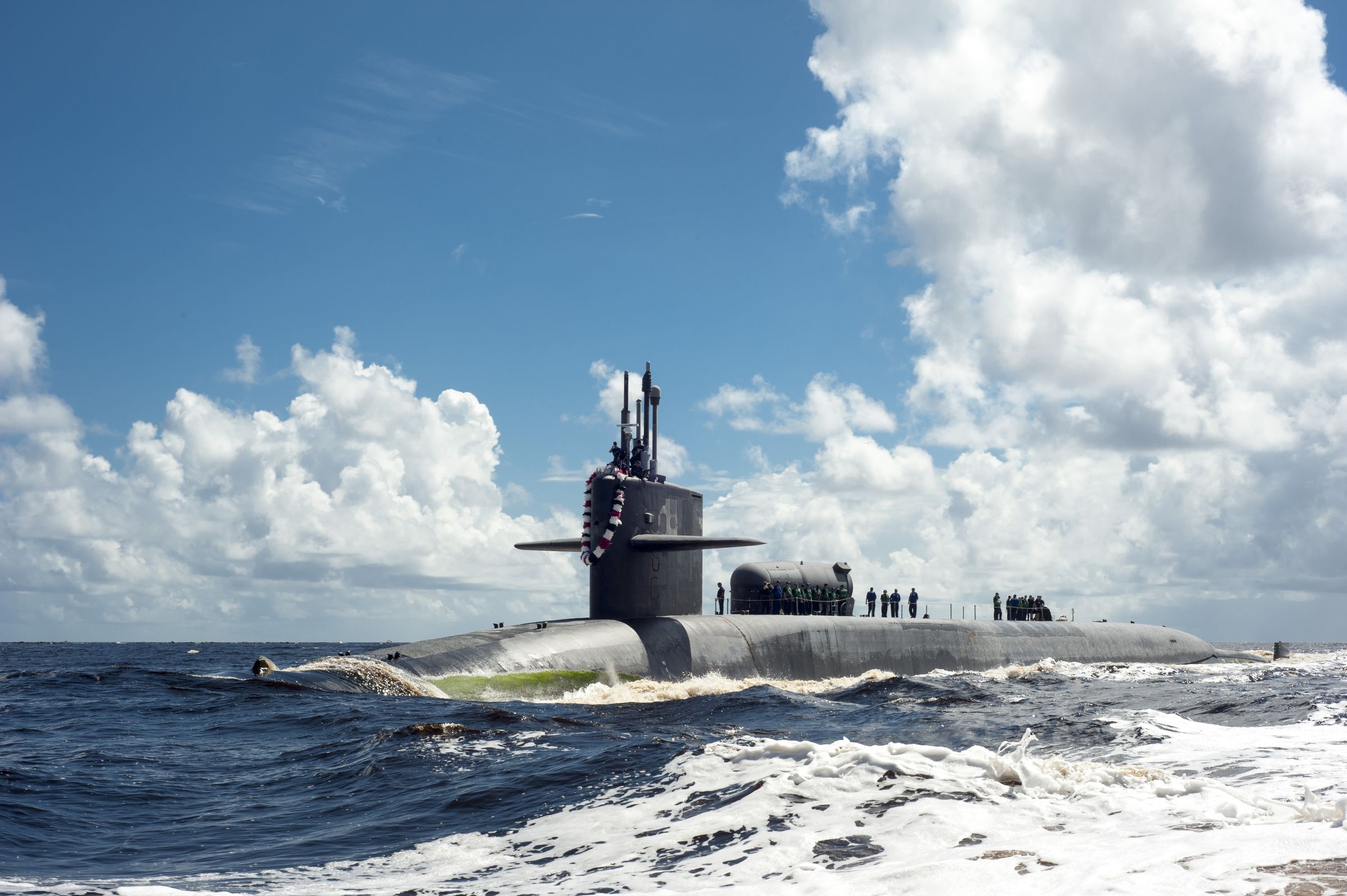
USS Georgia (SSGN-729) was a United States Navy Ohio-class nuclear-powered submarine built by the Electric Boat Division of General Dynamics. It entered service as the ballistic-missile submarine USS Georgia (SSBN-729) and later became a guided-missile and special-operations platform.
The conversion replaced its strategic ballistic-missile role with conventional land attack, special-operations support, intelligence functions, and command-and-control capabilities. In its SSGN configuration, Georgia could carry as many as 154 Tomahawk cruise missiles and accommodate up to 66 special-operations personnel.
Georgia completed its final operational deployment in July 2026. The Navy then began deactivating the submarine after approximately 42 years of commissioned service.
Construction and SSBN service
The U.S. Navy awarded the construction contract for Georgia on 20 February 1976. General Dynamics Electric Boat laid the keel at Groton, Connecticut, on 7 April 1979. The submarine was launched on 6 November 1982 and commissioned as USS Georgia (SSBN-729) on 11 February 1984.
Georgia initially carried Trident submarine-launched ballistic missiles as part of the United States strategic nuclear deterrent. Its Blue and Gold crews alternated responsibility for the submarine, allowing the vessel to remain available for patrols while the other crew trained and rested. Georgia began its first strategic deterrence patrol in January 1985 and completed its 65th and final deterrence patrol on 30 October 2003.
On 22 March 1986, the harbor tug USS Secota lost power after transferring a sailor from Georgia near Midway Island. The tug became caught on the submarine's starboard stern plane and sank. Ten people were rescued, but two Secota crew members died. Georgia subsequently received emergency repairs for minor damage.
The Navy removed Georgia's Trident missiles in November 2003. The submarine was redesignated SSGN-729 on 1 March 2004 as part of a program created after the 1994 Nuclear Posture Review concluded that only 14 of the Navy's 18 Ohio-class ballistic-missile submarines were required for strategic deterrence.
Conversion to SSGN
Georgia entered Norfolk Naval Shipyard in March 2005 for an Engineered Refueling Overhaul and conversion. The Navy contracted General Dynamics Electric Boat to perform the conversion work within the naval shipyard. Georgia completed the conversion in December 2007 and returned to service at Naval Submarine Base Kings Bay, Georgia, in March 2008.
The conversion changed 22 of the submarine's 24 former Trident missile tubes to accept Multiple All-Up-Round Canisters. Each canister could hold seven Tomahawk land-attack cruise missiles, giving the submarine a maximum theoretical capacity of 154 missiles. The two forward missile tubes became lockout chambers for the submerged deployment and recovery of special-operations personnel.
Additional berthing, communications equipment, mission-planning areas, and storage were installed. The converted missile tubes could also hold supplies, special-operations equipment, sensors, unmanned systems, or other mission-specific payloads instead of missiles. The U.S. Navy SSGN fact file describes the converted submarines as conventional strike and special-operations platforms with enhanced communications facilities.
Deactivation
Georgia returned to Kings Bay after its final deployment in July 2026. The Navy began the submarine's deactivation on 31 July, making it the first of the four converted Ohio-class SSGNs to enter the retirement process. The other converted submarines were scheduled to follow between fiscal years 2027 and 2029. A contemporary deactivation report confirmed the start of the process after approximately 42 years of service.
Design
Hull and arrangement
Georgia retained the large cylindrical hull of the Ohio class. It measures approximately 170.7 m (560 ft) long and 12.8 m (42 ft) across the beam. Its displacement is approximately 17,033 metric tonnes surfaced and 19,000 metric tonnes submerged.
The missile compartment is positioned behind the sail. In the original SSBN configuration, this area contained 24 ballistic-missile tubes. After conversion, 22 tubes supported Tomahawk canisters or alternative payloads, while the two forward tubes served as swimmer lockout chambers.
Up to two Dry Deck Shelters could be mounted behind the sail and connected with the lockout chambers. These removable modules supported the submerged operation of combat swimmers, SEAL Delivery Vehicles, and associated equipment.
Propulsion
The submarine uses one S8G pressurized-water nuclear reactor. Steam generated by the reactor drives two geared turbines connected to a single propulsion shaft. The machinery develops approximately 45,000 kW (60,000 shp). A small auxiliary propulsion motor is also fitted.
Nuclear propulsion gives Georgia an operating endurance governed mainly by food, maintenance requirements, and crew limitations rather than conventional fuel capacity. Published U.S. Navy information gives the Ohio-class SSGN a speed exceeding 20 knots (37 km/h).
Crew and mission facilities
Georgia used separate Blue and Gold crews to increase operational availability. U.S. Navy specifications list each crew as 15 officers and 144 enlisted personnel. The SSGN conversion added space for as many as 66 special-operations personnel.
The converted submarine received a Common Submarine Radio Room and two High Data Rate antennas. These systems supported secure communications and allowed the submarine to function as a submerged joint command center. Planning spaces and additional intelligence-processing capacity supported strike coordination and special operations.
The large payload volume allowed commanders to adjust the balance between cruise missiles, special-operations equipment, provisions, sensors, and unmanned vehicles. Consequently, the maximum figure of 154 Tomahawks represented a theoretical missile-focused load rather than a requirement for every deployment.
Armament
In its guided-missile configuration, Georgia could carry up to 154 Tomahawk land-attack cruise missiles. The missiles were arranged in groups of seven within Multiple All-Up-Round Canisters installed in as many as 22 converted missile tubes.
Four 533 mm (21 in) torpedo tubes provided additional offensive and defensive capability. The submarine carried Mk 48 heavyweight torpedoes for attacks against submarines and surface vessels.
Operational history
Georgia began its first operational deployment as a guided-missile submarine in August 2009. Its missions combined conventional strike readiness, special-operations support, surveillance, and forward command functions.
In December 2020, Georgia made an unusually visible surfaced transit through the Strait of Hormuz accompanied by the cruisers USS Port Royal and USS Philippine Sea. The transit publicly demonstrated the presence of a major American undersea strike platform in the region.
During another transit in May 2021, Iranian fast attack craft approached Georgia and its escorts. The U.S. Coast Guard cutter Maui fired warning shots after the craft continued to close on the formation.
In August 2024, the U.S. Secretary of Defense ordered Georgia to move from the Mediterranean toward the Middle East during preparations for a possible Iranian attack against Israel. The public announcement of a submarine movement was unusual because the locations of deployed nuclear-powered submarines are normally withheld.
Georgia returned to Naval Submarine Base Kings Bay in July 2026 following its final operational deployment. Its deactivation began as the Navy prepared to withdraw all four Ohio-class SSGNs. Virginia-class Block V submarines fitted with the Virginia Payload Module are intended to recover part of the lost undersea missile capacity, but each such submarine has a smaller maximum vertical-launch payload than an Ohio-class SSGN.
Variants
- USS Georgia (SSBN-729): Original Ohio-class fleet ballistic-missile submarine configuration used for strategic nuclear deterrence from 1984 until its final deterrence patrol in 2003.
- USS Georgia (SSGN-729): Guided-missile configuration completed in 2007. It supported conventional land attack, special operations, intelligence missions, alternative payloads, and joint command functions.
Operators
- United States Navy: Operated Georgia as an SSBN and later as an SSGN with alternating Blue and Gold crews. Deactivation began in July 2026.
Specifications (USS Georgia SSGN-729)
General characteristics
- Type: Nuclear-powered guided-missile submarine
- Class: Ohio class
- Builder: General Dynamics Electric Boat Division
- Length: 170.7 m (560 ft)
- Beam: 12.8 m (42 ft)
- Draft: Approximately 11.6 m (38 ft)
- Displacement surfaced: Approximately 17,033 metric tonnes (16,764 long tons)
- Displacement submerged: Approximately 19,000 metric tonnes (18,750 long tons)
- Crew: Two alternating crews, each comprising 15 officers and 144 enlisted personnel
- Special-operations capacity: Up to 66 personnel
Propulsion and performance
- Reactor: One S8G pressurized-water nuclear reactor
- Main machinery: Two geared steam turbines
- Propulsion: One shaft
- Power: Approximately 45,000 kW (60,000 shp)
- Speed: More than 20 knots (37 km/h)
Armament and mission equipment
- Cruise missiles: Up to 154 Tomahawk land-attack missiles in 22 seven-round canisters
- Torpedoes: Mk 48 heavyweight torpedoes
- Torpedo tubes: Four 533 mm (21 in) tubes
- Special-operations facilities: Two swimmer lockout chambers and provision for two Dry Deck Shelters
- Communications: Common Submarine Radio Room and two High Data Rate antennas
Related equipment
- USS Ohio, USS Michigan, and USS Florida: The other three Ohio-class ballistic-missile submarines converted into guided-missile submarines.
- Virginia-class Block V: Attack-submarine configuration using the Virginia Payload Module to provide additional vertical-launch capacity for cruise missiles and future large payloads.
- Ohio-class SSBN: The strategic ballistic-missile configuration from which Georgia and the other SSGNs were converted.
 Argentina
 Armenia
 Australia
 Austria
 Austria-Hungary
 Belgium
 Brazil
 United Kingdom
 Brunei
 Bulgaria
 Canada
 Chile
Chile China
China Colonial America
 Colombia
 Confederate States
 Croatia
 Czech
Czech Denmark
 Egypt
Egypt Finland
 France
 Georgia
 Germany
 German Imperial
 Greece
 Holland
 Hungary
 India
India Indonesia
 Iran
Iran Iraq
Iraq Ireland
 Israel
 Italy
Italy Japan
Japan Japan (1940)
 Jordan
 Kingdom of Italy
 Malaysia
 Mexico
 Myanmar
 Nazi Germany
 Netherlands
 New Zealand
 North Korea
 Norway
 Pakistan
 Peru
Peru Philippines
 Poland
 Portugal
 Prussia
 Romania
 Russia
 Saudi Arabia
 Serbia
 Singapore
 Slovakia
 Slovenia
 South Africa
 South Korea
 Soviet Union
 Spain
Spain Sweden
 Switzerland
 Syria
Syria Taiwan
 Thailand
 Turkey
 UAE
UAE Ukraine
 Vietnam
 Yugoslavia