
History
The Lockheed Martin AN/BLQ-10(V) is an electronic-support system developed for United States Navy submarines. It detects, acquires, classifies, identifies and locates radar and communications signals.
The system provides threat warning, situational awareness and intelligence support in open-ocean and congested littoral electromagnetic environments. It processes hostile, neutral and friendly emissions and reports signals of immediate importance to the submarine command team.
AN/BLQ-10 originated as the Advanced Submarine Tactical ESM Combat System, or ASTECS, for the Virginia-class attack submarine program. Lockheed Martin in Syracuse, New York, is its developer, manufacturer and system integrator.
Development
The Virginia-class electronic-support suite entered Engineering and Manufacturing Development in October 1994. Engineering development models were scheduled to undergo an at-sea operational assessment in late fiscal 1999 or early fiscal 2000. The original design combined signal receivers, operator displays, processing equipment and analytical functions in a minimally staffed system.
The Navy subsequently adopted an open-architecture and incremental development process. Hardware and software packages called Technical Insertions are fielded at regular intervals, while Advanced Processing Builds introduce software capabilities. Commercial off-the-shelf and non-developmental hardware support continuing upgrades without replacing the complete system.
Testing and modernization
In October 2012, the Navy operationally tested the TI-08 configuration and the Multifunction Modular Mast. TI-08 improved interception of some low-probability-of-intercept radars. A 2013 DOT&E assessment reported limitations in communications-signal collection, operator training and the scope of operational testing. It also found that the Multifunction Modular Mast provided communications-localization accuracy sufficient for most missions, although it did not meet the Navy's established test thresholds.
A January 2024 contract modification valued at $311.9 million covered TI-20, TI-22 and TI-24 equipment. The modernization applied commercial off-the-shelf hardware and software to systems installed across several submarine classes.
In 2025, the Navy awarded Lockheed Martin an indefinite-delivery, indefinite-quantity contract for engineering, technical support, production and modernization. Its potential value, including options, was approximately $1.36 billion.
In July 2026, Naval Sea Systems Command issued delivery order N00024-26-F-6261, worth up to $44.64 million, for production material supporting TI-26. The order also obligated $22.32 million from fiscal 2025 and 2026 funds. Work was assigned mainly to Syracuse, New York, with smaller shares in La Mesa, Mexico, and Orlando, Florida, and was expected to finish in July 2029. The parent contract also covers TI-28 and TI-30 modernization.
Design
AN/BLQ-10(V) uses a secure, modular and open architecture designed for continued hardware and software insertion. Its software framework incorporates DevSecOps practices and containerized applications. Lockheed Martin states that cybersecurity measures protect system confidentiality, integrity and availability.
Signal collection and processing
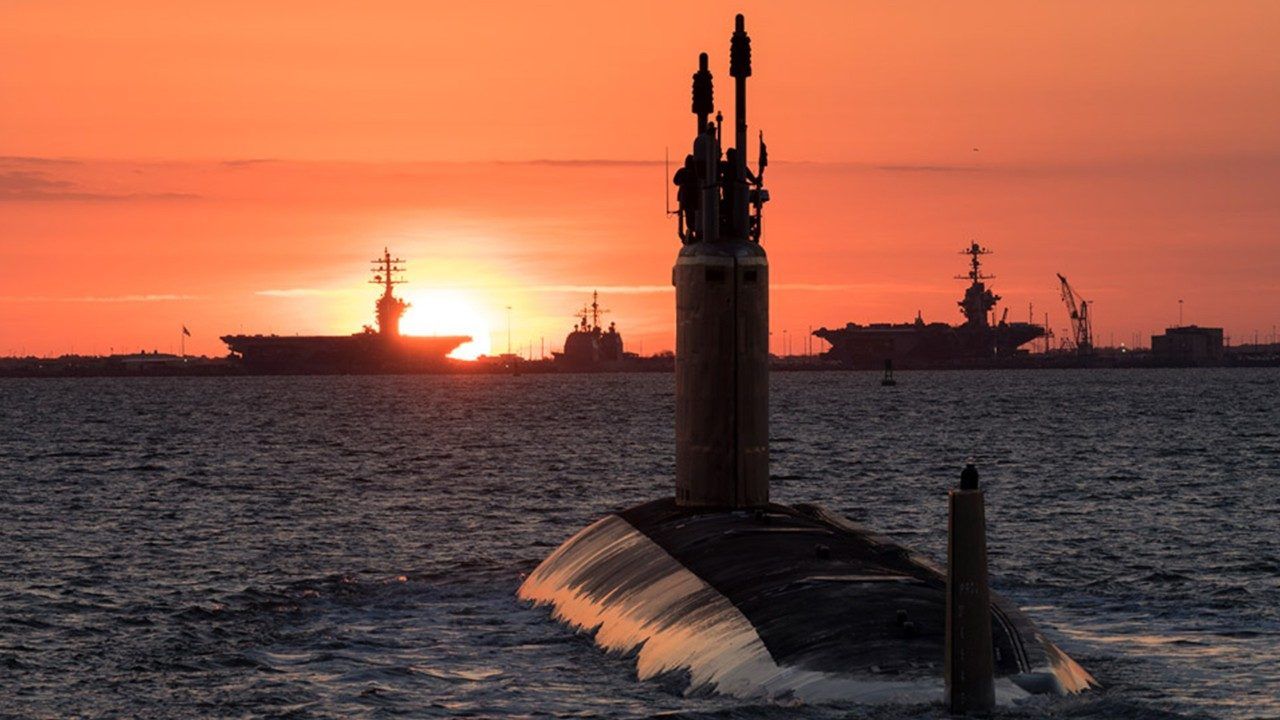
The system receives signals through the submarine's masts. Radar emissions are collected by a photonics mast on Virginia-class submarines or by a periscope on other supported classes. Communications emissions can be collected through the imaging mast and a dedicated intercept mast.
Dedicated mast types include the AN/BRD-7 on Los Angeles- and Seawolf-class submarines, the AN/BSD-2 on Virginia-class submarines, and the Multifunction Modular Mast fitted to some Los Angeles- and Virginia-class boats. These installations provide similar core functions but differ in frequency coverage and localization accuracy.
Separate subsystems process radar and communications signals. The system automatically detects and acquires emissions, analyzes their characteristics, attempts identification and determines direction or location. It interfaces with the submarine's non-propulsion electronic-systems tactical network and other ship systems.
Operator functions
Operator interfaces provide threat-warning and mission-tasking information, signal alerts, summary reports and geographic presentation. Other functions include identification-confidence displays, direction-finding plots, receiver control, contact management, signal exploitation and management of signals that are not currently of interest.
Information from AN/BLQ-10 supports counter-detection avoidance, collision avoidance, target-location assessment and intelligence, surveillance and reconnaissance. Submarine crews primarily use the system while operating at periscope depth, when the required antennas and sensors can receive external electromagnetic signals.
Operational history
The United States Navy employs AN/BLQ-10 on Virginia-, Los Angeles- and Seawolf-class fast-attack submarines and Ohio-class guided-missile submarines. Modernization contracts also cover the future Columbia-class ballistic-missile submarines.
The system has been integrated alongside imaging and electronic-support masts, exterior communications equipment, sonar and other submarine systems. Information gathered from detected emissions can be distributed through the submarine's combat-control and communications equipment.
Modernization releases
- TI-08: The first documented Technical Insertion, adding a subsystem intended to intercept some low-probability-of-intercept radar signals.
- TI-10: A subsequent configuration planned to include a new communications-intercept algorithm and additional testing.
- TI-20, TI-22 and TI-24: Modernization packages covered by the 2024 contract modification.
- TI-26: A modernization package supported by the 2026 production-material delivery order.
- TI-28 and TI-30: Later modernization efforts included within the 2025 contract vehicle.
Operators
- United States: Operated by the United States Navy on Los Angeles-, Seawolf-, Virginia- and Ohio-class submarines, with integration also planned for the Columbia class.
Specifications (AN/BLQ-10(V))
General characteristics
- Type: Submarine electronic-support and electronic-warfare system.
- Manufacturer and integrator: Lockheed Martin Rotary and Mission Systems, Syracuse, New York.
- Architecture: Secure modular open architecture using commercial off-the-shelf and non-developmental hardware and software.
- Primary inputs: Radar and communications emissions received through imaging, electronic-support and communications-intercept masts.
- Signal categories: Hostile, neutral and friendly radio-frequency emissions.
Capabilities
- Core processing: Automatic signal detection, acquisition, classification, identification and localization.
- Radar functions: Full-spectrum radar processing, threat warning and direction finding.
- Communications functions: Communications-signal interception, analysis and localization.
- Mission support: Threat avoidance, situational assessment, intelligence collection and target-location support.
- Operator outputs: Mission-tasking, early-warning, geographic, identification-confidence, direction-finding and signal-summary displays and reports.
Lockheed Martin's AN/BLQ-10(V) brochure describes the current architecture and operator functions. Historical background is also available in the ASTECS system overview, while later contract reporting documents the TI-20 through TI-24 upgrades and the 2025 Navy contract.
 Argentina
 Armenia
 Australia
 Austria
 Austria-Hungary
 Belgium
 Brazil
 United Kingdom
 Brunei
 Bulgaria
 Canada
 Chile
Chile China
China Colonial America
 Colombia
 Confederate States
 Croatia
 Czech
Czech Denmark
 Egypt
Egypt Finland
 France
 Georgia
 Germany
 German Imperial
 Greece
 Holland
 Hungary
 India
India Indonesia
 Iran
Iran Iraq
Iraq Ireland
 Israel
 Italy
Italy Japan
Japan Japan (1940)
 Jordan
 Kingdom of Italy
 Malaysia
 Mexico
 Myanmar
 Nazi Germany
 Netherlands
 New Zealand
 North Korea
 Norway
 Pakistan
 Peru
Peru Philippines
 Poland
 Portugal
 Prussia
 Romania
 Russia
 Saudi Arabia
 Serbia
 Singapore
 Slovakia
 Slovenia
 South Africa
 South Korea
 Soviet Union
 Spain
Spain Sweden
 Switzerland
 Syria
Syria Taiwan
 Thailand
 Turkey
 UAE
UAE Ukraine
 Vietnam
 Yugoslavia