

History
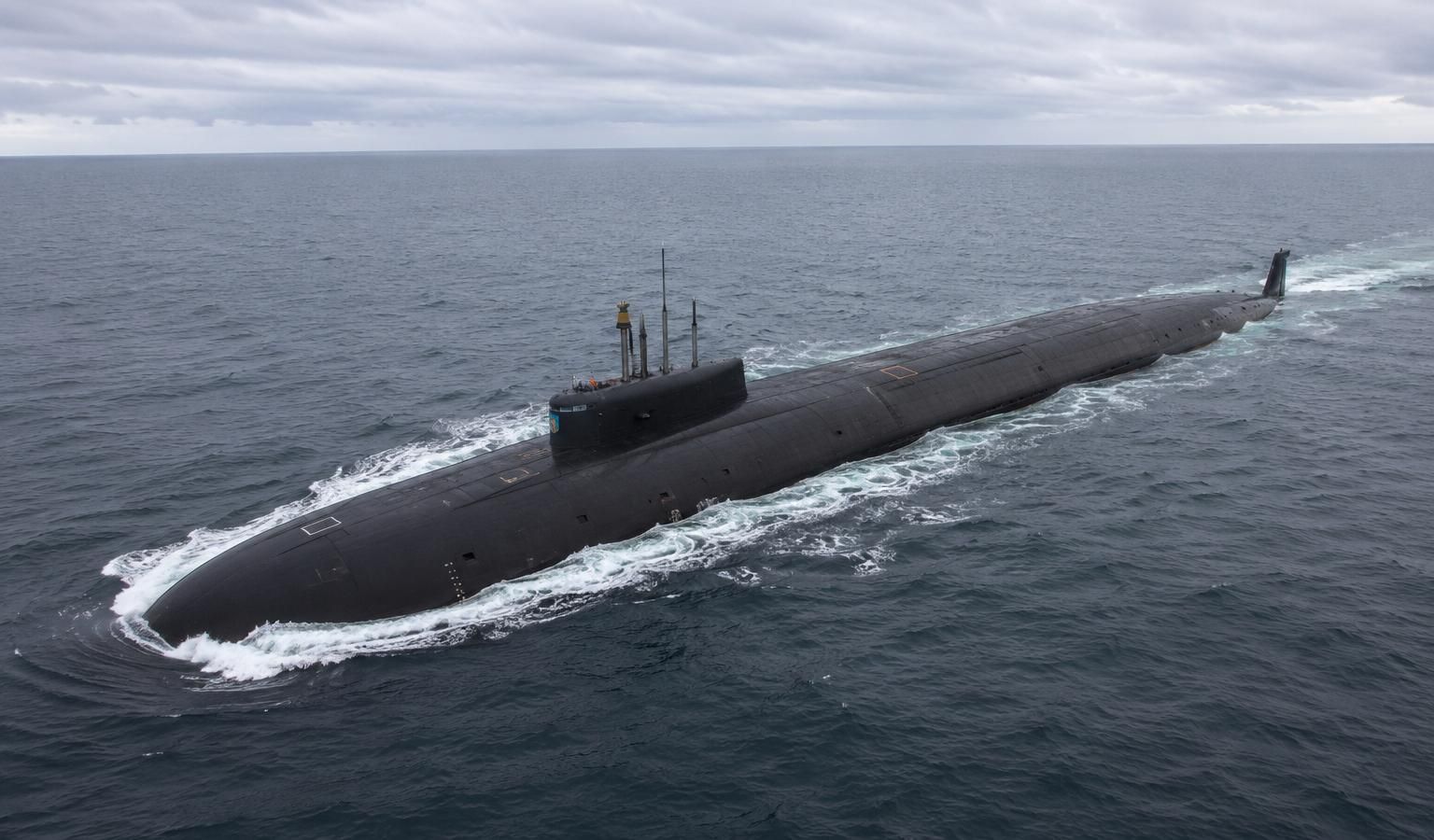
Project 09851 Khabarovsk is a Russian nuclear-powered special-purpose submarine developed as a dedicated carrier for the Poseidon 2M39 nuclear-powered underwater weapon. The Rubin Central Design Bureau designed the submarine, and Sevmash built the lead boat at Severodvinsk.
The design gives the Russian Navy a strategic delivery platform that differs from a conventional ballistic-missile submarine. Instead of submarine-launched ballistic missiles, Khabarovsk is intended to deploy very-long-range autonomous underwater weapons against coastal targets and infrastructure.
Open information about Project 09851 remains limited, and many dimensions and performance figures are estimates. Published imagery and independent analysis nevertheless establish its broad layout, launch history, and primary mission.
Development
Russia developed Khabarovsk alongside Poseidon. The submarine is widely reported to use design elements from the Project 955 Borei ballistic-missile submarine, but it omits the large ballistic-missile compartment. Its bow was instead arranged around the dedicated Poseidon payload.
Construction of the lead submarine began at Sevmash on 27 July 2014. The project became publicly associated with Russia's new strategic underwater weapon program during 2015. Unlike the Project 09852 Belgorod, which was converted from an unfinished Project 949A hull, Project 09851 was designed for the Poseidon role from the outset.
Launch and trials
Khabarovsk was ceremonially launched on 1 November 2025 and subsequently lowered into the water. Contemporary reporting described the event as the first public view of the dedicated Project 09851 carrier, although the bow remained concealed. The launch exposed a pump-jet propulsor at the stern.
On 17 August 2026, Sevmash sent Khabarovsk to sea for factory trials, marking its first reported voyage under its own trial program. Commissioning had previously been projected for the end of 2026, but that date remains a plan rather than a confirmed service milestone. The submarine has been reported as intended for the Russian Pacific Fleet.
A detailed overview of the program and its strategic purpose was published by the U.S. Naval Institute, while subsequent imagery analysis by Naval News examined the submarine's probable internal arrangement.
Design
Hull and propulsion
Khabarovsk is a large nuclear-powered submarine with a compact strategic layout compared with the Borei class. Open-source estimates place its length between approximately 113 and 140 m and its beam between about 10 and 13.5 m. Surfaced displacement is commonly estimated at about 10,000 tonnes. These figures have not been released as a complete official specification.
The submarine is reported to use a pressurized-water nuclear reactor driving a pump-jet propulsor. Nuclear propulsion gives it a range limited principally by stores, maintenance, and crew endurance rather than fuel. Published estimates place submerged speed at 30 to 32 knots, operating depth at up to approximately 500 m, crew at about 100, and endurance at roughly 90 to 120 days. These remain open-source assessments.
Payload arrangement
Analysis of the visible hull indicates that the Poseidon weapons are carried forward rather than in a central ballistic-missile compartment. The probable arrangement uses two flooded side hangars with large bow loading and launch openings. A smaller conventional torpedo room is thought to occupy the space between them.
This arrangement is similar in concept to the forward payload installation on Belgorod. The available space for conventional torpedoes is consequently smaller than on a general-purpose attack submarine. The number and calibre of conventional torpedo tubes and the quantity of reloads have not been confirmed.
Armament
The primary payload is reported as six Poseidon 2M39 autonomous underwater weapons. Poseidon combines nuclear propulsion with a nuclear warhead and is intended to travel over intercontinental distances underwater. Exact performance and warhead claims vary substantially among sources and remain difficult to verify.
Conventional heavyweight torpedoes are also reported for self-defence. Claims that Project 09851 can carry land-attack or anti-ship cruise missiles have appeared in secondary sources, but no confirmed launcher configuration has been published.
Program status
As of August 2026, Khabarovsk was in factory sea trials and had not been confirmed in operational service. It is the first purpose-built Project 09851 carrier and the second Russian submarine associated with Poseidon after Belgorod. The readiness of the submarine and the operational status of its principal weapon are separate milestones.
Russian planning has included additional Poseidon carriers. Reports identify Ulyanovsk and Orenburg in connection with follow-on construction, although sources differ over names, sequence, and whether later boats belong to Project 09851 or the related Project 09853 design. These vessels should therefore not be treated as confirmed production units of an identical Khabarovsk configuration.
Variants and related projects
- Project 09851 Khabarovsk — the lead purpose-built nuclear-powered Poseidon carrier launched in 2025 and sent to factory trials in 2026.
- Project 09852 Belgorod — an earlier Poseidon-capable special-purpose submarine converted from a Project 949A Oscar II-class hull and delivered in 2022.
- Project 09853 — a reported follow-on design associated with later Poseidon carriers; its relationship to Project 09851 and detailed configuration have not been officially clarified.
Specifications (Project 09851 Khabarovsk)
General characteristics
- Type: nuclear-powered special-purpose strategic submarine
- Designer: Rubin Central Design Bureau
- Builder: Sevmash, Severodvinsk
- Length: approximately 113–140 m, depending on source
- Beam: approximately 10–13.5 m, depending on source
- Surfaced displacement: approximately 10,000 tonnes
- Crew: approximately 100
- Endurance: estimated 90–120 days
- Powerplant: nuclear reactor with steam-turbine drive
- Propulsor: pump jet
Performance
- Maximum submerged speed: estimated 30–32 knots
- Operating depth: estimated up to approximately 500 m
- Range: effectively unlimited by propulsion fuel
Armament
- Strategic payload: up to six Poseidon 2M39 nuclear-powered autonomous underwater weapons
- Conventional weapons: heavyweight torpedoes; tube arrangement and reload count not confirmed
 Argentina
 Armenia
 Australia
 Austria
 Austria-Hungary
 Belgium
 Brazil
 United Kingdom
 United States
 Brunei
 Bulgaria
 Canada
 Chile
Chile China
China Colonial America
 Colombia
 Confederate States
 Croatia
 Czech
Czech Denmark
 Egypt
Egypt Finland
 France
 Georgia
 Germany
 German Imperial
 Greece
 Holland
 Hungary
 India
India Indonesia
 Iran
Iran Iraq
Iraq Ireland
 Israel
 Italy
Italy Japan
Japan Japan (1940)
 Jordan
 Kingdom of Italy
 Malaysia
 Mexico
 Myanmar
 Nazi Germany
 Netherlands
 New Zealand
 North Korea
 Norway
 Pakistan
 Peru
Peru Philippines
 Poland
 Portugal
 Prussia
 Romania
 Saudi Arabia
 Serbia
 Singapore
 Slovakia
 Slovenia
 South Africa
 South Korea
 Soviet Union
 Spain
Spain Sweden
 Switzerland
 Syria
Syria Taiwan
 Thailand
 Turkey
 UAE
UAE Ukraine
 Vietnam
 Yugoslavia