
History
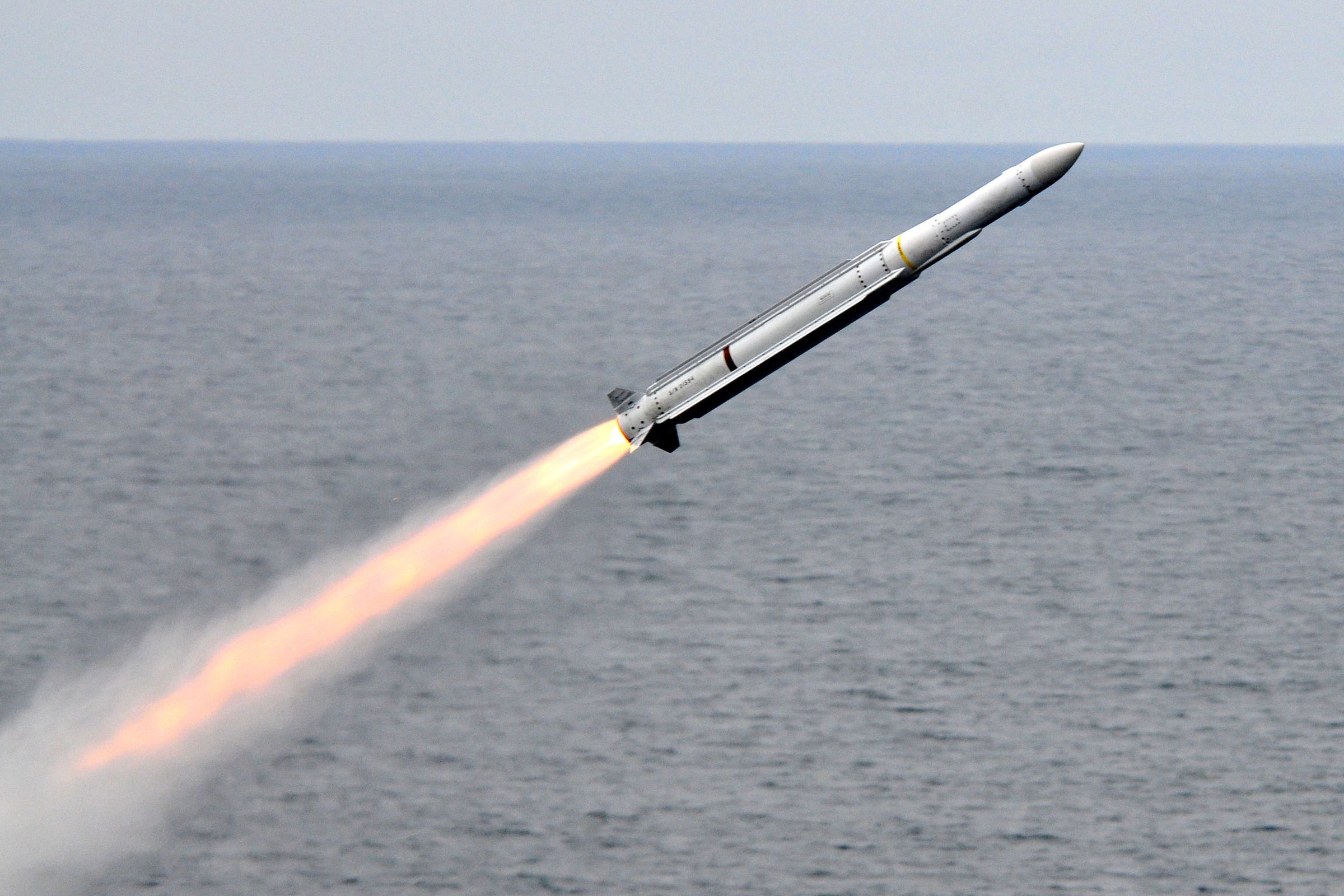
The RIM-162 Evolved SeaSparrow Missile (ESSM) is a ship-launched guided missile developed to protect naval vessels against aircraft, anti-ship cruise missiles, and other fast or maneuvering threats. It evolved from the RIM-7 Sea Sparrow family but introduced substantially improved propulsion, aerodynamics, guidance, and maneuverability.
ESSM was developed as an international cooperative program led by the United States with Australia, Canada, Denmark, Germany, Greece, the Netherlands, Norway, Spain, and Turkey. The U.S. Navy fact file describes Block 1 as a kinematic upgrade to the RIM-7P Sea Sparrow that combines U.S. guidance technology with multinational development and production arrangements.
The missile entered production during the late 1990s, with production reported from September 1998. Development testing followed, including a successful maneuvering-target engagement during Block 1 testing in March 2000 and Aegis-guided live firings in 2001. Initial production missiles entered operational evaluation in 2002, and the first production ESSM was delivered to the U.S. Navy late that year. Full operational use in the U.S. Navy began in 2004.
Development and testing
The ESSM program grew from NATO Sea Sparrow efforts to counter increasingly fast, low-altitude anti-ship threats. A proposal to improve the NATO Sea Sparrow Missile System was submitted in 1991, leading to the missile that became ESSM. According to the CSIS Missile Threat profile, the program added capabilities including an inertial guidance system, midcourse data uplinks, redesigned control features, and an improved warhead section.
In July 2002, USS Shoup launched ESSM from a Mk 41 Vertical Launching System during operational evaluation. Australia followed with a successful firing from HMAS Warramunga in October 2003. The Royal Netherlands Navy conducted a live firing from HNLMS De Zeven Provinciën in November 2003 using the APAR radar and Interrupted Continuous Wave Illumination guidance technique. German and Dutch frigates carried out additional live-fire programs in 2004 and 2005.
On 7 October 2008, USS John C. Stennis achieved the first reported target kill by a RIM-162D launched from a U.S. Navy carrier's Mk 29 launcher. In 2013, ESSM intercepted a high-diving supersonic test target, demonstrating capability against demanding airborne threats. Thailand also conducted a successful firing from HTMS Naresuan in 2015.
Block 2
Development of ESSM Block 2 began in 2014. The new version retained the propulsion section of Block 1 but enlarged the guidance section to 254 mm and introduced a dual-mode seeker combining semi-active and active radar guidance. This reduces dependence on continuous target illumination by the launching ship and improves engagement flexibility against maneuvering targets.
The first live-fire test of Block 2 occurred in 2018, when the missile intercepted a BQM-74E target drone using its active seeker. The U.S. Navy states that Block 2 achieved initial operational capability in 2021. Belgium and Portugal joined the group of NATO Sea Sparrow Consortium nations participating in the Block 2 effort.
In August 2026, the U.S. Naval Sea Systems Command sought industry input on a future replacement or new development derived from the ESSM requirement. The request indicated that the Navy was examining a successor capability while ESSM remained an established fleet-defense weapon.
Design
ESSM is a compact naval missile optimized for rapid acceleration and high maneuverability. The missile uses a high-thrust solid-propellant rocket motor and tail control augmented by thrust-vector control. The arrangement gives the missile the agility required to engage fast, maneuvering targets at relatively short reaction times.
The missile is approximately 3.66 m long and has a maximum body diameter of 254 mm. The Block 1 guidance section narrows to about 203 mm, while the control and rocket-motor sections are 254 mm in diameter. The missile weighs approximately 280 kg. The Royal Australian Navy lists a range greater than 50 km and a speed greater than Mach 4, while the U.S. Navy publicly lists its range and speed as classified.
Guidance
Block 1 uses inertial flight control with ship-provided midcourse data updates and semi-active radar homing for terminal guidance. Depending on ship integration, ESSM can receive S-band or X-band uplinks. Its guidance architecture allows integration with combat systems including Aegis, NATO Sea Sparrow systems, Ship Self-Defense System, APAR-based configurations, and other national combat systems.
Block 2 introduces a dual-mode radar seeker using both semi-active and active radar guidance. Active terminal homing allows the missile to complete some engagements without continuous illumination from the launching ship's dedicated fire-control radar. A contemporary overview from The Defense Post describes ESSM as a networked fleet-defense interceptor integrated with shipboard radars, combat-management systems, and vertical launchers.
Warhead
The U.S. Navy describes Block 1 as carrying an annular blast-fragmentation warhead weighing about 41 kg. The missile uses a proximity-fuzed fragmentation effect to damage or destroy aerial and missile targets. Block 2 incorporates an updated blast-fragmentation warhead.
Launch systems
ESSM was designed for integration with several naval launch systems. These include the Mk 29 trainable launcher, Mk 41 Vertical Launching System, Mk 48 Guided Missile Vertical Launching System, Mk 56 Dual Pack ESSM Launching System, and Mk 57 Vertical Launching System.
A major feature of Mk 41 integration is the Mk 25 quad-pack canister, which allows four ESSMs to occupy one Mk 41 launch cell. This substantially increases the number of defensive missiles that can be carried compared with weapons that require one complete Mk 41 cell per missile. The Mk 48 and Mk 56 systems provide alternative installations for ships that do not use the Mk 41 configuration.
Operational history
The U.S. Navy has operated ESSM since 2004, and the missile has also entered service with numerous allied and partner navies. It is fitted to aircraft carriers, amphibious assault ships, destroyers, frigates, and other surface combatants equipped with compatible launchers and combat systems.
ESSM was used in combat for the first time on 9 October 2016, when USS Mason responded to anti-ship cruise missiles launched from Yemen. The destroyer fired one ESSM and two SM-2 missiles and deployed a Nulka decoy. The ship was not hit, but available reporting does not establish whether the ESSM destroyed either incoming missile.
The missile continues to form part of layered ship air-defense architectures alongside longer-range interceptors. Public technical summaries, including the RIM-162 ESSM reference overview, document its widespread integration with Mk 41, Mk 48, Mk 56, Mk 57, and Mk 29 launcher families.
Variants
- ESSM Block 1: Original operational production version. It uses inertial and midcourse guidance with terminal semi-active radar homing and is compatible with several launcher and combat-system configurations.
- ESSM Block 2: Follow-on version developed from 2014. It retains the Block 1 propulsion section while introducing a 254 mm guidance section, dual semi-active and active radar seeker, improved communications, and an updated warhead. U.S. Navy initial operational capability was achieved in 2021.
Operators
- Australia: ESSM consortium member and operational user.
- Belgium: NATO Sea Sparrow Consortium member participating in Block 2.
- Canada: ESSM consortium member and operational user.
- Chile: Foreign Military Sales user reported with ESSM.
- Denmark: ESSM consortium member and operational user.
- Finland: Foreign Military Sales customer for ESSM.
- Germany: ESSM consortium member and operational user.
- Greece: ESSM consortium member and operational user.
- Japan: Foreign Military Sales user.
- Mexico: ESSM customer with Mk 56 integration reported for its SIGMA-derived frigate program.
- Netherlands: ESSM consortium member and operational user.
- Norway: ESSM consortium member and operational user.
- Portugal: NATO Sea Sparrow Consortium member participating in Block 2.
- Spain: ESSM consortium member and operational user.
- Thailand: Foreign Military Sales user.
- Turkey: ESSM consortium member and operational user.
- United Arab Emirates: Foreign Military Sales user.
- United States: Principal development nation, consortium member, and U.S. Navy operator since 2004.
Specifications (ESSM Block 1)
General characteristics
- Type: Ship-launched surface-to-air and surface-to-surface guided missile
- Manufacturer: Raytheon Missile Systems
- Length: 3.66 m
- Maximum diameter: 254 mm
- Guidance-section diameter: 203 mm
- Weight: approximately 280 kg
- Propulsion: High-thrust solid-propellant rocket motor with thrust-vector control
- Warhead: approximately 41 kg annular blast-fragmentation warhead
Performance
- Range: greater than 50 km according to the Royal Australian Navy; U.S. Navy figure classified
- Speed: greater than Mach 4 according to the Royal Australian Navy; U.S. Navy figure classified
Guidance and launch
- Midcourse guidance: Inertial guidance with radar data uplinks
- Terminal guidance: Semi-active radar homing
- Launch systems: Mk 29, Mk 41 VLS, Mk 48 Guided Missile VLS, Mk 56 Dual Pack ESSM Launching System, and Mk 57 VLS
- Mk 41 loading: Up to four ESSMs in one Mk 41 cell using the Mk 25 quad-pack canister
Related equipment
- RIM-7 Sea Sparrow: Earlier naval surface-to-air missile from which ESSM was developed.
- AIM-7 Sparrow: Air-to-air missile family forming the earlier technological lineage of Sea Sparrow.
 Argentina
 Armenia
 Australia
 Austria
 Austria-Hungary
 Belgium
 Brazil
 United Kingdom
 Brunei
 Bulgaria
 Canada
 Chile
Chile China
China Colonial America
 Colombia
 Confederate States
 Croatia
 Czech
Czech Denmark
 Egypt
Egypt Finland
 France
 Georgia
 Germany
 German Imperial
 Greece
 Holland
 Hungary
 India
India Indonesia
 Iran
Iran Iraq
Iraq Ireland
 Israel
 Italy
Italy Japan
Japan Japan (1940)
 Jordan
 Kingdom of Italy
 Malaysia
 Mexico
 Myanmar
 Nazi Germany
 Netherlands
 New Zealand
 North Korea
 Norway
 Pakistan
 Peru
Peru Philippines
 Poland
 Portugal
 Prussia
 Romania
 Russia
 Saudi Arabia
 Serbia
 Singapore
 Slovakia
 Slovenia
 South Africa
 South Korea
 Soviet Union
 Spain
Spain Sweden
 Switzerland
 Syria
Syria Taiwan
 Thailand
 Turkey
 UAE
UAE Ukraine
 Vietnam
 Yugoslavia