
History
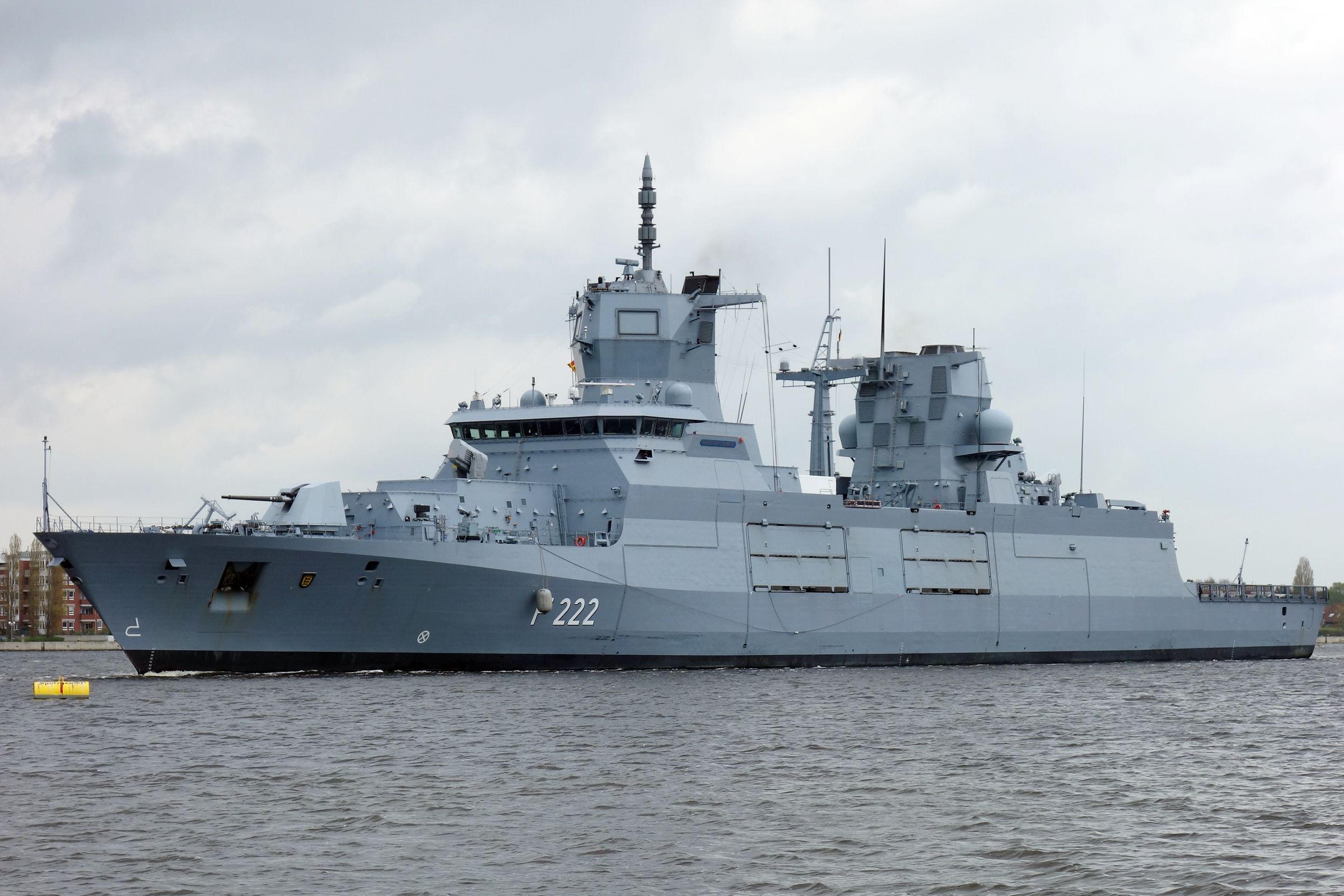
The Baden-Württemberg class, also designated F125, is a four-ship class of German Navy frigates developed for long-duration deployments, stabilization missions, crisis management, conflict prevention, international intervention, and support of special operations. With a displacement of about 7,200 tonnes and a length of approximately 149.5 m, the ships are unusually large for frigates but were originally equipped with comparatively limited weapons for high-intensity naval combat.
The design emphasizes endurance, reduced crew requirements, automation, survivability, and sustained operation far from German home ports. The class was built around a concept in which ships could remain deployed for extended periods while rotating crews, rather than returning frequently for conventional maintenance and personnel changes.
The original armament centered on a 127 mm gun, Harpoon anti-ship missiles, remotely operated guns, and RIM-116 Rolling Airframe Missiles for close-range air defense. The absence of a medium-range surface-to-air missile system and organic anti-submarine warfare equipment became increasingly significant as the maritime threat environment evolved. Germany subsequently began adapting the IRIS-T SLM system for the class.
Development and construction
Germany ordered four F125 frigates on 26 June 2007. The ships were developed and constructed by ARGE F125, a joint venture involving ThyssenKrupp Marine Systems and Lürssen. The class was intended to replace part of the German Navy's Bremen-class frigate force while introducing a different operational concept focused on long deployments and lower-intensity stabilization missions.
Early weapon concepts included naval adaptations of the PzH 2000 155 mm artillery system and the M270-derived guided multiple-launch rocket system. These concepts were abandoned because of the difficulties and costs associated with adapting land-based weapons for shipboard use. The production configuration instead received a 127 mm naval gun with Vulcano-compatible ammunition.
The lead ship, Baden-Württemberg, was laid down in November 2011 and launched in December 2013. During trials, the ship experienced technical problems that included a persistent list to starboard, excessive weight, and software problems affecting the operations room. The German procurement authority returned the ship to the builder for corrective work rather than accepting it into service at that stage.
Baden-Württemberg was eventually accepted and entered German Navy service in 2019. Nordrhein-Westfalen followed in 2020, Sachsen-Anhalt in 2021, and Rheinland-Pfalz in 2022. All four planned ships were therefore in service by 2022.
Air-defense modernization
The original F125 configuration relied on two 21-cell RIM-116 Rolling Airframe Missile launchers for close-range air defense and had no medium- or long-range surface-to-air missile battery. Germany began examining the feasibility of integrating IRIS-T SLM with the class in 2024.
A navalized IRIS-T SLM demonstrator was developed in 2025. In October 2025, Baden-Württemberg participated in a maritime firing exercise off Andøya, Norway, using an experimental anti-air warfare module based on IRIS-T SLM. The ship fired three live missiles, while its radar supplied target information to the missile system. The demonstration established the basic ability to connect the F125 sensor architecture with the navalized missile system.
In 2026, Germany moved from the demonstrator stage toward a fleet-capable installation. Diehl Defence and the Federal Office of Bundeswehr Equipment, Information Technology and In-Service Support agreed on an adaptation and development program involving prototypes and additional test firings. The planned configuration provides two launchers on each frigate, with 16 missiles per launcher and 32 IRIS-T SLM missiles in total.
The IRIS-T SLM integration is intended to add a medium-range self-defense capability without installing a conventional large vertical-launch system. The missile system has an engagement range of about 40 km (25 mi) and an altitude envelope of approximately 20 km (65,000 ft). The modernization does not convert the F125 into a dedicated area-air-defense destroyer, and the ships still lack the large missile battery associated with Germany's F124 Sachsen-class frigates.
Design
Hull and survivability
The F125 design uses two large separated superstructure blocks, often described as a two-island arrangement. Important systems are distributed between these structures so that damage to one part of the ship does not necessarily disable all corresponding functions. Components of the TRS-4D radar installation are distributed across the superstructures.
The ships were designed with reduced radar, infrared, and acoustic signatures. Modular sensor masts and distributed systems were intended to improve survivability and support later changes to sensors and communications equipment. Space is also provided for containerized mission equipment.
Crew and endurance
Automation allows the class to operate with a standard crew of approximately 110 personnel despite its large displacement. Accommodation is available for additional embarked personnel, including aviation crews, specialists, and special operations forces, with total accommodation reaching approximately 190 people.
The operational concept called for deployments lasting as long as two years away from home ports, supported by rotating crews. The ships were designed for more than 5,000 hours of sea operation per year and for sustained service in demanding climates, including tropical conditions.
Propulsion
The class uses a combined diesel-electric and gas propulsion arrangement. The machinery includes one General Electric LM2500 gas turbine rated at about 20 MW, four MTU 20V 4000 M53B diesel generator sets rated at approximately 3.0 MW each, and two Siemens electric propulsion motors rated at about 4.5 MW each. Power is transmitted through gearboxes to two shafts with controllable-pitch propellers. A bow thruster assists low-speed maneuvering.
The arrangement allows economical diesel-electric operation for normal cruising while the gas turbine provides additional power when higher speed is required. Maximum speed is approximately 52 km/h (28 knots), while diesel-only operation permits about 37 km/h (20 knots).
Sensors and combat systems
The primary surveillance sensor is the TRS-4D active electronically scanned array radar. The class also carries navigation radars, identification equipment, electro-optical sensors, infrared surveillance equipment, electronic-support systems, and tactical data links. Its combat-system architecture was designed around extensive automation and networked sensor management.
A notable limitation of the original configuration was the difference between the detection capability of the ship's sensors and the engagement range of its close-in air-defense weapons. The IRIS-T SLM program is intended to use the existing sensor architecture to extend the ship's ability to engage airborne threats at medium range.
Armament
The principal gun is a 127 mm Oto Melara/Leonardo 127/64 lightweight naval gun capable of using Vulcano ammunition. Anti-ship armament consists of eight RGM-84 Harpoon missiles in the original configuration. Close-range air defense is provided by two Mk 49 launchers, each carrying 21 RIM-116 Rolling Airframe Missiles.
Additional weapons include two remotely operated 27 mm MLG 27 cannon systems, five remotely operated 12.7 mm Hitrole-NT weapon stations, and manually operated heavy machine guns for force protection. The ships also carry soft-kill countermeasures and equipment intended for protection against asymmetric threats.
The planned IRIS-T SLM modernization adds two 16-missile launchers for a total of 32 medium-range surface-to-air missiles. This capability is being adapted specifically to the F125 architecture and remains a modernization program rather than part of the class's original commissioned armament.
Aviation and boats
The class has a flight deck and hangar capable of supporting two NH90 helicopters. Four approximately 11 m rigid-hull inflatable boats can be handled through side-mounted launch and recovery arrangements, supporting boarding operations, special forces missions, and other maritime security tasks.
Operational history
The four F125 frigates entered German Navy service between 2019 and 2022. The lead ship reached full operational capability by 2023. Baden-Württemberg subsequently participated in a major Indo-Pacific deployment in 2024.
During its return from that deployment in November 2024, Baden-Württemberg avoided the Red Sea because its existing air-defense capability was considered insufficient for the missile and drone threat in the region. The ship instead returned by a route around Africa. The episode highlighted the operational consequences of relying primarily on short-range RAM missiles for air defense.
In October 2025, Baden-Württemberg became the test platform for the navalized IRIS-T SLM demonstrator during firing trials near Andøya. Three live missiles were launched, and the ship's radar supplied targeting data to the system. The successful demonstration led to the subsequent development and qualification effort for installation across the class.
Ships in class
- Baden-Württemberg (F 222) – lead ship, entered service in 2019.
- Nordrhein-Westfalen (F 223) – entered service in 2020.
- Sachsen-Anhalt (F 224) – entered service in 2021.
- Rheinland-Pfalz (F 225) – entered service in 2022.
Operators
- Germany – German Navy operates all four Baden-Württemberg-class frigates.
Specifications (Baden-Württemberg class)
General characteristics
- Type: Frigate
- Displacement: approximately 7,200 tonnes full load
- Length: 149.52 m
- Beam: 18.80 m
- Draft: 5.40 m
- Standard crew: approximately 110
- Total accommodation: approximately 190 personnel
- Propulsion: combined diesel-electric and gas arrangement with one LM2500 gas turbine, four MTU 20V 4000 M53B diesel generators, and two Siemens electric motors driving two shafts
Performance
- Maximum speed: approximately 52 km/h (28 knots)
- Diesel-only speed: approximately 37 km/h (20 knots)
- Range: approximately 15,000 km (8,000 nmi)
Armament
- Main gun: 1 × 127 mm Oto Melara/Leonardo 127/64 lightweight naval gun
- Anti-ship missiles: 8 × RGM-84 Harpoon
- Close-range air defense: 2 × 21-cell RIM-116 Rolling Airframe Missile launchers
- Medium-range air defense: planned 2 × 16-missile IRIS-T SLM launchers, 32 missiles total
- Remote cannon: 2 × 27 mm MLG 27
- Remote machine guns: 5 × 12.7 mm Hitrole-NT weapon stations
Aviation
- Aircraft capacity: 2 × NH90 helicopters
 Argentina
 Armenia
 Australia
 Austria
 Austria-Hungary
 Belgium
 Brazil
 United Kingdom
 United States
 Brunei
 Bulgaria
 Canada
 Chile
Chile China
China Colonial America
 Colombia
 Confederate States
 Croatia
 Czech
Czech Denmark
 Egypt
Egypt Finland
 France
 Georgia
 German Imperial
 Greece
 Holland
 Hungary
 India
India Indonesia
 Iran
Iran Iraq
Iraq Ireland
 Israel
 Italy
Italy Japan
Japan Japan (1940)
 Jordan
 Kingdom of Italy
 Malaysia
 Mexico
 Myanmar
 Nazi Germany
 Netherlands
 New Zealand
 North Korea
 Norway
 Pakistan
 Peru
Peru Philippines
 Poland
 Portugal
 Prussia
 Romania
 Russia
 Saudi Arabia
 Serbia
 Singapore
 Slovakia
 Slovenia
 South Africa
 South Korea
 Soviet Union
 Spain
Spain Sweden
 Switzerland
 Syria
Syria Taiwan
 Thailand
 Turkey
 UAE
UAE Ukraine
 Vietnam
 Yugoslavia