
History
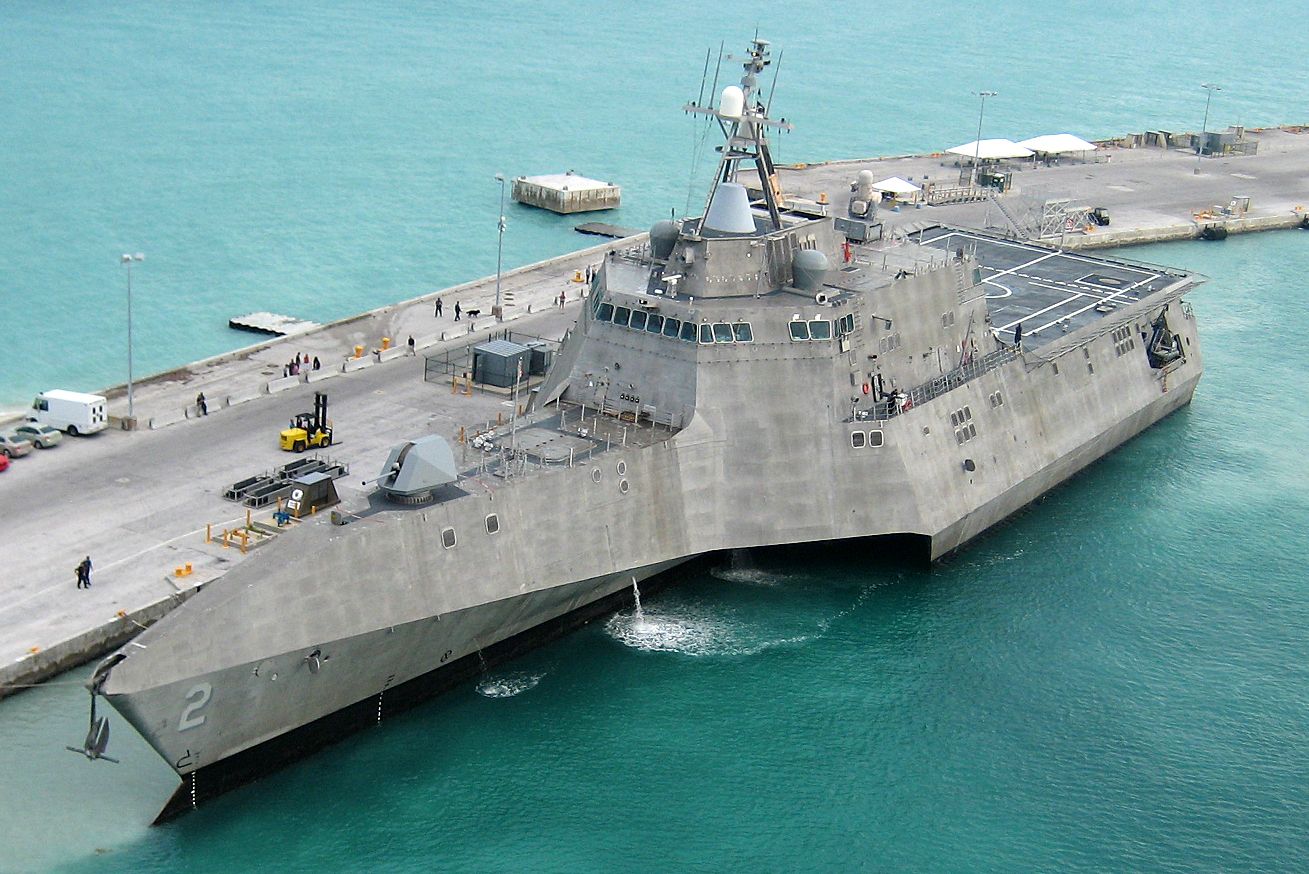
The Littoral Combat Ship (LCS) program was launched by the U.S. Navy in 2002 to develop a new class of fast, agile ships for littoral operations. In 2003 the Navy committed to the $15 billion (2003 dollars) programme. Production contracts were awarded in 2004, selecting two design teams: Lockheed Martin for the steel monohull Freedom variant and General Dynamics (later Austal USA) for the aluminum trimaran Independence variant. The USS Freedom (LCS 1) had her keel laid on 2 June 2005, was christened and launched on 23 September 2006, and was commissioned on 8 November 2008. The USS Independence (LCS 2) had her keel laid on 19 January 2006, was launched on 30 April 2008, and was commissioned on 16 January 2010. Between 2013 and 2015 the Navy progressively reduced planned procurement from 55 to 40 ships. In April 2020 the Constellation-class frigate was selected as a complementary multi-mission surface combatant.
Specifications
Freedom variant
The Freedom variant is a steel monohull built by Lockheed Martin at the Fincantieri Marinette Marine shipyard in Marinette, Wisconsin. Its length is 118.1 m (387.6 ft), beam 17.6 m (57.7 ft), draft 4.3 m (14.1 ft), with a full-load displacement of approximately 3,450 MT. Propulsion combines diesel and gas turbine engines with steerable water jet drives, providing a speed greater than 40 knots. The core crew is 50 with accommodations for 98 sailors. The hangar can accommodate two MH-60 helicopters or one MH-60 and one MQ-8 Fire Scout unmanned aerial vehicle. The flight deck is over 1.5 times the size of that on traditional surface combatants. Standard armament includes a 57 mm Mk 110 gun and RIM-116 Rolling Airframe Missiles.
Independence variant
The Independence variant is an aluminum trimaran. LCS 2 and LCS 4 were built by General Dynamics; LCS 6 and subsequent ships were built by Austal USA in Mobile, Alabama. Its length is 128.5 m (421.5 ft), beam 31.6 m (103.7 ft), draft 4.6 m (15.1 ft), with a full-load displacement of approximately 3,200 MT. The trimaran hull provides what the Navy describes as the largest flight deck of any current U.S. Navy surface combatant, and the aviation hangar can accommodate two MH-60-class helicopters.
Forward aviation role
During Steel Knight 23 in December 2022, the Independence-variant USS Jackson (LCS 6) operated with Marine AH-1Z Vipers and UH-1Y Venoms, demonstrating the ability to position two H-1 helicopters on the flight deck, conduct arming and de-arming procedures, refuel the aircraft, and relaunch them. In October 2026 the Independence-variant USS Canberra (LCS 30) conducted operations with an AH-1Z Viper of Marine Light Attack Helicopter Squadron 367 (HMLA-367), including a landing while underway in the Philippine Sea on 1 October 2026 and a departure preparation at White Beach Naval Facility, Okinawa, on 5 October 2026. These operations demonstrate the LCS's potential as an alternate launch and recovery platform for Marine attack helicopters within a distributed aviation network. An LCS, however, lacks the fuel reserves, weapons magazines, maintenance depth, and full aviation-support infrastructure of an amphibious assault ship, and no publicly announced program exists to permanently base AH-1Z detachments aboard LCS vessels.
 Argentina
 Armenia
 Australia
 Austria
 Austria-Hungary
 Belgium
 Brazil
 United Kingdom
 Brunei
 Bulgaria
 Canada
 Chile
 China
 Colonial America
 Colombia
 Confederate States
 Croatia
 Czech
 Denmark
 Egypt
 Finland
 France
 Georgia
 Germany
 German Imperial
 Greece
 Holland
 Hungary
 India
 Indonesia
 Iran
 Iraq
 Ireland
 Israel
 Italy
 Japan
 Japan (1940)
 Jordan
 Kingdom of Italy
 Malaysia
 Mexico
 Myanmar
 Nazi Germany
 Netherlands
 New Zealand
 North Korea
 Norway
 Pakistan
 Peru
 Philippines
 Poland
 Portugal
 Prussia
 Romania

 Russia
 Saudi Arabia
 Serbia
 Singapore
 Slovakia
 Slovenia
 South Africa
 South Korea
 Soviet Union
 Spain
 Sweden
 Switzerland
 Syria
 Taiwan
 Thailand
 Turkey
 UAE
 Ukraine
 Vietnam
 Yugoslavia