
History
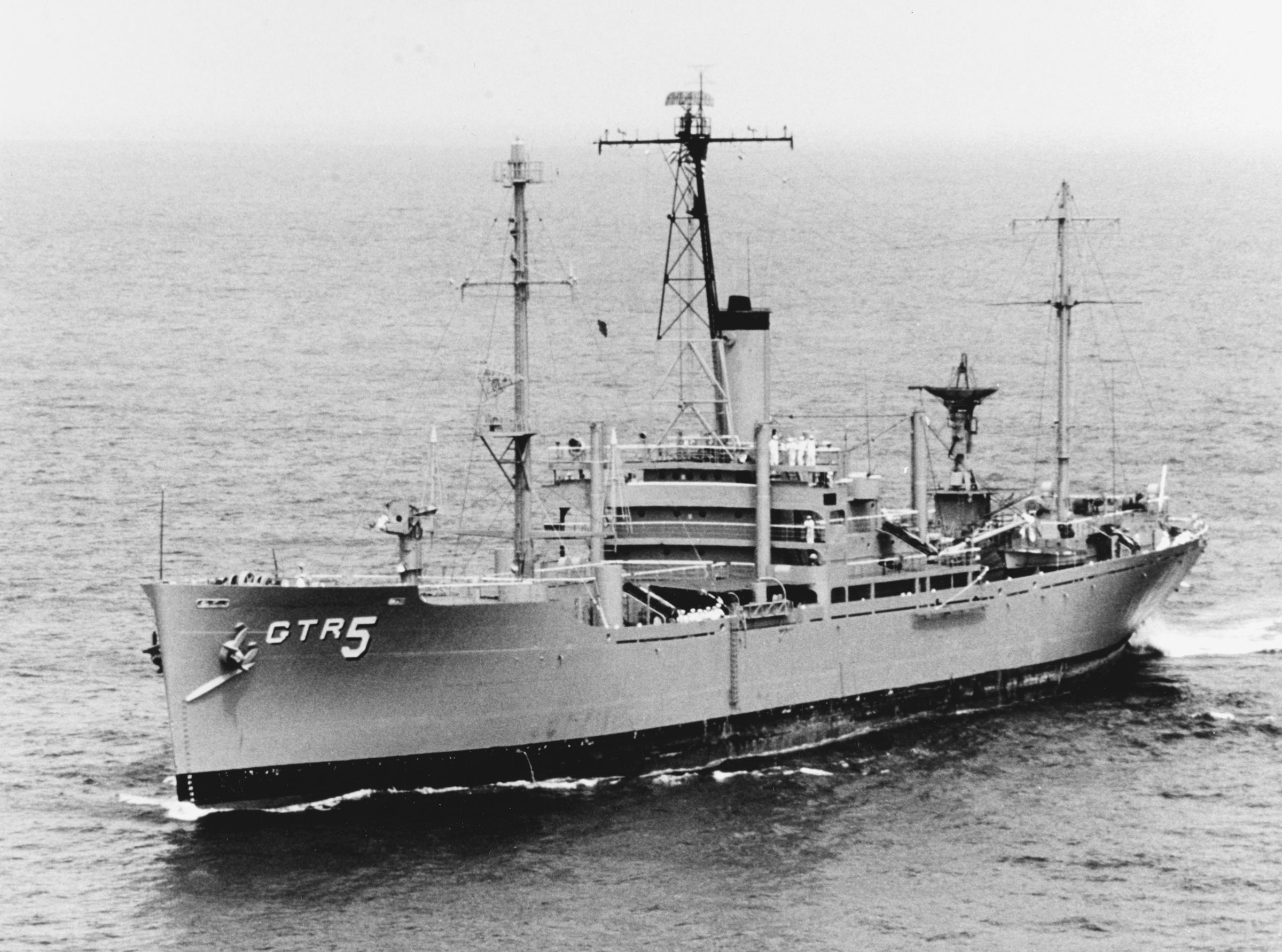
USS Liberty (AGTR-5) was a Belmont-class technical research ship operated by the U.S. Navy for electronic intelligence gathering. The vessel began life as SS Simmons Victory, a VC2-S-AP3 type Victory cargo ship whose keel was laid down on 23 February 1945 at Oregon Shipbuilding Corporation, Portland, Oregon. She was launched on 6 April 1945 and completed on 4 May 1945 for the War Shipping Administration.
The Navy contacted the Maritime Administration on 14 February 1962 about acquiring Simmons Victory for conversion into a missile range instrumentation ship. The vessel was permanently transferred to the Navy on 25 March 1963 and delivered to Willamette Iron & Steel Corp. in Portland, Oregon, for conversion. She was renamed Liberty and initially classified as a Technical Research Ship (communications and electromagnetic radiation), AG-168, on 8 June 1963, before being reclassified AGTR-5 on 1 April 1964. Liberty was commissioned at Puget Sound Navy Yard, Bremerton, Washington, on 30 December 1964. Her home port was Norfolk, Virginia.
During 1965 and 1966, Liberty conducted various operational deployments, including stops at Guantánamo Bay, Abidjan, Lagos, and Monrovia. In early June 1967, in response to escalating Arab-Israeli hostilities, Liberty departed Rota, Spain, on 2 June and proceeded to a position north of the Egyptian coast in the Mediterranean. She was conducting an intelligence collection mission in international waters during the Arab-Israeli Six-Day War (5–10 June 1967).
On the afternoon of 8 June 1967, while approximately 25 miles northeast of the nearest land off the Sinai Peninsula, Liberty was attacked by Israeli forces. Two jet fighters, presumed to be Israeli, made multiple strafing runs. Twenty minutes later, three motor torpedo boats from Israeli MTB Division 914 closed at high speed and launched five torpedoes; one, fired from T-203, struck the ship and exploded between frames 53 and 66, tearing a tear-drop shaped hole 39 feet (11.9 m) across at its widest point in the starboard side. Twenty crew members were killed instantly. In total, of the 293 U.S. personnel aboard, 34 were killed (31 Sailors, two Marines, and one National Security Agency civilian) and 170 were wounded, though some accounts cite figures as high as 174 wounded. Israel expressed deep regret and offered assistance, which was refused due to the sensitive nature of the ship’s mission. The Israeli government later paid $12 million in compensation to the families of the deceased. The question of whether the attack was deliberate or an accident of war remains disputed; various boards of inquiry and government reviews concluded it was a terrible mistake, while survivors have contested that account for decades.
Liberty departed the area and made way to Valletta, Malta, arriving on 14 June 1967 for temporary repairs, before continuing to Naval Amphibious Base, Little Creek, Virginia, for more extensive work. The ship was subsequently deemed prohibitively costly to repair, was decommissioned on 1 June 1968, stricken from the Naval Vessel Register on 1 June 1970, and sold for scrap in 1973.
For the crew’s actions during the attack, Liberty was awarded the Presidential Unit Citation (signed by President Lyndon B. Johnson in 1968, formally presented in June 1991) and the Combat Action Ribbon, making her the U.S. Navy’s most highly decorated ship for a single action. Commander William L. McGonagle, the ship’s commanding officer, was awarded the Medal of Honor on 11 June 1968. Lieutenant Commander Philip Armstrong Jr., the executive officer, was posthumously awarded the Navy Cross. Eleven crewmembers received Silver Stars (two posthumously), 19 received Bronze Stars, and over 200 received Purple Hearts. The ship was also awarded the National Defense Service Medal. The remains of six crew members are buried under a single headstone in a mass grave at Arlington National Cemetery.
In a separate legal matter, a report prepared by the House Appropriations Committee examining communications failures surrounding the attack was found by the U.S. Court of Appeals for the 9th Circuit to fall outside the Freedom of Information Act. The NSA had obtained a copy of the report in May 1968. Researcher and veteran Michelle Kinnucan requested the document in 2019 and filed suit in 2020. The court’s August 2026 ruling held that the report remained a congressional record because Congress retained control over it despite the NSA’s possession and internal use. Kinnucan filed a petition for rehearing on 8 October 2026, arguing that decades of NSA use brought the document within FOIA’s scope.
Specifications
The principal characteristics of USS Liberty (AGTR-5) as a converted technical research ship were:
- Displacement: 7,725 tons (light)
- Length: 139 m (456 ft)
- Beam: 18.9 m (62 ft)
- Draft: 7 m (23 ft)
- Propulsion: Westinghouse steam turbines, single shaft, 8,500 hp (6.3 MW)
- Speed: 17.5 knots (32.4 km/h) maximum sustained; 21 knots emergency
- Range: 12,500 nmi (23,200 km) at 12 knots (22 km/h)
 Argentina
 Armenia
 Australia
 Austria
 Austria-Hungary
 Belgium
 Brazil
 United Kingdom
 Brunei
 Bulgaria
 Canada
 Chile
 China
 Colonial America
 Colombia
 Confederate States
 Croatia
 Czech
 Denmark
 Egypt
 Finland
 France
 Georgia
 Germany
 German Imperial
 Greece
 Holland
 Hungary
 India
 Indonesia
 Iran
 Iraq
 Ireland
 Israel
 Italy
 Japan
 Japan (1940)
 Jordan
 Kingdom of Italy
 Malaysia
 Mexico
 Myanmar
 Nazi Germany
 Netherlands
 New Zealand
 North Korea
 Norway
 Pakistan
 Peru
 Philippines
 Poland
 Portugal
 Prussia
 Romania

 Russia
 Saudi Arabia
 Serbia
 Singapore
 Slovakia
 Slovenia
 South Africa
 South Korea
 Soviet Union
 Spain
 Sweden
 Switzerland
 Syria
 Taiwan
 Thailand
 Turkey
 UAE
 Ukraine
 Vietnam
 Yugoslavia