

History
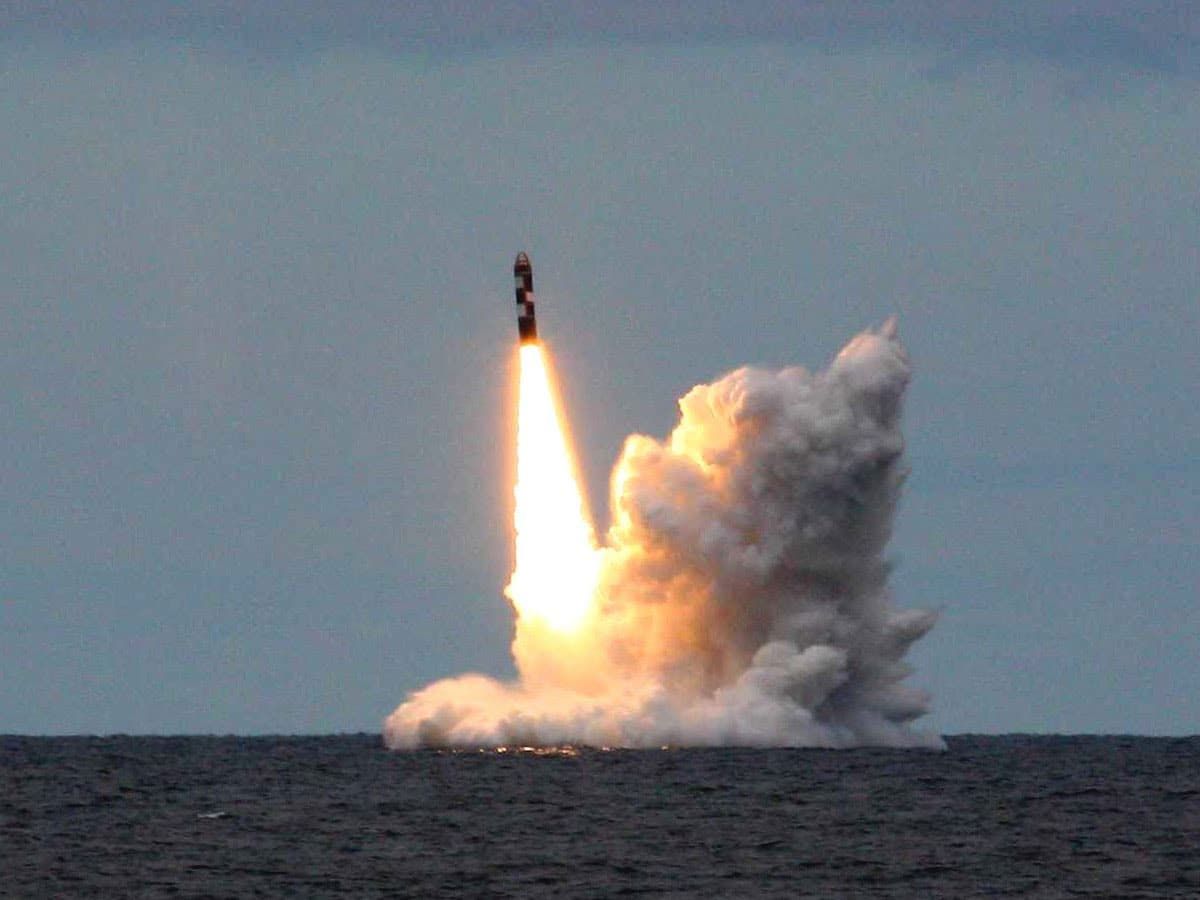
The RSM-56 Bulava (NATO reporting names SS-N-30 or SS-N-32, also referenced as SS-NX-32; GRAU index 3M30) is a nuclear-capable submarine-launched ballistic missile developed for the Russian Navy by the Moscow Institute of Thermal Technology. Development was initiated in the late 1990s as a replacement for the R-39 Rif solid-fuel SLBM. Although it uses some engineering solutions from the RT-2PM2 Topol-M ICBM, the Bulava was developed virtually from scratch.
Testing began in 2004 aboard the Dmitry Donskoy, a converted Delta IV-class submarine serving as a launch test platform. The first powered flight test on 27 September 2005 was successful, with the missile covering 5,500 km and its warheads striking designated targets at the Kura impact range. A series of failures followed between 2006 and 2009, attributed to third-stage engine malfunctions and flight control system faults. The first successful launch from an operational Borei-class submarine occurred on 27 June 2011 from the Yury Dolgorukiy. A maximum-range test on 27 August 2011 from the same submarine carried warheads approximately 9,300 km to a target in the Pacific Ocean. On 22 May 2018, a four-missile salvo was launched from the Yury Dolgorukiy, the first such salvo by Russia since 1991.
The missile was adopted into experimental service on 10 January 2013 with the Yury Dolgorukiy. It was formally accepted into the armaments on 7 May 2024, as stated by the head of the Moscow Institute of Thermal Technology. The most recent test in the supplied evidence is a submerged launch from the Generalissimus Suvorov in the Sea of Okhotsk on 28 October 2026, with warheads striking the Chizha test range in the Arkhangelsk region as part of Pacific Fleet training.
Design
The Bulava can be launched from an inclined position, allowing a submarine to fire while moving. It follows a low flight trajectory that has led some analysts to classify it as quasi-ballistic. The missile is designed to carry multiple independently targetable reentry vehicles (MIRVs) and is reported to be equipped with targeting decoys and the capability for evasive manoeuvres during the terminal phase to defeat missile defences. The first stage employs an accelerated ascent profile intended as a countermeasure against potential anti-ballistic missile systems. The missile is also reportedly capable of continuing its mission after exposure to a nuclear detonation as close as 500 metres away.
Specifications
- Stages and propulsion: Three-stage. Russian sources describe all three stages as solid-fuel; other sources describe two solid-fuel boosters with a liquid-fuelled upper stage to provide high manoeuvrability during warhead separation.
- Range: Reported values vary by source: 8,000 km; 8,300 km; 9,300 km (published Russian specifications, also demonstrated in the 27 August 2011 test); 9,500 km (declared under START with a 1,150 kg throw weight). Actual performance depends on payload and flight profile.
- Length: 12.1 m (estimated 1213.5 m)
- Diameter: 2.0 m
- Launch weight: 36,800 kg (estimated range 36,00039,000 kg)
- Payload: Up to 10 MIRVs, total throw weight 1,150 kg
- Warhead yield: 100150 kt per warhead (one source reports 550 kt total for all warheads)
- CEP: 250300 m (one source reports 350 m)
Operators
The Russian Navy is the sole operator of the Bulava. As of July 2025, 128 missiles were deployed on eight Borei-class ballistic missile submarines: Yury Dolgorukiy (K-535), Alexander Nevsky (K-550), Vladimir Monomakh (K-551), Knyaz Vladimir (K-549), Knyaz Oleg (K-552), Generalissimus Suvorov (K-553), Imperator Aleksandr III (K-554), and Knyaz Pozharskiy (K-555). Each Borei or Borei-A submarine carries 16 launch tubes for the missile. The Generalissimus Suvorov was transferred from the Northern Fleet to the Pacific Fleet in October 2023, basing permanently in Kamchatka. One source also lists a converted Typhoon-class submarine as a potential launch platform.
 Argentina
 Armenia
 Australia
 Austria
 Austria-Hungary
 Belgium
 Brazil
 United Kingdom
 United States
 Brunei
 Bulgaria
 Canada
 Chile
 China
 Colonial America
 Colombia
 Confederate States
 Croatia
 Czech
 Denmark
 Egypt
 Finland
 France
 Georgia
 Germany
 German Imperial
 Greece
 Holland
 Hungary
 India
 Indonesia
 Iran
 Iraq
 Ireland
 Israel
 Italy
 Japan
 Japan (1940)
 Jordan
 Kingdom of Italy
 Malaysia
 Mexico
 Myanmar
 Nazi Germany
 Netherlands
 New Zealand
 North Korea
 Norway
 Pakistan
 Peru
 Philippines
 Poland
 Portugal
 Prussia
 Romania
 Saudi Arabia
 Serbia
 Singapore
 Slovakia
 Slovenia
 South Africa
 South Korea
 Soviet Union
 Spain
 Sweden
 Switzerland
 Syria
 Taiwan
 Thailand
 Turkey
 UAE
 Ukraine
 Vietnam
 Yugoslavia