
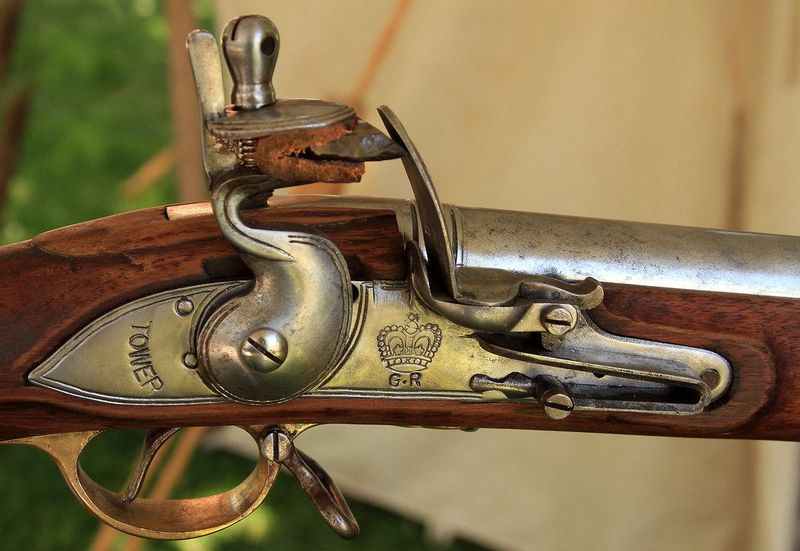
History of the British Land Pattern Musket (Brown Bass)
The
Brown Bess is a standard British military rifle, at the top of its experience range. It was used by various factions, including Americans during the American Revolutionary War, the Zulu Kingdom fighting the British Empire, and Mexico fighting the United States in the mid-19th century. The use of Brown Bess comes at a time when the military is beginning to standardize on different weapon types, allowing manufacturers to mass-produce one weapon to help the military manage logistics more efficiently. The Brown Bess - better known as the "British Land Mode Musket" - was in service from 1722 until the 1860s, a testament to its design and sheer global reach.
While the early forms were the widely accepted flintlock action, later forms eventually transitioned to the more reliable and efficient shock cap firing system, which subsequently became the standard around the world. Either way, the Brown Bass has proven to be the weapon of choice for standard military, revolutionary, guerrilla, frontier, sport hunters and hillbilly fighters. The origin of the name "Brown Bess" varies, some believe it refers to Queen Elizabeth I, referring to the brown walnut color or the German translation of "Braun Buss" ("Strong Gun").
The title "Brown Bess" was never officially recognized and historically covers all the different land mode musket designs. Production was taken over by several companies, including Tower Armories and H.W. Mortimer & Company of England.
All in all, the Brown Bess is revered as a fine pistol design that is traditional in both form and function. Wood is used extensively throughout the weapon, including the shoulder rest, receiver and front end. Metal furniture was made of iron and (later) brass for heavy parts of the design. Typically, long guns are identified by their long barrel configuration.
The action of the flintlock is completely contained in the rear of the wooden body. The shoulder rest serves as a third stabilization point when shooting, and the other two are where the foregrip and trigger handle are supported between the receiver and the shoulder rest. No sights are mounted on the gun, and the bayonet is optional, adding considerable length to an already long gun. The pushrod is an important attachment and is secured in a ring under the barrel.
No doubt these were large guns, relatively heavy, for collective use with solid wood parts and metal fittings. All Brown Bess molds are fitted. 705 or .72 caliber bullet, a huge bullet capable of hitting targets between 50 and 100 yards individually, with an accuracy of up to 175 yards in a salvo.
For the "Flintlock" rifle, Brown Bess used a piece of flint sandwiched in the breech of the "beak" assembly (hence the gun term "cocked gun"). Located on the right side of the gun body, when the trigger is pulled to the waiting metal surface, the trigger mechanism is released, producing the spark needed to ignite the gunpowder in the open pot (hence the "flare in the pot"). ). This will allow for further ignition of the available gunpowder within the bottom plate of the barrel, the resulting ignition eventually squeezing the musket's "ball" bullet out of the heavy smoothbore. The smoothbore means the ball can be fired at greater distances far less accurate, because once the ball leaves the barrel, the physics takes over for wind and other changes in battlefield and environmental conditions. As a "long shot" long gun, the Braunbeth was loaded from the muzzle end of the barrel, and a well-trained musketeer with a wood or (later) metal push rod for the contents could fire three or four shots in a minute.
The standard ammunition load per soldier is approximately 24 rounds.
In a typical shooting operation, the musket must be handled at both ends. First, the soldier took his paper tube and opened one end with his teeth. Place the first batch of gunpowder in an open glitter pot (or "crimp"), then close the pot to prevent the contents from spilling.
The gun is then placed on its rear end and the remaining powder is poured over the barrel, stopping near the bottom of the firing action. The paper portion of the cartridge is then pushed down the barrel along with the projectile, effectively using the entire cartridge content. Both are pushed down the barrel by the aforementioned push rod. The operator can now fully "cock" the gun and prepare to fire.
Historically, the flintlock proved to be a revolutionary design at the time - while fairly complicated to use, it was easy to maintain, somewhat reliable, and easy to manufacture in large numbers.
Of course, the limitations of the flintlock method eventually led to the rise of the "firing cap" system, where many flintlock firearms of the time were converted in one inexpensive step. Both methods use largely the same parts in their actions, making the switch fairly painless and cheap in the short term.
The flintlock system operated for about 200 years before being replaced, but was severely affected by weather conditions that caused many to catch fire in the heat of battle. Also, it's not uncommon for the operator to have to measure the correct amount of powder to detonate inside the barrel.
There's also a noticeable delay between pulling the trigger and firing the bullet from the barrel, which affects accuracy, and the basic firing method creates a puff of smoke that, even if she's hidden, only alerts the target to the gunner's position. The Impact Cap System changes all that, providing a protected shooting action for more efficient operation in wet weather. It also reduces smoke in the action and proves to be responsive after pulling the trigger. "Hammer" now replaces "rooster" and no longer requires flint in clips. The curl has been replaced with a hat holder so there is no exposed gunpowder.
This new system was recognized by many throughout its development, and was essentially derived from the creation of mercury fulminate (which replaced the ignition powder), requiring people to design their own strike system, leading to its use with the "cap". - hence the "hit cap". The natural teething problem was finally resolved, making the primer system a good alternative to flintlocks. In the UK, the detonator cap gained prominence in the 1820s, while in the US the flintlock stock was converted to the detonator cap method.
The primer itself was eventually replaced by the introduction of separate cartridges to manage primer, powder and balls in one package.
The British doctrine of warfare was then accepted, relying on well-trained and disciplined formations of infantry who were required to fire projectiles at targets (and hopefully formations too). Therefore, individual accuracy in these confrontations is less important than group firepower. An officer shouted the necessary orders, telling the team to change their position or fire direction, reload or fire.
This method of warfare proved very useful at the time and helped maintain the British Empire and its growing armed forces. This concentrated fire was accurate to within 175 yards, and the musket shells shattered bones, ripped flesh, and knocked people out in battle. Combined with artillery fire, the smaller enemy was virtually powerless in the face of British military power at the time.
If the officer seizes the moment, he can summon a bayonet charge to "clean up" any remaining enemies and crush them, forcing them to flee, or die in place. The sheer length of the Brown Bess rifle gives the operator a good fighting distance from the target when fighting with the bayonetup to several feet, in fact.
Of course, when surrounded, the muskets became rather unwieldy in tight quarters, and charging infantry could easily be overtaken by charging enemies.
The Brown Bess exists beyond its famous "long form", the British (long) ground musket. These were originally done with a 62" barrel. Many Brown Bess form a common visual similarity, distinguished primarily by different barrel lengths. After determining that this shorter barrel would not affect accuracy, the long gun form was subsequently completed with a 46-inch barrel. The Long Land Rifle was in service from 1722 to 1793 and as the standard British infantry rifle from 1722 to 1768.
The total weight is approximately 10.4 pounds and the overall length is 62.5 inches.
In 1778 a mode of maritime service appeared, which continued until 1854. This version of HMS Brambeth was issued to the naval units of the Royal Navy, which acted as the "heavy hand" of the British military at sea, capable of engaging in long-range or lethal close-quarters engagement with enemy sailors, pirates and naval forces - Hand fight. The barrel length is 37 inches and the overall length is 53.4 inches. Weighs about 9 lbs. Shortland muskets entered service in 1740 and ended their term around 1797, as they were standardized among British ranks during this time.
Due to its reduced length, it can be fired from horseback, making the cavalry "dragon" even more intimidating. The barrel length is 42 inches, the overall length is 58.5 inches, and the weight is 10.5 lbs.
The cavalry carbine was in use from 1796 to 1838 and, as the name suggests, was issued to the cavalry units of the British Army. The barrel length is 26 inches and the overall length is 42.5 inches. It's fairly compact at 7.40 pounds, making it ideal for use on horseback. The Indian model was used from 1797 to 1854 and was used as a standardized rifle during this period. The barrel length is 39 inches, the overall length is 55.25 inches, and the weight is 9.68 lbs.
The lighter weight and shorter length in turn is due to a more manageable service rifle. Early production was carried out by the British East India Company. The new longland rifle shape was used from 1802 to 1854, although its production was limited. It has a barrel length of 39 inches and an overall length of 55.5 inches. The weight is just over 10kg.
This was followed by the new light infantry land muskets from 1811 to 1854, also with a barrel length of 39 inches and an overall length of 55.5 inches. The weight corresponds to the weight of the new land pattern. The two weapons are differentiated by subtle physical differences, including barrel color. The 1839 model was a conversion from a flintlock Braunbeth shape to a shock cap ignition system.
In 1841, a large number of these models (pending rebuilding) were destroyed in a fire at the fabled Tower of London, leading to the production of the 1842 model to compensate for these losses.
After 1736, brass fittings became commonplace in Brown Bess production. Brass has the advantage of not rusting over iron. The wooden putter was still issued in 1765. These are also found on Navy and Royal Navy rifles due to exposure to the corrosive effects of the Aral Sea.
Specification
Roles
- Close Combat (CQB) / Personal Protection
- Frontline infantry/gunner
Dimensions
1,490 mm (58.66 in)
1,100 mm (43.31 in)
4.80 kg
Iron.
Performance
Single-shot muzzle-loading flintlock pistols
3 rounds per minute
150 ft (46 m; 50 yd)
Changes
Long Land Pattern - Standard infantry rifle; in service from 1722 to 1768; 46" barrel length; 62.5" overall; 10.4 lbs.
Shortland Mode - Issued to Infantry and Dragoons; in service from 1740 to 1979; 42" barrel length; 58.5" overall; 10.5 lbs.
Indian Model - Standard issue rifle; in service from 1797 to 1854; 39" barrel length; 55.
 Argentina
 Armenia
 Australia
 Austria
 Austria-Hungary
 Belgium
 Brazil
 United States
 Brunei
 Bulgaria
 Canada
 Chile
Chile China
China Colonial America
 Colombia
 Confederate States
 Croatia
 Czech
Czech Denmark
 Egypt
Egypt Finland
 France
 Georgia
 Germany
 German Imperial
 Greece
 Holland
 Hungary
 India
India Indonesia
 Iran
Iran Iraq
Iraq Ireland
 Israel
 Italy
Italy Japan
Japan Japan (1940)
 Jordan
 Kingdom of Italy
 Malaysia
 Mexico
 Myanmar
 Nazi Germany
 Netherlands
 New Zealand
 North Korea
 Norway
 Pakistan
 Peru
Peru Philippines
 Poland
 Portugal
 Prussia
 Romania
 Russia
 Saudi Arabia
 Serbia
 Singapore
 Slovakia
 Slovenia
 South Africa
 South Korea
 Soviet Union
 Spain
Spain Sweden
 Switzerland
 Syria
Syria Taiwan
 Thailand
 Turkey
 UAE
UAE Ukraine
 Vietnam
 Yugoslavia