
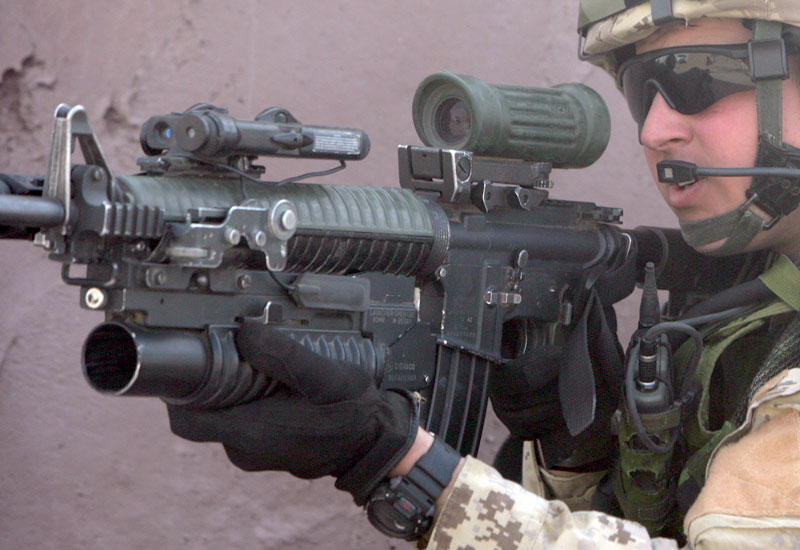

History of Colt Canada / Diemaco C7
The C7 assault rifle stems from Canada's decision to use the 5.56mm NATO cartridge as the standard ammunition for the Canadian Armed Forces. The American-made M16A1 rifle produced by Colt became the base weapon of choice in 1984 (as the Colt Model 715), and an improved M16A2 variant was subsequently adopted in production as the "C7" in service with the Canadian Army...although outwardly It looks similar to the US M16A2, but the C7 version's differences aren't noticeable to the casual observer. However, significant modifications have been made to weapons that meet Canadian military requirements.
Concerns over the longevity of the guns continue to be split between development and production by Canadian DiMarco and American Colt. In 2005, Colt Firearms acquired Diemaco and created the "Colt Canada Corporation" brand label.
Unlike the U.S. Army M16A2, the Canadian C7 uses a fully automatic fire mode - the U.S. M16A2 uses a three-shot burst and single-shot firing. The C7 also has a deflector on the ejection port, allowing for "pseudo-dexterous" operation, not just in favor of right-handers.
Equipped with flip-up sights that can be used in close and long-range combat, the C7 has an internal firing mechanism designed to accept NATO SS109 or US M193 bullets, allowing the C7 to be customized for logistical needs. The M16's gas operating and rotating bolt system remains the same, as does the overall design line of the original American Colt product. The C7 has a rate of fire of 700 to 900 rounds per minute and can see 400 yards through optics (the exact version has a range of 600 yards).
The C10 became the full-length training version of the C7 rifle, a . 22 long rifle cartridge that was only available for semi-automatic fire.
The C7A1 became the natural successor to the C7, with the most notable change being the absence of the M16-style integral handle. Instead, a Weaver Rail Mounting System was installed to use various optics - primarily the 3.4x ELCAN C79 optical sight. Iron sights were retained to ensure optics. The C7A2 followed, showcasing a change in combat service based on Canada's involvement in Afghanistan. The controls for this version have been made pretty nifty, and the stock has been redesigned to be scalable.
Three accessory rails have been added to allow for items like binoculars and flashlights, while an optical sight can be mounted above the receiver. These changes greatly improve the tactical effectiveness of the C7 series.
The rise of the "designated marksman" position in Western doctrine led to the appearance of a pair of Designated Marksman Rifle (DMR) shapes in the "C7CT" and "C8CT" (CT = "Custom Tactical") rifles. These versions are all high-precision versions of their service rifle counterparts, and are designed to be used by trained professional marksmen to deliver accurate repeat shots to targets outside the range of an assault rifle. While these DMR elements themselves are not formally trained as snipers, these DMR elements are trained to operate at the squad level and add a new dimension of firepower to the squad. The DMR form features a free-floating heavy-duty barrel, specialized trigger and adjustable stock, and improved gas handling. A silencer is also optional, allowing for covert operations.
As a result, DMR personnel can engage targets at medium and long distances, allowing them to move in and out of the area with a fair chance of survival while protecting their own teams.
Like the M16 before it, the C7 full-length service rifle was developed into a more compact carbine form called the "C8". The C8 was originally developed as a weapon for vehicle occupants who needed close-range service with automatic weapons, but has since been used by special forces, paratroopers and security personnel.
These versions were designed by Colt under the name "Colt Type 725" and first appeared in 1994. The gun has a shortened handguard and barrel, but uses a C7A2 style retractable stock. It also holds 5.56x45mm NATO cartridges and has an M16 style carrying handle. An improved version came in the form of the "C8A1" and replaced the detachable carrying handle with the C79 optical sight.
The "C8SFW" (Special Forces Weapon) is a high-capacity carbine version that allows for a longer, heavier barrel assembly and a mounting bracket for a 40mm inline grenade launcher. The "C8FTHB" (Flat Top Heavy Barrel) is another modified basic C8 shape with a heavy barrel and standard mount for the C79 sight.
The C8CQB (Close Combat) carbine is a complex melee weapon, while the C8PDW (Personal Defense Weapon) is designed as a more compact version of the carbine. The "C8A3" is the latest C8 carbine styling, combining improvements from the C7A2 family of models with design cues from the C8FTHB carbine styling in one standardized production model.
The Diemaco LSW (Light Support Weapon) is an automatic weapon production model of the C7 series. The weapon retains some of the obvious lines of the original C7, but includes more "heavy" abilities for continuous-fire characters (similar to the Belgian FN Minimi/US M249 SAW character).
This version includes the heavier barrel assembly required for repetitive shooting roles, as well as a bipod that folds forward for stability, an improved foreguard that covers the barrel and gas cylinder for a firm "three-point" grip Vertical fore-grip for holding (rests on shoulder), accessory rail mount and receiver optics for remote use. Rather than firing from a traditional detachable magazine, this version allows us to be the "drum" of ammo, allowing for a long-lasting shot while adding weight.
In addition to being used by the Canadian military (and some police and security personnel), the C7 series is also used by the armed forces (security and special forces) of Denmark (LSW), Iceland, the Netherlands and Norway, and the United Kingdom (C8SFW carbine as "L119A1" ). The model was also issued to members of the Afghan National Army during the critical reconstruction phase of the Afghan National Army.
Specification
Roles
- Close Combat (CQB) / Personal Protection
- Frontline/Attack
- remote precision
- Fire Support/Suppression/Defense
Dimensions
1020 mm (40.16 in)
508 mm (20.00 in)
3.30 kg
Adjustable iron; optional optics
Performance
Gas powered pivot
3,030 feet per second (924 meters per second)
800 rounds per minute
1,312 ft (400 m; 437 yd)
Changes
C7 - Designation of the base series; Canadian equivalent of the M16A2 production model; fully automatic fire capability.
C7A1 - Similar to the base C7 model, but with the carry handle removed to accommodate optics and accessories.
C7A2 - Telescopic stock; supports three rail accessories.
C7CT - Designated Marksman
C8 - Carabiner Shape
C8A1 - first production model
C8SFW ("Special Forces Weapon") - C8 carbine modified for special forces use; undermount grenade launcher mount.
C8FTHB ("Flat Top Heavy Barrel")
C8A3 - Tireless facility.
LSW M/04 ("Light Support Weapon") - C7-based variant of the squad automatic weapon.
C8CT - Designated Marksman
L119A1 - UK-designated C8SFW
 Argentina
 Armenia
 Australia
 Austria
 Austria-Hungary
 Belgium
 Brazil
 United Kingdom
 United States
 Brunei
 Bulgaria
 Chile
Chile China
China Colonial America
 Colombia
 Confederate States
 Croatia
 Czech
Czech Denmark
 Egypt
Egypt Finland
 France
 Georgia
 Germany
 German Imperial
 Greece
 Holland
 Hungary
 India
India Indonesia
 Iran
Iran Iraq
Iraq Ireland
 Israel
 Italy
Italy Japan
Japan Japan (1940)
 Jordan
 Kingdom of Italy
 Malaysia
 Mexico
 Myanmar
 Nazi Germany
 Netherlands
 New Zealand
 North Korea
 Norway
 Pakistan
 Peru
Peru Philippines
 Poland
 Portugal
 Prussia
 Romania
 Russia
 Saudi Arabia
 Serbia
 Singapore
 Slovakia
 Slovenia
 South Africa
 South Korea
 Soviet Union
 Spain
Spain Sweden
 Switzerland
 Syria
Syria Taiwan
 Thailand
 Turkey
 UAE
UAE Ukraine
 Vietnam
 Yugoslavia