


History of Kalashnikov PK (Pulemyot Kalashnikova)
The
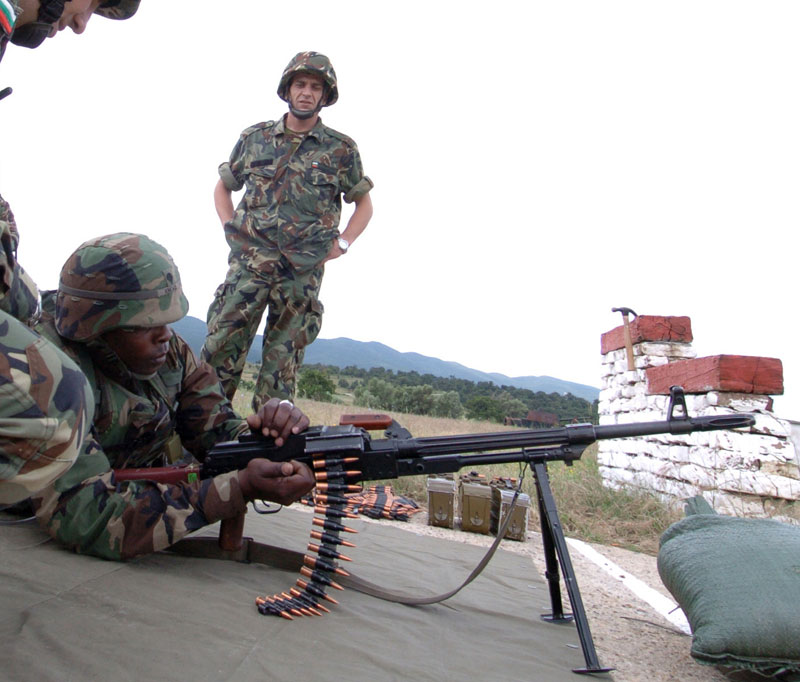
PK (Pulemyot Kalashnikova) machine gun was introduced in 1961, marking the first time a true General Purpose Machine Gun (GPMG) entered service with the Soviet Army. The GPMG is named for its ability to fill a variety of much-needed roles on the battlefield, such as: B. Fire support and enemy forces via bipods, tripods, vehicles or aircraft installations.
These weapons can also fire full-power rifle-caliber bullets, and they have excellent long-range penetration and longer reach compared to assault rifles.
PK follows the popular RP-46 line of machine guns after World War II (detailed elsewhere on this site). From the Vietnam War (1955-1975) to today's civil wars in Syria, Donbas and Yemen, this new weapon has gained significant combat service under numerous national flags.
More than 1 million units have been produced at home and abroad.
The PK is loaded with the proven 7.62x54mmR rifle cartridge, fired via a Kalashnikov open-bolt pneumatic system that has proven to be highly reliable for decades. Feeding is by non-disintegrating chain straps and counts 100, 200 and 250 rounds. The gun system uses a typical bipod assembly with a total weight of 19.85 pounds and an overall length of 47.5 inches.
The barrel is 23.8 inches long.
Has a rate of fire of 650 rounds per minute and a range of 1,095 yards. Maximum range is 4,155 yards. Aiming is via tangential iron sights, although optics (both night vision and thermal imaging types) are supported.
In practice, PK was officially released as an enterprise-level support weapon. Its robust design allows it to fire more powerful cartridges than traditional service rifles or even light machine guns. The barrel can be replaced to compensate for overheating that could deform or crack the barrel assembly and render the weapon unusable in crossfire.
Its reliability and flexibility made it a Soviet-era classic - a well-respected and valued weapon.
PKS, PKM, PKMN, PKMS, PKMSN, and PKT are all descendants of the base PK design. The PKP "Pecheneg" (detailed elsewhere on this page) is an updated PK series weapon influenced by the original, with a fixed heavy barrel and forced air cooling.
Although it originated in the 1960s, the PK series has been active into the new millennium. There are also tens of thousands of examples from foreign factories, adding to an already impressive total output.
The availability of Soviet 7.62mm cartridges also helped it move beyond Soviet-Russian borders, with many former Soviet states and supporting allies relying on the product.
Specification
Roles
- Fire Support/Suppression/Defense
Dimensions
1,203 mm (47.36 in)
605 mm (23.82 in)
19.84 lbs (9.00 kg)
Tangent iron; optional optics.
Performance
Gas powered; open bolt; fully automatic; belt feed only
2,710 feet per second (826 meters per second)
650 rounds per minute
3,285 ft (1,001 m; 1,095 yd)
Changes
PK - Base series model; original production model.
PKS - Tripod-mounted variant; heavy support fire.
PKM - 1969 Modernized Model
PKMN - PKM with near vision support
PKMS - Tripod version
PKMSN - Tripod-mounted variant with night vision support.
PKT - Vehicle-mounted machine gun variant
PKP "Pecheneg" - Modernized model from 2001; influenced by PKM design; heavy duty stationary barrel with convection cooling.
 Argentina
 Armenia
 Australia
 Austria
 Austria-Hungary
 Belgium
 Brazil
 United Kingdom
 United States
 Brunei
 Bulgaria
 Canada
 Chile
Chile China
China Colonial America
 Colombia
 Confederate States
 Croatia
 Czech
Czech Denmark
 Egypt
Egypt Finland
 France
 Georgia
 Germany
 German Imperial
 Greece
 Holland
 Hungary
 India
India Indonesia
 Iran
Iran Iraq
Iraq Ireland
 Israel
 Italy
Italy Japan
Japan Japan (1940)
 Jordan
 Kingdom of Italy
 Malaysia
 Mexico
 Myanmar
 Nazi Germany
 Netherlands
 New Zealand
 North Korea
 Norway
 Pakistan
 Peru
Peru Philippines
 Poland
 Portugal
 Prussia
 Romania
 Russia
 Saudi Arabia
 Serbia
 Singapore
 Slovakia
 Slovenia
 South Africa
 South Korea
 Spain
Spain Sweden
 Switzerland
 Syria
Syria Taiwan
 Thailand
 Turkey
 UAE
UAE Ukraine
 Vietnam
 Yugoslavia