

History
Before World War II (1939-1945), many guns opened the way necessary for mass production and combat usesome out of desperation of shortages. In the late 1930s, the Swedish state pioneered the "Kg m/40", an automatic machine gun design intended to serve portable squads for its light machine gun needs.
It is basically a conventional weapon, using gas-operated and fully automatic fire, while holding the local 6.5x55mm Swedish military rifle cartridge. The cartridge itself was adopted as early as 1894.
The m/40s had a short lifespan as part of World War I, during the conflict they were also known as "Machine Gun 35" (MG35) in Nazi Germany, or simply "Knorr-Bremse" after the Berlin company produced them with . During the Winter War against the Soviet Union, small German stocks were shipped to Finland, while Norway topped the list of known weapons operators. In service in Germany, these guns were replaced by Czech light machine guns of various types.
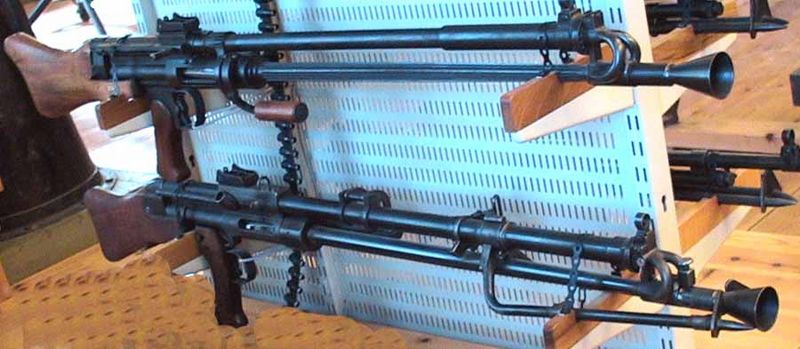
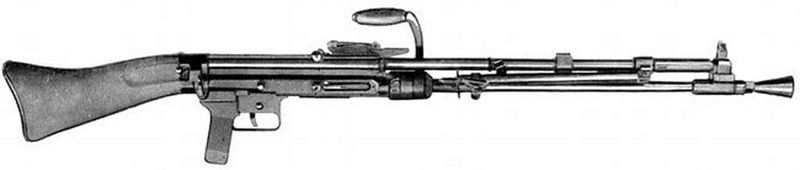
The m/40 is mainly made of metal and can be seen on the receiver, barrel and cylinder. The gas cylinder is located above the barrel, with a noticeable gap between the gas cylinder and the barrel. The carrying handle is easy to transport and can also be used as a barrel change handle during bursts. Sling loops also aid operator travel, loops on the cylinder and under the shoulder rest. The stock and grip are made of wood, the grip is designed to be almost vertical, and the stock has some smooth contours.
Iron sights are mounted above the receiver and at the very front of the remote fire cylinder. Ammunition is fed from a 20-round detachable magazine inserted into the left side of the receiver, and spent cartridges are ejected from a port on the right side.
These magazines are based on the American BAR straight case, but slightly adapted to the Swedish model - the Swedes also produced locally a version of the American BAR light machine gun called the "Kg m/37". The rate of fire is 490 rounds per minute and the muzzle velocity is 2,600 feet per second.
Patents for Swedish guns were registered around 1933-1934, and earlier forms were rejected by the government. The design then fell into the hands of the Knorr-Bremse group in Berlin, Germany, who at the time specialized in automotive braking equipment, certainly not a recognized firearms manufacturer.
Still, they were able to lure the Waffen SS to buy a small inventory of the Swedish design. Their retention in German stocks was short-lived as more efficient products emerged. Then they were used up by the Finns in a short time. The Swedish Army's m/40 service was also rather short-lived.
However, Knorr-Bremse's inexperience in building military weapons eventually became apparent. These guns were largely of a solid Swedish design, although the failure of some of their individual components had somewhat marred their history of use - chief among them were improperly set fuses and the stock loosening from firing vibrations caused fire.
Overall, this leaves the m/40 gun forgotten in the plethora of WWII guns.
KG m/40 (Knorr-Bremse) size
Roles
- Fire Support/Suppression/Defense
Dimensions
1,308 mm (51.50 in)
692 mm (27.24 in)
22.05 lbs (10.00 kg)
Front and rear iron
Performance
Gas powered; fully automatic
2,600 feet per second (792 meters per second)
490 rounds per minute
 Argentina
 Armenia
 Australia
 Austria
 Austria-Hungary
 Belgium
 Brazil
 United Kingdom
 United States
 Brunei
 Bulgaria
 Canada
 Chile
Chile China
China Colonial America
 Colombia
 Confederate States
 Croatia
 Czech
Czech Denmark
 Egypt
Egypt Finland
 France
 Georgia
 Germany
 German Imperial
 Greece
 Holland
 Hungary
 India
India Indonesia
 Iran
Iran Iraq
Iraq Ireland
 Israel
 Italy
Italy Japan
Japan Japan (1940)
 Jordan
 Kingdom of Italy
 Malaysia
 Mexico
 Myanmar
 Nazi Germany
 Netherlands
 New Zealand
 North Korea
 Norway
 Pakistan
 Peru
Peru Philippines
 Poland
 Portugal
 Prussia
 Romania
 Russia
 Saudi Arabia
 Serbia
 Singapore
 Slovakia
 Slovenia
 South Africa
 South Korea
 Soviet Union
 Spain
Spain Switzerland
 Syria
Syria Taiwan
 Thailand
 Turkey
 UAE
UAE Ukraine
 Vietnam
 Yugoslavia