


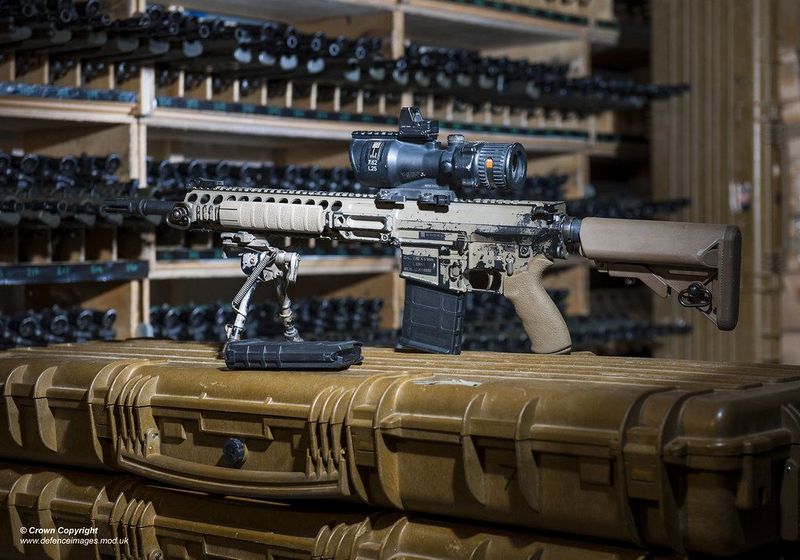


History of the L129A1 Sniper Rifle
The L129A1 is classified as a "Designated Marksman Rifle" (DMR), somewhere between an assault rifle and a dedicated sniper rifle. Thus, the designated gunner itself provides some of the inherent advantages of both warfightersthe ability to provide auto-reloading, repetitive fire to the enemy at ranges beyond the range of a standard assault rifle. However, designated snipers are not trained in the complex elements of sniping, but instead possess battlefield skills more akin to ordinary combat soldiers.
The United States has developed its designated marksman components through its evolving theater experience in Afghanistan and Iraq, and is able to develop supplemental weapons as appropriate through its established programs and facilities for use by the Army and Navy. When the British Army tried to follow suit, they found that they lacked the right weapons - their standard small-caliber L85 assault rifles were not up to the task, especially when trying to take out enemies at a distance with light machine guns - or the right internal facilities , making the right weapon a reality.
Therefore, it was decided to purchase a new weapon system for the larger 7.62mm cartridge, which also has several other features required by the DoD, including ease of maintenance, simple operation with only basic shooting training, and a compact transport profile or reconnaissance tasks, and of course repeatability over long distances to human-sized targets.
The Department of Defense set out to create an internal sniper program, to which Lewis Machine & Tool submitted an improved version of their excellent 7.62mm LM308MWS rifle. After an extensive evaluation process, the L129A1 was selected for further consideration due to its ability to "hit the target" in continuous fire, which bodes very well for the product. Additionally, LMT has its own certified manufacturing facility, which undoubtedly contributed to its proposal. The LM308MWS competes with top competitors from Germany's Heckler & Koch HK417 and Belgium's Fabrique-National SCAR-17.
The end result was that the LM308 was accepted as the British Army's newest firearm for decades - designated "L129A1" in the British Army stockpile and modified for the rigors of combat.
From the outside, the L129A1 is very traditional. Construction uses heavy metal components and lightweight corrosion resistant polymers. The receiver contains all the necessary internal functions as well as external fire selector switches on both sides (near the pistol grip) for true ambidextrous use. There are two ignition modes - "safe" and "semi-automatic", indicated by the red and white labels on the selector position.
The charging handle and ejection port are located on the right side of the receiver, benefiting right-handed shooters but also keeping the ejection projectile away from the shooter's face. The firing process is carried out using the proven direct gas shock system common in other firearms in this class. The pistol grip and trigger assembly follows a very traditional M16-like appearance, with the grip angled back for an ergonomic, firm grip. The direct detachable spring-loaded 20-round magazine feeds directly to the front of the trigger assembly.
There is a hooded front end for used grips and is ribbed for a secure fit. The long barrel receiver and front section are fitted with a Picatinny rail system to which various types of optics can be attached (alternative sights supplied by Knight's Armament Company). The British Army standard telescopic sight associated with the L129A1 is the Trijicon 6x48mm ACOG with BDC reticle. Additionally, accessory rails are provided along the front and bottom sides, the latter allowing the installation of a simple front handle for improved grip.
The SOPMOD style stock is supported by a tubular base and extends to a fully moulded stock that can be adjusted to six preset positions. The free-floating 16" stainless steel barrel protrudes from the vented front cover and is covered by a muzzle compensator/muzzle flash suppressor adapter.
It's worth noting that the barrel is fully removable "in the field" and can be replaced if necessary The LMT comes in a hard foam padded case containing the rifle itself, eight magazines (manufactured by Knight's Armament Company) and a cleaning kit.
The British Ministry of Defense (MoD) has selected the L129A1 to replace its Accuracy International L96 series of bolt-action rifles in use by its designated marksmen. While a quality rifle in its own right, the system does not fit properly into the rather defined role of the DMR.
As of this writing (2012), the MoD has ordered (and presumably already received) some 440 L129A1 systems.
L129A1 Sharpshooter Rifle Specification
ROLES
- Long-Range Precision
STRUCTURAL
406 mm (15. 98 in)
Rear Flip-up, Front Post; Optional Optics
PERFORMANCE
gas-operated; rotating bolt
2,624 ft (800 m; 875 yd)
VARIANTS
L129A1 - Base Series Designation
LW308MWS - Commercial Market Form that the L129A1 is based on.
 Argentina
 Armenia
 Australia
 Austria
 Austria-Hungary
 Belgium
 Brazil
 United States
 Brunei
 Bulgaria
 Canada
 Chile
Chile China
China Colonial America
 Colombia
 Confederate States
 Croatia
 Czech
Czech Denmark
 Egypt
Egypt Finland
 France
 Georgia
 Germany
 German Imperial
 Greece
 Holland
 Hungary
 India
India Indonesia
 Iran
Iran Iraq
Iraq Ireland
 Israel
 Italy
Italy Japan
Japan Japan (1940)
 Jordan
 Kingdom of Italy
 Malaysia
 Mexico
 Myanmar
 Nazi Germany
 Netherlands
 New Zealand
 North Korea
 Norway
 Pakistan
 Peru
Peru Philippines
 Poland
 Portugal
 Prussia
 Romania
 Russia
 Saudi Arabia
 Serbia
 Singapore
 Slovakia
 Slovenia
 South Africa
 South Korea
 Soviet Union
 Spain
Spain Sweden
 Switzerland
 Syria
Syria Taiwan
 Thailand
 Turkey
 UAE
UAE Ukraine
 Vietnam
 Yugoslavia