


History
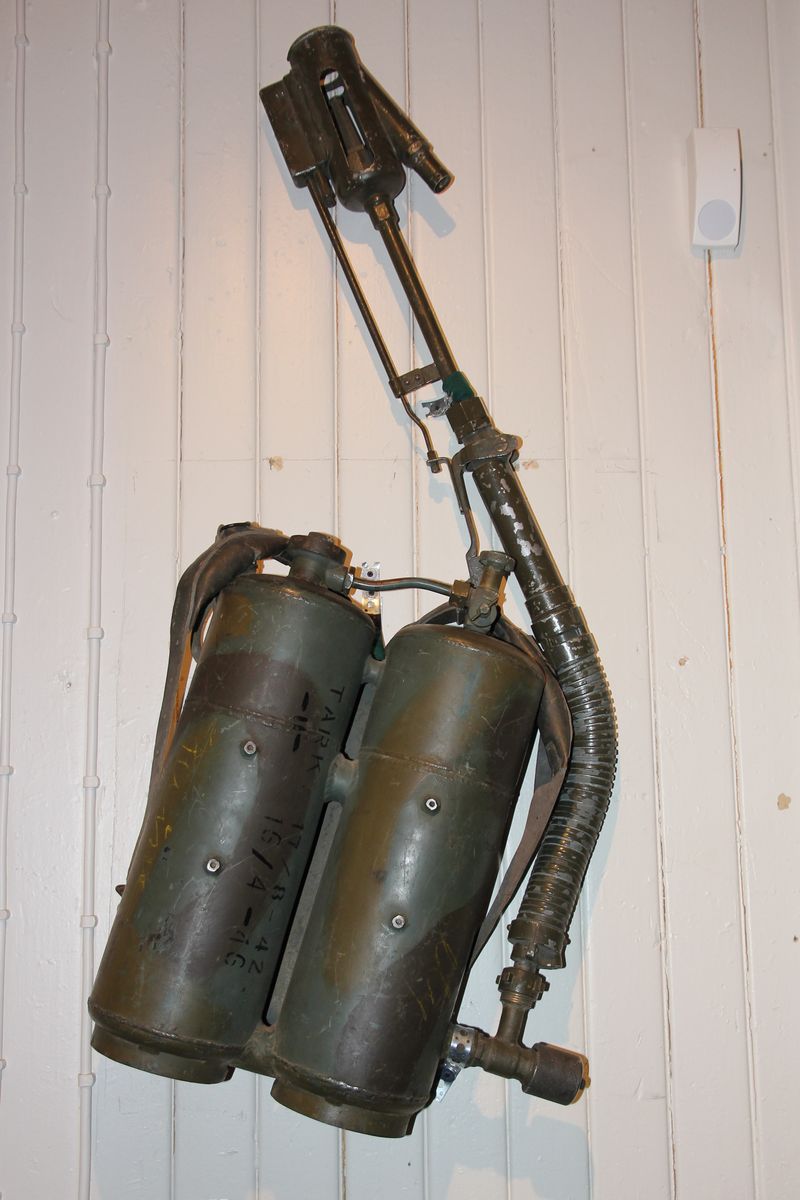
The Italians joined the Germans, Americans, Soviets and British in using flamethrowers in WWII. The Lanciafiamme Spalleggiato Modello 1935 (Mod. 35) was adopted by the Italian Army in 1935, with a traditional double cylindrical fuel tank design, each internally divided to accommodate the required supply of nitrogen propellant and fuel tanks. The fuel tank is connected by a hose to the projection gun held in both hands by the operator. These early forms of systems were ignited by flint and ultimately proved unreliable in use.
The projector is lit. Due to the weight and bulky nature, the Italian backpack flamethrowers were distributed to the two-person crew.
The Modello 1935 flamethrower has a curb weight of 29 pounds, although that number jumps to 56 pounds when fully fueled. The overall size of the unit also precludes the operator from using any other primary weapon, requiring him to rely on a pistol (if available) and a bayonet for self-defense.
So it's a good practice to use flamethrower units with regular infantry to protect yourself. A direct hit by an incendiary bomb on a tank could set the operator (and anyone nearby) on fire. However, a pressure canister hit with a standard bullet would drive the operator in one direction almost against his will.
Without a doubt, flamethrower units are invaluable targets for snipers on the other side of the battlefield.
The Modello 35 has a fuel reserve of 29 liters and can perform up to 30 one-second firings, or 20 consecutive firings. The maximum range listed is 27 feet, although this is variable and somewhat affected by environmental conditions. The stream of flames can be aimed at sideline targets/areas, or can arc at embedded enemy units under cover.
The liquid nature of the flame's composition means that the diffuse spray can have a catastrophic effect on enemy forces hidden in fortified structures such as bunkers. Wooden structures can be destroyed by fire in minutes.
Flamethrowers play an important role in driving away determined enemies. As such, they are used both as physical tools for maiming and killing and as terrifying psychological weapons. It's a testament to America's normality across the Pacific against fanatical Japanese. For the Italians, their flamethrowers were widely used during the Second Italian-Abyssinian War (1935-1941). By 1940, about 1,500 units were in circulation as standard Italian Army flamethrowers.
Units were sold to Finnish troops during the war with the Soviet Union, and Italian units on the Eastern Front also used this weapon against Soviet troops. Italian flamethrowers were also shipped to North Africa to engage Italy there.
In 1940, a slightly modified version of the Modello 1935 appeared, with a more reliable electronic ignition system. These are aptly called "Modello 1940s".
Specification
Roles
Dimensions
26.00 kg
Not applicable
Performance
Flint ignition (early); nitrogen propellant
27 ft (8 m; 9 yd)
Changes
Modello 1935 - Original production model with flint ignition system.
Modello 1940 - Electronic ignition system
Liekheitin M/40 - Finnish Army designation; received at least 16 units from Italy.
 Argentina
 Armenia
 Australia
 Austria
 Austria-Hungary
 Belgium
 Brazil
 United Kingdom
 United States
 Brunei
 Bulgaria
 Canada
 Chile
Chile China
China Colonial America
 Colombia
 Confederate States
 Croatia
 Czech
Czech Denmark
 Egypt
Egypt Finland
 France
 Georgia
 Germany
 German Imperial
 Greece
 Holland
 Hungary
 India
India Indonesia
 Iran
Iran Iraq
Iraq Ireland
 Israel
 Italy
Italy Japan
Japan Japan (1940)
 Jordan
 Malaysia
 Mexico
 Myanmar
 Nazi Germany
 Netherlands
 New Zealand
 North Korea
 Norway
 Pakistan
 Peru
Peru Philippines
 Poland
 Portugal
 Prussia
 Romania
 Russia
 Saudi Arabia
 Serbia
 Singapore
 Slovakia
 Slovenia
 South Africa
 South Korea
 Soviet Union
 Spain
Spain Sweden
 Switzerland
 Syria
Syria Taiwan
 Thailand
 Turkey
 UAE
UAE Ukraine
 Vietnam
 Yugoslavia