


History of the M39 Enhanced Marksman Rifle (EMR)
The M39 EMR (Enhanced Marksman Rifle) evolved from the mature action of the original "M14" battle rifle in 1959, itself an evolution of the WWII-era M1 Garand automatic rifle. The M14 served in the Vietnam War, Europe throughout the Cold War, and the turbulent Korean peninsula.
With around 1.5 million copies eventually produced, this weapon can still be found in inventory today, with private owners appreciating the type's good characteristics.
The newer M39 has controllable origins and shares many of the same qualities as the M14 before it, including its pneumatic, semi-automatic firing action, and its ability to accommodate standard 7.62x51mm NATO cartridges. The M39 is essentially an evolution of the M14 series itself, extending the life of the decades-old platform to the demands of new battlefields.
The name "Enhanced Marksman Rifle" suggests that it is primarily used by "non-sniper" elements, with an operator more similar to the US Army's "designated marksman" (also referred to elsewhere as "sniper") - a type of long-range binding A battlefield element, the repeating gun is intended as an integral part of an infantry squad. The M39 EMR was developed by the United States Marine Corps (USMC) to replace the M14 Designated Marksman Rifle (M14 DMR) in the same role starting in 2008.
The M14 DMR itself served from 2001 to 2010, witnessing the 2001 US invasion of Afghanistan and the 2003 US invasion of Iraq.
The role of the designated marksman falls on the operator who provides precise, long-range, repetitive fire at squad level. This differs from the traditional dedicated sniper element, as the DM itself is not officially classified as a sniper ("scout sniper" in USMC nomenclature). As a result, designated marksmen are given a slightly different role tool - a weapon designed to fill the gaps within squads already equipped with automatic assault rifles and squad-based assault weapons (SAWs).
In the case of the M39 EMR, the DM gets a proven battle rifle that fires a full-power rifle cartridge - a quality that American assault rifles lack (this can hold a 5.56mm cartridge). Optics enable the precision needed for long-range attacks.
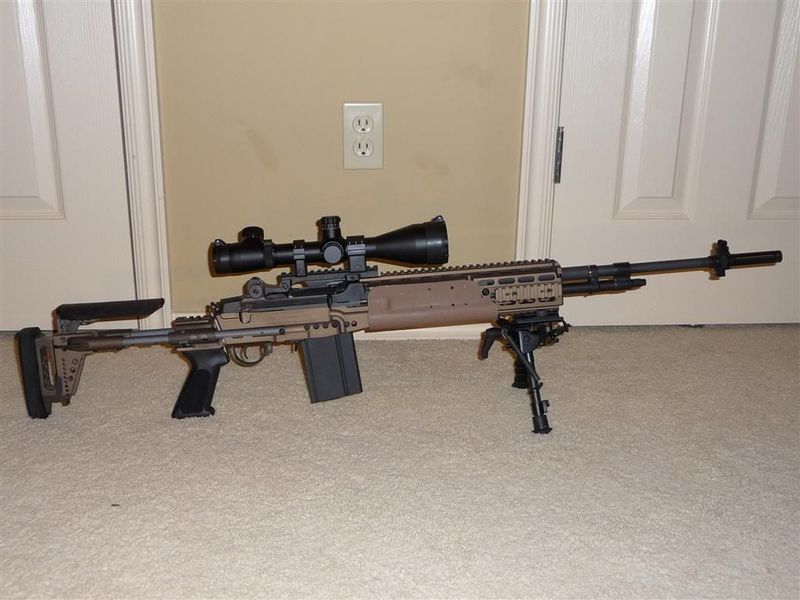
At the heart of the M39 is a heavily modified version of the original M14 series, which, despite the changes, is still recognisable in its basic form as the M14. The receiver contains all major internal working components as well as an ergonomically designed pistol grip.
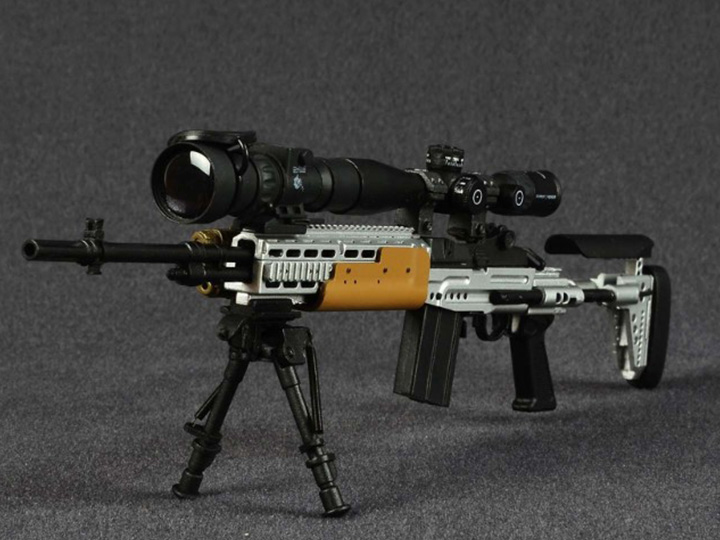
The trigger mechanism was suspended below the receiver and placed directly in front of the pistol grip. The fuse is mounted on the front of the trigger unit. The metal stock is adjustable for use and features an integrated cheek piece for comfort. The straight-box magazine common to the M14 was retained in the M39 and was mounted in the normal fashion on the lower front of the receiver.
Therefore, like the M14, the charging handle is also installed on the right side of the receiver. The front end of the M39 gives the weapon a unique look compared to the original solid wood body of the M14. The M39 has a perforated and ribbed front to accommodate accessories when needed. Therefore, a foldable bipod is standard.
The front end encloses the low-level gas cylinder, with the barrel at the top. The barrel protrudes at the front end, covered with a prominent slotted flash hider and a front iron sight.
The M8541 Scout Sniper Day Scope (SSDS) sight is standard, but the receiver's Picatinny rail mount will accept any compatible device. All in all, the M39 does look like a designated marksman's rifle, although - thanks in large part to its M14 pedigree - it can be used as a service rifle/battle rifle if the situation calls for it.
The M39's internal action uses gas cylinders to "tap" the pressure from the previous round. This pressure is used to refill new cartridges ready to fire and to achieve the "repeat" feature required in many automatic weapons today. The gas action is linked to a rotating bolt locking mechanism that allows a rate of fire of 60 rounds per minute - a definite advantage over the bolt action commonly found in traditional sniper weapons.
The weapon is fed from a 20-round detachable magazine with a 7.62x51mm cartridge. The muzzle velocity is about 2,840 feet per second. The effective range is listed as 850 yards, which gives the USMC DMR a decent "range" on the modern battlefield.
While the M39 does live up to its expectations in the field, the system retains its origins in 1950s Cold War designs. Because of this, the U.S. Marine Corps evaluated and eventually adopted the newer, more advanced M110 Semi-Automatic Sniper System (SASS), which was introduced in 2008, resulting in the M39's rather short lifespan in the industry. Manufactured by Knight's Armament Company, the M110SASS is similar in appearance to the Colt M16 Assault Rifle. Like the M39, the M110's chamber accommodates a full-power 7.62x51mm NATO rifle cartridge.
As of this writing (2012), the M39 is still in service, while the M110 is struggling to gain a foothold on the USMC roster.
Specification
Roles
- Frontline/Attack
- remote precision
Dimensions
1,122 mm (44.17 in)
559 mm (22.01 in)
7.50 kg
Standard optics; spare iron sights
Performance
Gas powered; rotating bolt
2,837 feet per second (865 meters per second)
60 rounds per minute
2,550 ft (777 m; 850 yd)
Changes
M39 EMR - basic series designation; bipod and optics are standard equipment; adjustable axis.
 Argentina
 Armenia
 Australia
 Austria
 Austria-Hungary
 Belgium
 Brazil
 United Kingdom
 Brunei
 Bulgaria
 Canada
 Chile
Chile China
China Colonial America
 Colombia
 Confederate States
 Croatia
 Czech
Czech Denmark
 Egypt
Egypt Finland
 France
 Georgia
 Germany
 German Imperial
 Greece
 Holland
 Hungary
 India
India Indonesia
 Iran
Iran Iraq
Iraq Ireland
 Israel
 Italy
Italy Japan
Japan Japan (1940)
 Jordan
 Kingdom of Italy
 Malaysia
 Mexico
 Myanmar
 Nazi Germany
 Netherlands
 New Zealand
 North Korea
 Norway
 Pakistan
 Peru
Peru Philippines
 Poland
 Portugal
 Prussia
 Romania
 Russia
 Saudi Arabia
 Serbia
 Singapore
 Slovakia
 Slovenia
 South Africa
 South Korea
 Soviet Union
 Spain
Spain Sweden
 Switzerland
 Syria
Syria Taiwan
 Thailand
 Turkey
 UAE
UAE Ukraine
 Vietnam
 Yugoslavia