



History of the Massachusetts Arms Maynard Carbine
Dr. Dentist. Edward Maynard of New Jersey (1813-1891) used his talents to develop a new rifle primer system that allowed for faster reloading of flintlocks.
The system was designed to help counteract the poor results typically achieved with such weapons, and earned the name "Maynard Tape Primer" from the doctor himself. This system was adopted by the US Model 1855 rifle. Band fuses were also used in the carbine, also named "Maynard's Carbine" after Dr.
The weapon that would function during the upcoming American Civil War (1861-1865).
Work on the carbine began in 1851 and the design was used for production by the Massachusetts Arms Company of Chicopee Falls, MA. Originally founded to manufacture revolvers to fend off Colt's grip on the pistol market, the company switched to long guns in 1855.
Its first product was the breech-loading "Green Carbine", some of which were used by the British Army in the Crimean War (1853-1856) as well as in the American Civil War. The next product to arrive is the Maynard Carbine.
The Maynard Carbine is a single-shot weapon primarily intended for use with a . 50 caliber metal cartridge. Original ink cartridges from . The 52 caliber proved to be even rarer. The same goes for the 35 caliber die.
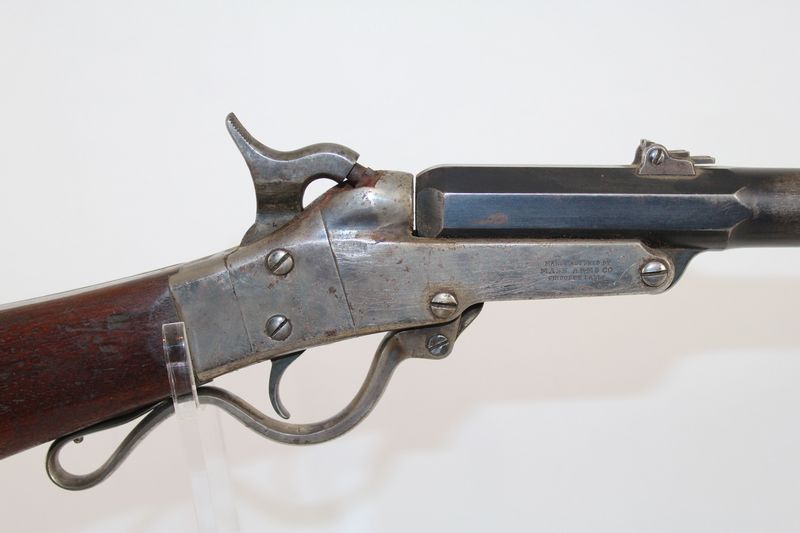
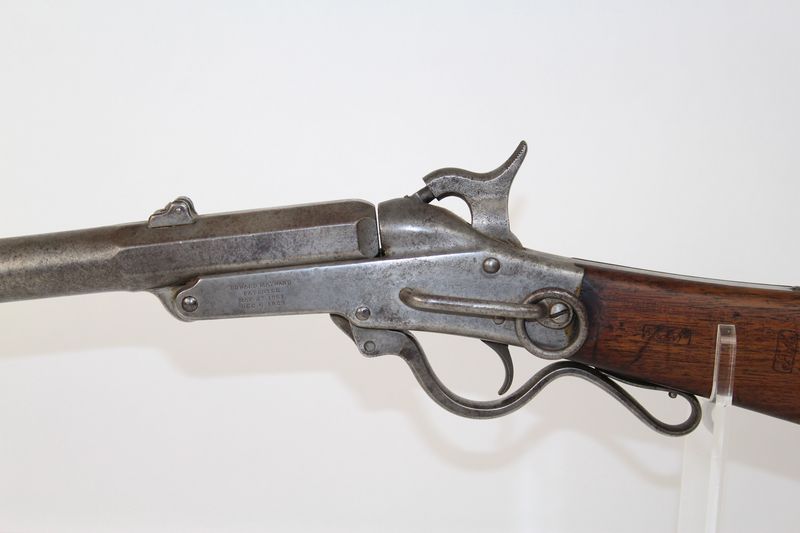
This is a breech-loading weapon whose lever system (when pulled under the receiver and pulled forward) allows access to the breech by folding the barrel down on a hinge (like a hunting shotgun). When the breech is closed, a small gap is intentionally left between the breech and the receiver, this space is intended to be filled by the wide flange base of the cartridge to provide the necessary gas seal.
Like other guns of the period, Maynard's action relied on a striking cap attached to a service connector. When the hammer is struck, the lid provides the necessary spark in action. The hammer is cocked back in the usual way, the impact cap is fitted and the cartridge is inserted into the breech (breech is fully closed and sealed). After aiming, pull the trigger, release the hammer, hit the cap and spark.
The metal cartridge itself has a small hole in its bottom that keeps the powder contents inside and allows sparks to enter and ignite the primer. This then ignites the cartridge and the resulting pressure shoots the bullet out of the barrel through the open muzzle.
The lever is then operated to open the breech, the spent case is removed and a new cartridge is inserted.
With 1850s technology, easy breech access allowed for quick reloading of the weapon - especially compared to muzzle-loading rifles still in use at the time. The Maynard Carbine is known for its ease of use, ease of maintenance and simple construction - so it is favored by many users who find it a pleasure to fire with little to no violent recoil, and a very accurate range. The folding rear sight on the receiver provides 100, 200 and 300 yard adjustment for alignment with the front rear sight. A well-trained marksman can reach a range of up to 600 yards and a rate of fire of nearly 12 rounds per minute.
The carbine was also compact, 40 inches long and had a 20-inch barrel, which was valuable for cavalry. The stock is made of walnut and no front end is used - the latter can cause problems if the barrel gets hot after prolonged use.
The Maynard carbine came in two well-known production forms, simply distinguished as "Type I" and "Type II" (also known as "Type 1863"). The first model carbine appeared in 1858-1859 and featured a stock patch box, as well as the use of Dr. Maynard's tape primer system. Production totaled just 5,000 units, notably the 9th Pennsylvania Infantry and the 1st Wisconsin.
Some government agencies are also given this type, as is the U.S. Marine Corps. In addition to these northern groups, hundreds of states in Florida, Georgia and Mississippi also used the first procurement model, while militias in Louisiana and South Carolina also stockpiled.
The first model appeared in their tradition. 50 caliber form, but also in the lesser known .35 caliber shape. During the Civil War, these guns were highly regarded by Confederate and Union cavalry.
The first model is followed by the second model, which lacks the stock patch box and tape primer system. Production of this version was much larger, reaching 20,000 units, and appeared between 1863 and 1865.
Some notable recipients of the second model include the 9th Indiana, 11th Indiana, and 11th Tennessee Infantry Regiments.
Specification
Roles
- Close Combat (CQB) / Personal Protection
Dimensions
1,000 mm
550 mm (21.65 in)
Flip up; retweet the post.
Performance
Single; breech loader
12 rounds per minute
1,800 ft (549 m; 600 yd)
Changes
Maynard Carbine - Base Series Name
First model - first production batch; 5,000 units produced; Maynard start system; patch box in stock.
Second model ("Model 1863") - subsequent batch of 20,000 units; no stock patch box; no Maynard starter system.
 Argentina
 Armenia
 Australia
 Austria
 Austria-Hungary
 Belgium
 Brazil
 United Kingdom
 Brunei
 Bulgaria
 Canada
 Chile
Chile China
China Colonial America
 Colombia
 Confederate States
 Croatia
 Czech
Czech Denmark
 Egypt
Egypt Finland
 France
 Georgia
 Germany
 German Imperial
 Greece
 Holland
 Hungary
 India
India Indonesia
 Iran
Iran Iraq
Iraq Ireland
 Israel
 Italy
Italy Japan
Japan Japan (1940)
 Jordan
 Kingdom of Italy
 Malaysia
 Mexico
 Myanmar
 Nazi Germany
 Netherlands
 New Zealand
 North Korea
 Norway
 Pakistan
 Peru
Peru Philippines
 Poland
 Portugal
 Prussia
 Romania
 Russia
 Saudi Arabia
 Serbia
 Singapore
 Slovakia
 Slovenia
 South Africa
 South Korea
 Soviet Union
 Spain
Spain Sweden
 Switzerland
 Syria
Syria Taiwan
 Thailand
 Turkey
 UAE
UAE Ukraine
 Vietnam
 Yugoslavia