


History of the Mauser C96
One of the most famous early semi-automatic pistols became the Mauser C96 series. The C96 form is the classic front loading magazine, thin barrel assembly and "broom" pistol grip. Proving extremely popular over time, the C96 pistol was crushed to the numbers needed in two world wars and many skirmishes, becoming a secondary weapon for guerrillas, front-line military personnel, and recreational civilian shooters. The C96 and all its variants enjoy a long, healthy production life and extended life, and its success has resulted in direct replication of the design by multiple foreign sources.
Some of their brands have since become coveted collectibles.
The Mauserwerke C96 series semi-automatic pistols were a collective product design of three brothers, whose last name was Federle, when they were employed by Mauser in 1894. The following year, the design was patented under the Mauserwerke brand.
The original model was designed to be loaded with 7.65mm Borchardt cartridges, fired by a semi-automatic internal action, and fed from a 10-round internal magazine. The weapon was tested until 1896 before it was officially mass-produced.
Therefore, the pistol was given the official designation "C96" to coincide with the first year of production.
Early manufacturing proved to be slow, with just over 100 samples produced in a 9-month period. By the end of the year, the design had been further refined around a slightly modified proprietary 7mm cartridge, the 7.63x25mm Mauser cartridge.
Firing the original Borchardt cartridge through the new Mauser design was found to be too violent, knocking back 7.65mm bullets while still in the magazine, while bullets have been known to eject completely from the magazine. The Mauser cartridge is more or less based on the same Borchardt design, but with an increased propellant charge and a more secure case design to hold the bullet in place. This resulted in extremely high velocity cartridges with higher penetration values ??and acceptable engagement areas compared to contemporaries.
As the cartridge design was finalized, production of the C96 pistol increased and subtle design changes were introduced, including an initial 10-shot version, a 6-shot version, and later a novel but interesting 20-shot model for further consideration.
In 1897, Mauser engineers redesigned the internals of the new pistol, adding an additional locking lug on the breech. Additional changes have been made to further enhance the operation. Although the C96 appeared in the military and general market, it failed to achieve the required volume of sales - especially by the Reichstag Army, which instead became interested in the mass use of the 9mm Parabellum pistol cartridge.
In the end, the pistol found some notable overseas homes - mainly in Italy (navy), Russia (army) and Turkey (army). In 1899, the Italian Navy purchased 5,000 of them from Mauser.
In 1902, Mauser revised the design of the C96 to incorporate a new patented safety mechanism. The mechanism allows for a one-handed trigger, primarily used by cavalry, to pass a hammer safety - a lever used to block the hammer from the striker to establish a "safe" still loaded position.
This move resulted in the name "Pistol C96 with fuse C02" in 1902. In 1905 Mauser produced a C96 die with a shortened drafter and a smaller size hammer, resulting in the "C1905 pistol with short drafter".
In 1912 Mauser modified the C96 again, this time with an updated safety mechanism, resulting in the "pistol C96 with the new C1912 safety".
In June 1914, Europe was plunged into war when Archduke Franz Ferdinand of Austria was assassinated during a visit to Sarajevo by Yugoslav nationalist Gavrilo Principe. Austria-Hungary declared war on neighboring Serbia and sent the Russians to mobilize, and in response, Germany declared war.
When Germany invaded Belgium on its way to France, Britain declared war on Germany as an ally. German troops managed to reach the Marne before the once-flowing front turned into a bloody stalemate, as both sides dug in the vast network of trenches on the opposite side.
The German Empire, Austria-Hungary and the Ottoman Empire strongly represented the Allies. The Ottoman Empire ordered 1,000 Mauser pistols in 1896.
A war economy soon developed, including the production and procurement of various war materials. This includes mass production of the once shunned C96 pistol to make up for the Bundeswehr's shortage of small arms. Since the 9mm Parabellum cartridge was still the main pistol cartridge for the German army, in 1915 the authorities ordered a new 9mm form of the C96. Assessments began shortly after, and the guns were cleared to fire Parabellum ammunition.
In response, Mauser was charged with an initial count of 150,000 pistols. While the pistols remained more or less faithful to the original Mauser design, they were of course revised internally and external markings were introduced to make the changes clear - (capital "9" on the grip). These also produce the "Red Nine" Mauser, when the engraved figures are filled with red. While the general form of the 9mm cartridge is quite different from the original 7.63mm cartridge, the loader still holds 10 rounds.
The 9mm caliber C96 pistol was widely used during World War I, with approximately 137,000 Red Nine Mausers procured.
After the "war to end all wars" ended, Germany was identified as the culprit in the conflict and took most of the blame. The Austro-Hungarian and Ottoman Empires were disintegrated, basically nothing more, leaving Germany to bear the brunt of the war reparations and the only punishment. This also severely limited their future combat capabilities until the 1920s, especially under the strict provisions of the Treaty of Versailles. However, the production of the C96 pistol continued, and in 1921 the "Bolo model" Mauser appeared for sale to Bolshevik Russia (the former USSR).
The gun was bulk-purchased for the new world power, and one of the main differences in this product was the shorter barrel length of 99mm (was 140mm). This is just one of the limitations of the Treaty of Versailles.
Mauser continued to produce its long line of pistols into the 1930s. Additional work resulted in the "Pistol M711" branding, which was more or less based on the pre-war 7.63mm Mauser. In addition to the original 10-round detachable box magazine, there are also 20-round and even 40-round forms. The "Pistol M712", also known as the "Pistol M30 Schnellfeuer System Nickl", is a fully automatic submachine gun based on the M711.
The M712 features fully automatic firing via a selector lever on the left side of the frame, fed from a conventional detachable magazine inserted into a holding tube under the receiver. Very similar to the original Mauser design, these weapons were based on a certain Joseph Nick (hence the name) patent and were designed to provide the operator with considerable firepower - albeit at the cost of control and accuracy. These guns are nothing more than novelties in their general scope unless equipped with seemingly necessary shoulder rests for their fully automatic fire modes, making them generally uncontrollable and unusable as personal hands-free weapons.
China purchased this Mauser product in 1931 (the line was considered "box guns"), and Yugoslavia followed suit in 1933.
At this point, Mauser pistols are gradually being replaced by self-loading semi-automatic pistols from other countries and knockoff pistols (through the Astra brand - 900 series) mainly from Spain. This prompted Mauser to launch the 1936 Pistol M36 Schnellfeuer System Westinger based on the work of in-house engineer Karl Westinger.
This weapon type is sold in the original 7.63mm Mauser form and the long-range 9mm Parabellum. China was again the main buyer of this pistol and started illegal mass production of Mauser rifles - albeit of much lower quality (like the "Type 80" based on the M712 rapid fire). After Adolf Hitler came to power in Germany and cemented his position on the military and political fronts, the Mauser C96 was designed to serve in the nascent and rearmed German army.
Some 8,000 rapid-fire Mauser pistols were issued to the Luftwaffe in the latter part of World War II. Notably, the Spanish Mauser Type 900 and 903 cannons were also issued and used in the conflict.
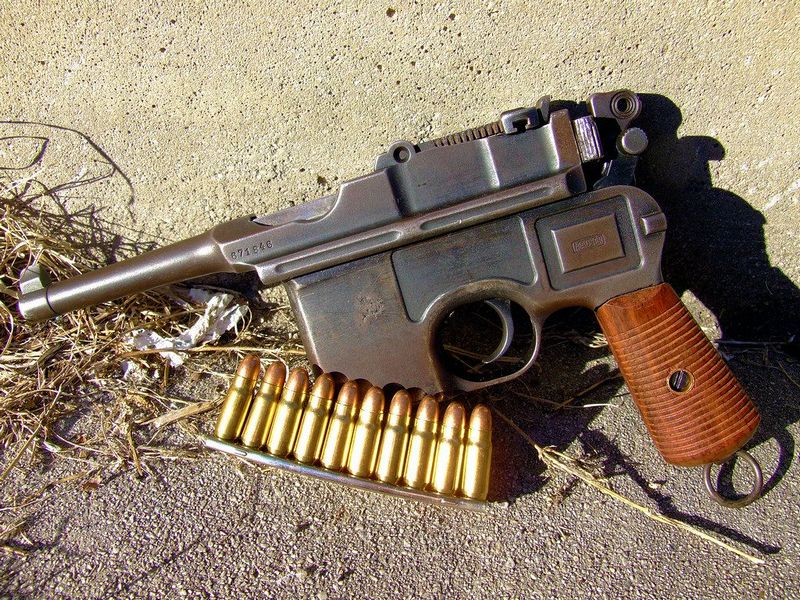
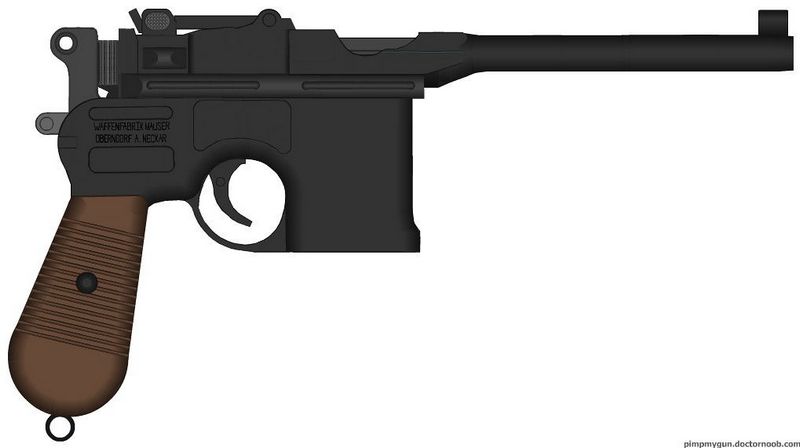
The C96 is one of the most iconic shapes of all early semi-automatic pistols and is a rare type because its magazine is mounted before the action. This pistol is equipped with a recognizable "broom" style pistol grip, which provides a reasonable one-handed grip, with the trigger set in the front in the usual fashion.
The curved trigger assembly is located in a circular ring and is integrated into the body of the pistol. The magazine well is located in front of the trigger and, unconventionally (on earlier models), is passed through the top of the receiver via an off-the-shelf "loader" - the ammunition is placed on the connecting platform and inserted into the well as a complete unit, with each round in The platform is peeled off individually during filming (hence also known as "stripper clip"). The barrel is very slender and protrudes quite a distance from the frame. The front and rear of the weapon feature iron sights (adjustable V-notch rear tangent aiming at 1,000 yards and an inverted V front), while a loop under the pistol grip allows the weapon to be stowed by a cord to attach to the belt. An optional hollow wood stock is almost always issued and can be mounted to the rear of the pistol grip for more stable and accurate shooting.
The butt was hollowed out for use as the C96's own suitcase or makeshift holster equipment. The pistol operates with short recoil, has a muzzle velocity of 1,400 feet per second, and has an effective range of up to 200 yards.
Earlier versions used the charging capabilities of a charger, while later versions featured a true detachable boxed magazine arrangement.
Although total production of Mauser C96s has proven generally elusive due to many apparently illegal copies, the series is believed to have reached over 1 million units between 1896 and 1937, followed by Mauser bullets and 9x19 mm Parabellum wartime, but one version also includes the US .45 ACP cartridge (made in China), and the more rare 9mm Mauser "export" cartridge. Mauser also experimented with the 8.15mm Mauser form. The weapon was used in the Second Boer War (1899-1902), the Boxer Movement (1899-1901), the Xinhai Revolution (1911-1912), the First World War (1914-1918), the Anglo-Irish War (1919) -1921), Finnish Civil War (1918), Mexican Revolution (1910-1920), Russian Civil War (1917-1922), Spanish Civil War (1936-1939), Second Sino-Japanese War (1937-1945), Second World War (1939-1945), Chinese Civil War (1927-1937, 1946-1950), Korean War (1950-1953) and Vietnam War (1955-1975).
The weapon finally found it in the inventory of the Qing Dynasty, Austria-Hungary (World War I), Brazil, Denmark, Finland (Civil War; World War II), the Korean Empire, Indonesia, Italy, Malaysia and Norway (Trial, WWII), Ottoman Empire (WW1), Philippines (WWII), Poland, Portugal, Spain, Soviet Union (Bolo Mauser), Taiwan and Great Britain (WW1, private purchase by officers).
Specification
Roles
- Close Combat (CQB) / Personal Protection
- Sidearms
Dimensions
312 mm (12.28 in)
140 mm (5.51 in)
2.49 lbs (1.13 kg)
Adjustable V-notch rear tangent; reverse front V
Performance
semi-automatic; short recoil operation
1,394 ft/s (425 m/s)
656 ft (200 m; 219 yd)
Changes
C96 - Base series name; issued to Italy, the Russian Empire and the Ottoman Empire.
Mauser Automatic Pistol Bau 96 (c/96) - Official designation from 1896; loaded with 7.63x25mm Mauser cartridge; counts 6, 10 and 20 shots Charger loads.
Pistol c/96 with fuse c/02 - Model 1902; Hammer safety introduced.
Pistol c/96 with short rifle, model c/1905 - 1905; shortened extractor and smaller size hammer.
 Argentina
 Armenia
 Australia
 Austria
 Austria-Hungary
 Belgium
 Brazil
 United Kingdom
 United States
 Brunei
 Bulgaria
 Canada
 Chile
Chile China
China Colonial America
 Colombia
 Confederate States
 Croatia
 Czech
Czech Denmark
 Egypt
Egypt Finland
 France
 Georgia
 Germany
 Greece
 Holland
 Hungary
 India
India Indonesia
 Iran
Iran Iraq
Iraq Ireland
 Israel
 Italy
Italy Japan
Japan Japan (1940)
 Jordan
 Kingdom of Italy
 Malaysia
 Mexico
 Myanmar
 Nazi Germany
 Netherlands
 New Zealand
 North Korea
 Norway
 Pakistan
 Peru
Peru Philippines
 Poland
 Portugal
 Prussia
 Romania
 Russia
 Saudi Arabia
 Serbia
 Singapore
 Slovakia
 Slovenia
 South Africa
 South Korea
 Soviet Union
 Spain
Spain Sweden
 Switzerland
 Syria
Syria Taiwan
 Thailand
 Turkey
 UAE
UAE Ukraine
 Vietnam
 Yugoslavia