


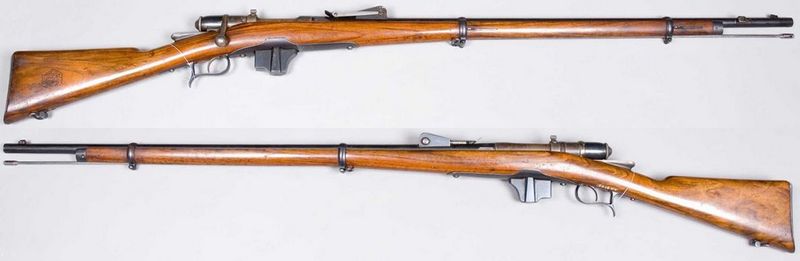
1870 Italian Vitelli Story
The 19th century turned out to be crucial to the development of guns. Until now, the flintlock muzzle-loading system was the accepted standard, but that all changed with the advent of shock cap systems and breech-loading configurations.
Furthermore, the arrival of self-contained cartridges and guns in the late 18th century was a far cry from the beginning of the century.
In Switzerland, Johann-Freidrich Vetteri developed a new cartridge-based breech-loading bolt-action rifle, which entered service with the Swiss Army in 1869 - the "Vetterli-Gewehr". This long gun is based on the Swiss 10.4 x 38mm cartridge, a rim-fired cartridge loaded with black powder.
The rifle was in service from 1869 to 1890, and some of the 36,700 troops of World War I (1914-1918) served in Russia.
The Italian army itself was looking for a modern cartridge-style long gun and shortly thereafter adopted the Swiss gun, known as the Model 1870 "Italian Vitelli". The Italian model differed from its original Swiss design, as it took care to simplify the product to meet the needs of the Italian army. The rifle - which used to be an 11-round tubular weapon - was reduced to single-shot firing and was refitted with a 10.35x47mmR, a black powder center-fired cartridge.
Broadly speaking, these rifles retain the same design form as the Swiss version, with a long wooden stock, ornate trigger guard and folding bolt handle. The large rear sight assembly is a distinguishing feature of the Italian brand, with a two-belt assembly on the long wooden body leading to the muzzle.
In 1887, the rifle was upgraded with a four-wheel protruding magazine case for repeated firing, allowing for a very efficient use of bolt action arrangements. The magazine was designed locally by Italian artillery captain G. Vitali - whose last name was used for the modified 1870/87 model "Italian Vetterli-Vitali". The magazine is fed from a preloaded Mannlicher-style magazine while still holding the 10th 4x47R cartridge.
Modified weapons are marked accordingly on the stock.
By the time of World War I (1914-1918), the Italian government - like other world powers - was in dire need of many viable war products, including service rifles. It plunged into the war on the Allied side in 1915 and quickly scoured its store for a variety of useful weapons. This means that older models from the 1870s are still in use, when they numbered in the hundreds of thousands.
However, in order to produce a more modern final product, the design was forced to undergo local modifications - the most significant of these changes was a switch to the standard 6.5x52mm Italian Carcano rifle cartridge, which contained smokeless powder. The move also required a new barrel liner and magazine (Mannlicher type).
The Italian 6.5mm Vetterli guns were issued to second-rate Italian Army regiments in the hope that these groups would not be pushed into serious combat operations - but if they were, they could carry fairly useful infantry rifles. In general, however, this did not prove to be the norm, as the rifles faced direct combat action against the enemy during several Italian offensives of the war.
Italian cousins ??remained in circulation throughout the interwar period, and some even played a role in the Italian invasion of Ethiopia during the Second Italian-Ethiopian War (1935-1936), in which the Italians achieved a decisive victory.
Specification
Roles
- Manual Repeat Shot
- Frontline infantry/gunner
Dimensions
Front and rear shoes
Performance
Single shot (original); manual bolt action
3 rounds per minute
Changes
Model 1870 "Italian Vetterli" - basic series name; original black powder model of 1870 based on Swiss model 1869 Vetterli but optimized for cost effectiveness; 10. 4x47mmR cavity.
Model 1870/87 "Italian Vetterli-Vitali" - Model of 1887; reworked as a repeat-fire rifle with 4-round integral magazine; 10. 4x47mmR chambering.
Model 1870/87/15 "Carcano" - Model of 1915; World War 1 models converted by Carcano to 6. 5mm smokeless cartridge use (Mannlicher-type magazine).
 Argentina
 Armenia
 Australia
 Austria
 Austria-Hungary
 Belgium
 Brazil
 United Kingdom
 United States
 Brunei
 Bulgaria
 Canada
 Chile
Chile China
China Colonial America
 Colombia
 Confederate States
 Croatia
 Czech
Czech Denmark
 Egypt
Egypt Finland
 France
 Georgia
 Germany
 German Imperial
 Greece
 Holland
 Hungary
 India
India Indonesia
 Iran
Iran Iraq
Iraq Ireland
 Israel
 Italy
Italy Japan
Japan Japan (1940)
 Jordan
 Malaysia
 Mexico
 Myanmar
 Nazi Germany
 Netherlands
 New Zealand
 North Korea
 Norway
 Pakistan
 Peru
Peru Philippines
 Poland
 Portugal
 Prussia
 Romania
 Russia
 Saudi Arabia
 Serbia
 Singapore
 Slovakia
 Slovenia
 South Africa
 South Korea
 Soviet Union
 Spain
Spain Sweden
 Switzerland
 Syria
Syria Taiwan
 Thailand
 Turkey
 UAE
UAE Ukraine
 Vietnam
 Yugoslavia