


History
Like other major militaries of the period, China employed a special close quarter suppression firearm (CQB), the output of which was intended for use by special forces. This weapon became the Type 64 Submachine Gun (SMG) in 1966. It was designed from the outset to use an integrated silencer, making it slightly quieter in operation compared to typical unmodified weapons of similar form and function. The Type 64 wasn't really a "quiet" weapon, as it did not use a subsonic cartridge, but instead relied on a locally produced Soviet standard 7.62x25mm Tokarev loaded pistol cartridge as the "7.62x25mm Type 51".
The fired bullet can maintain a more useful muzzle velocity.
The Type 64 weighs 3.4 kg and measures 33.2 inches (843 mm) in overall length. Its foldable stock allows for a more compact shape of 25 inches (635 mm). The barrel itself is 9.6mm (244mm) long. Selected cartridges are fired by basic recoil action using the breech mechanism.
The bolts are from 1942 Soviet WWII PPS-43 submachine guns, of which about 2 million were in circulation by the end of the war. The trigger group is believed to be "inspired" by the Czech ZB vz of the 1920s. 26 light machine guns, made of steel stampings, capable of selective fire (single-shot or fully automatic). The two systems were integrated into the fuselage of the Soviet AKS - a metal folding stock variant of the famous Kalashnikov AK-47 assault rifle.
Both the AK-47 and AKM attack systems are manufactured locally in China.
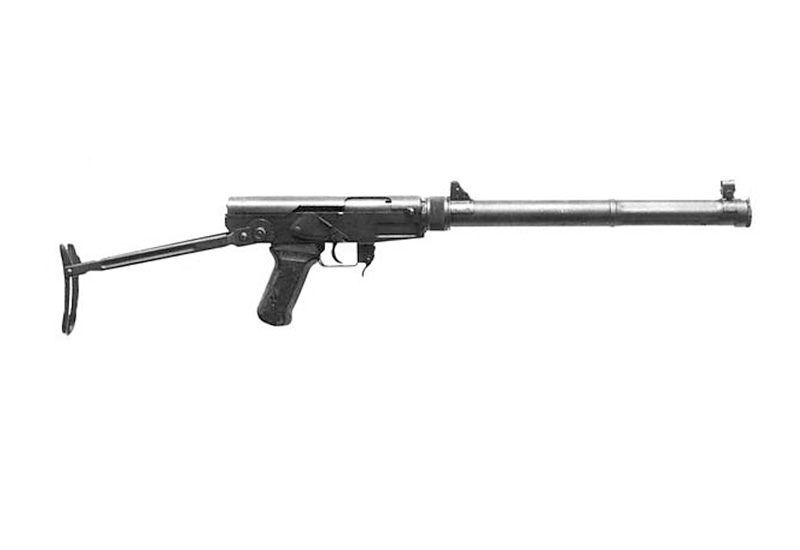
Externally, the Type 64 has a rather modest appearance due to its dedicated role. The receiver is somewhat tubular in shape, and the sides of the board are nicely contoured towards the integrated suppressor cylinder. The angled pistol grip hangs below the receiver as usual, while the rectangular trigger ring is large enough to encourage use by gloved hands. The stock is metal with two struts, similar to the Kalashnikov series, with the hinge folded under the receiver. The magazine is inserted into the waiting chute at the front of the action and holds a proprietary 30-round magazine.
To give the gun the required dampening qualities, drill holes in the barrel accordingly and mount the silencer as a sleeve on the barrel, screw on the front end of the receiver and wrap the barrel in its entirety.
All in all, the Type 64's rate of fire is closer to 1,000 rounds per minute (although heavy use of full auto fire tends to drain the suppressor faster than normal). Muzzle velocity is specified at 960 feet per second, giving it sonic penetration between short and medium range (the most common attack range for submachine gun types). Under ideal conditions, the maximum range is 650 feet.
The weapon is fed from a detachable 30-round magazine inserted into the bottom of the receiver. The sight is a simple iron device with front and rear positions.
The Type 64 provided useful service throughout its life cycle and enabled further development of similar weapons systems - namely the Type 85 (in suppressed form) in 1985 that replaced the Type 64 in service at the time. The Suppressed Type 85 variant uses the 7.62x25mm subsonic Type 64 cartridge to achieve the desired quiet operation.
Specification
Roles
- Stealth
- Close Combat (CQB) / Personal Protection
Dimensions
843 mm (33.19 in)
244 mm (9.61 in)
3.40 kg
Front and rear iron
Performance
Recoil; choose fire
960 feet per second (293 meters per second)
1,000 rounds per minute
500 ft (152 m; 167 yd)
VARIANTS
Type 64 - Base Series Designation
 Argentina
 Armenia
 Australia
 Austria
 Austria-Hungary
 Belgium
 Brazil
 United Kingdom
 United States
 Brunei
 Bulgaria
 Canada
 Chile
Chile Colonial America
 Colombia
 Confederate States
 Croatia
 Czech
Czech Denmark
 Egypt
Egypt Finland
 France
 Georgia
 Germany
 German Imperial
 Greece
 Holland
 Hungary
 India
India Indonesia
 Iran
Iran Iraq
Iraq Ireland
 Israel
 Italy
Italy Japan
Japan Japan (1940)
 Jordan
 Kingdom of Italy
 Malaysia
 Mexico
 Myanmar
 Nazi Germany
 Netherlands
 New Zealand
 North Korea
 Norway
 Pakistan
 Peru
Peru Philippines
 Poland
 Portugal
 Prussia
 Romania
 Russia
 Saudi Arabia
 Serbia
 Singapore
 Slovakia
 Slovenia
 South Africa
 South Korea
 Soviet Union
 Spain
Spain Sweden
 Switzerland
 Syria
Syria Taiwan
 Thailand
 Turkey
 UAE
UAE Ukraine
 Vietnam
 Yugoslavia