

History
The RPD ("Ruchnoy Pulemot Degtyaryova" - "Degtyaryov's Handheld Machine Gun") was developed as a class portable light machine gun, a further development of the famous DP series introduced by Vasily Degtyaryov in 1928. The DP was properly modernized through the DPM and RP-46 programs, but these were for full-power Russian 7.62x54mmR rifle cartridges. In the new design, this moves to a smaller 7.62x39mm cartridge, which promises more control. Work on what became the RPD began in 1943 during World War II (1939-1945), and about three competing designs were offered to Soviet authorities for review for possible adoption. The core content of Degtyaryov's submission is nothing more than a scaled-down DP.
It was finally accepted as "RPD" in 1944, although it did not appear in limited pre-production form until the end of the war in 1945.
The delay ultimately meant that the RPD was not released on a large scale until 1953, and over time established itself as the Soviet Army's standard LMG/squad support weapon, designed to pair with infantry squads already equipped with the famous AK- 47 Kalashnikov assault rifle for extended, massive firepower. The RPD uses an action centered on a traditional pneumatic piston system. The gun weighs 16.3 pounds, has an overall length of 41 inches, and has a 20.5-inch barrel. Unlike the DP and its variants, the barrels of the RPD are not interchangeable. The rate of fire is close to 750 rounds per minute, and the muzzle velocity is 2,400 feet per second.
Effective range of up to 1,000 meters with the included front and rear iron sights.
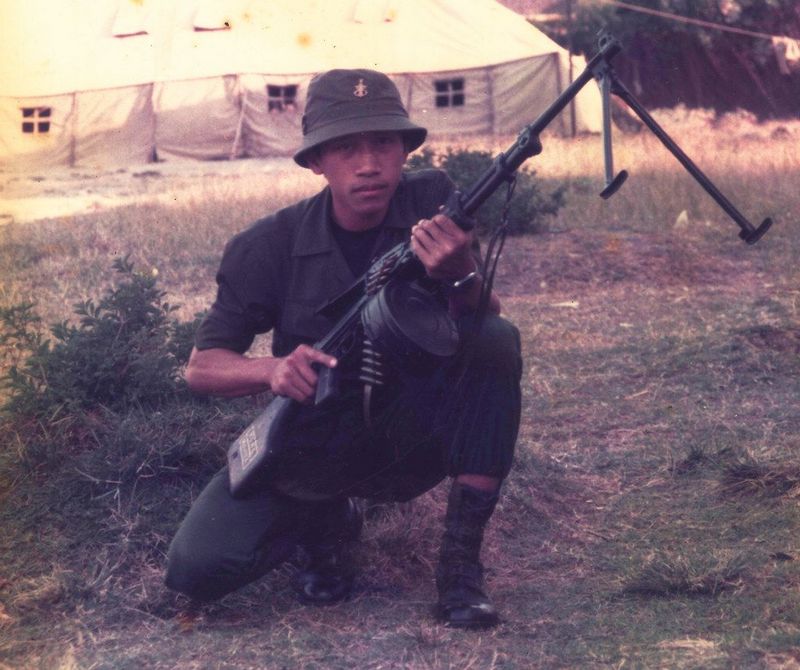
The RPD shows a rectangular receiver that contains the charging handle, ejection port, mirrors, trigger assembly and all related internal components. A beautifully shaped wooden stock is used for the stock, and the pistol grip is also made of wood. A unique handguard is located in front of the receiver and on the bottom of the barrel and cylinder. The cylinder is mounted under the barrel - unlike the Kalashnikov, which is characterized by the upper barrel. The barrel is covered by a forward-looking device, and a foldable bipod is seen clipped into the area.
In this way, the weapon can be shoulder fired as a typical offensive weapon or mounted on its bipod to support fire/suppress enemy positions.
The RPD holds the 7.62x39mm rifle cartridge and is the first Soviet automatic weapon to carry this cartridge. It was designed with a frameless bottle neck and was mass produced during the Cold War - in fact, it's still in use today (2014). The 100-round belt is mounted in a drum under the receiver.
A special mechanism is used inside to lift the strap and insert it into the action.
The RPD has been modified accordingly throughout its life cycle. Both the stock and the handle are manufactured in a timely manner according to operational service requirements. The gas cylinder is lengthened and the stock has a recoil absorber for more stable shooting. A cleaning stick is issued and installed in the stock, while a magazine cover is installed to prevent damage from dust and debris.
Despite the additions and modifications, the feed mechanism was never a truly reliable performance, noticeably lacking in the power needed. In addition, the role of the gun was limited to fully automatic fire, which, combined with the gun's light weight, proved to be somewhat problematic in terms of accuracy. Combined with the lack of a replaceable barrel, the operator must ensure that the barrel does not overheat.
A sustained rate of fire of 100 rounds in a minute is the absolute stated limit.
The production time span of this weapon was from 1944 to 1960, although the scope of use was well beyond that window. There are many operators, including Afghanistan, China, Egypt, Finland, East Germany, Hungary, Indonesia, Iraq, Laos, Libya, North Korea, Pakistan, Romania, Sudan, Syria, Thailand, Vietnam and Yemen (see list of operators).
The locally produced gun by the Chinese is the "Type 56" under the NORINCO brand label. Although the Soviets replaced the RPD with the RPK line, the RPD is still in service with some units today (December 2013). The weapon's combat history includes World War II, the Korean War, the Vietnam War, the Cambodian Civil War, the Iran-Iraq War, the 1991 Gulf War, the 2001 invasion of Afghanistan, the 2003 Iraq War, the Libyan Civil War, and the Syrian Civil War.
There are also many regional conflicts that use this type.
RPD Specification (Ruchnoy Pulemyot Degtyaryova)
Roles
- Fire Support/Suppression/Defense
Dimensions
1,037 mm (40.83 in)
520 mm (20.47 in)
7.40 kg
Rear sliding notch; semi-concealed front pillar
Performance
Gas powered; fully automatic
2,400 ft/s (732 m/s)
700 rounds per minute
2,500 ft (762 m; 833 yd)
Changes
RPD - Base Series Name
RPDM - Modify Variants
Type 56 - Native Chinese variant of NORINCO
Type 56-1 - Native Chinese variant of NORINCO; based on RPDM.
Type 62 - North Korean variant
 Argentina
 Armenia
 Australia
 Austria
 Austria-Hungary
 Belgium
 Brazil
 United Kingdom
 United States
 Brunei
 Bulgaria
 Canada
 Chile
Chile China
China Colonial America
 Colombia
 Confederate States
 Croatia
 Czech
Czech Denmark
 Egypt
Egypt Finland
 France
 Georgia
 Germany
 German Imperial
 Greece
 Holland
 Hungary
 India
India Indonesia
 Iran
Iran Iraq
Iraq Ireland
 Israel
 Italy
Italy Japan
Japan Japan (1940)
 Jordan
 Kingdom of Italy
 Malaysia
 Mexico
 Myanmar
 Nazi Germany
 Netherlands
 New Zealand
 North Korea
 Norway
 Pakistan
 Peru
Peru Philippines
 Poland
 Portugal
 Prussia
 Romania
 Russia
 Saudi Arabia
 Serbia
 Singapore
 Slovakia
 Slovenia
 South Africa
 South Korea
 Spain
Spain Sweden
 Switzerland
 Syria
Syria Taiwan
 Thailand
 Turkey
 UAE
UAE Ukraine
 Vietnam
 Yugoslavia