
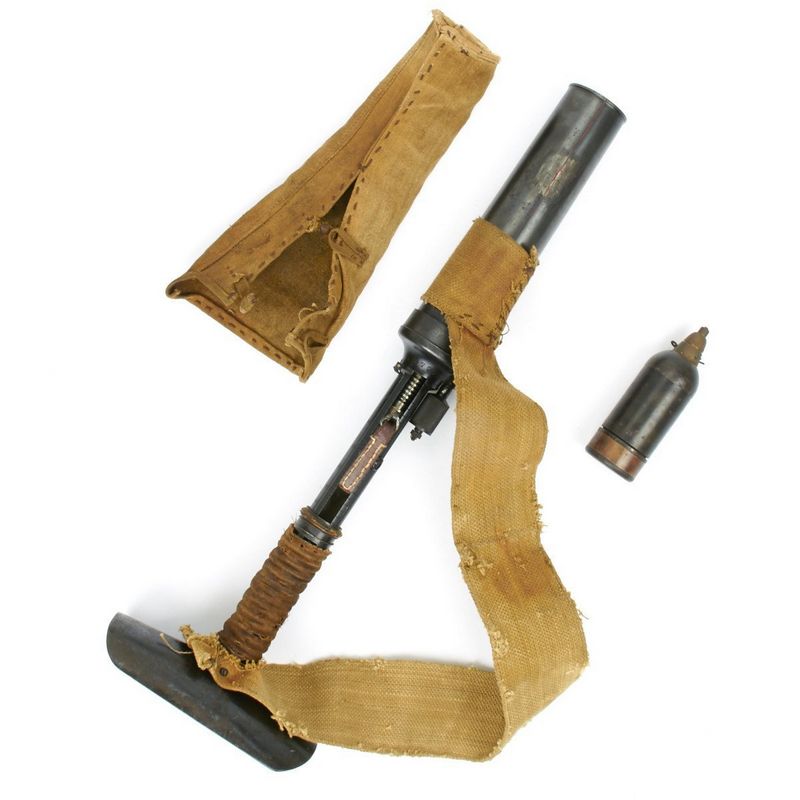


The history of the Type 89, 50mm grenade launcher
The Type 89 "Grenade Launcher" was another "light mortar" system used by Imperial Japan during World War II. Although not a true mortar system, the Imperial Japanese Army found uses for this weapon throughout the Pacific and during the Second Sino-Japanese War. The Type 89 was designed to improve upon the inherent limitations of the 1921 Type 10 and completely replaced this earlier model in 1941.
The Type 89 was in service from 1929 to 1945, and proved to be a more accurate, longer-range weaponand therefore a more tactically sensible device.
The Type 89 weighs about 10 pounds and is 24 inches long, 10 inches of which is the launch tube itself. The Type 89 is fired from a modified 50mm grenade with a range of between a minimum of 131 yards and a maximum of 732 yards. The main difference in the Type 89 compared to the Type 10 is that it uses a rifled barrel instead of a smoothbore. In addition, the Type 89 eliminated the vent-based disassembly system of the Type 10, and replaced it with an adjustable striker for disassembly.
The deeper the firing pin is set in the barrel, the greater the expected range of the projectile. Conversely, the higher the firing pin is set in the barrel, the shorter the range.
Aiming is very useful because there are no markings on the barrel other than the sight - no optical sights are provided. This proved manageable, especially with trained Japanese soldiers. The low weight cost of returning fire is more than enough to offset the basic nature of the weapon.
The range of ammo is also a bonus.
Well-trained Type 89 crews can fire about 25 rounds per minute, comparable to the number of light mortar systems used by the enemy. The Type 89's relatively low weight also means it can be transported alone or in a convenient holster, while retaining the soldier's basic equipment and weapons loadout.
The Type 89 maintains mind control over the US Navy operating in the Pacific, which is now trained to hit the dirt with the sound of the Type 89 taking off.
The Type 89 is the same as the Type 10, only the detonator, the fixed base plate and the projectile itself. 45-degree angle). The projectile is then dropped (bottom to bottom) into the launch tube and activated by the firing pin at a predetermined distance set by the operator. Operation Type 89 officially requires three personnel for best results, but one operator can still operate the weapon if desired.
The shovel base plate is designed to allow the operator to poke the launcher base into solid objects, such as fallen trees, to aid recoil during launch.
The Americans mistakenly mistranslated the accompanying Japanese mortar manual and believed that the Type 89 (and Type 10) were designed to be fired from the thigh, so these weapons were collectively referred to as "knee mortars". Of course, this is completely false, as shooting with this recoil can (and does) result in operator injury.
A slightly newer shell was developed for the new Type 89. Like the Type 10 and other mortar systems, the Type 89 is designed to fire various types of projectiles to meet battlefield demands. The first round is the Type 89 50mm HE "High Explosive" projectile, powered by an impact fuze, capable of inflicting a lot of damage while increasing the psychological effect.
The Type 91 is a fragmentation-based bullet with a 7-second delay fuze that can be used to cut through the lush foliage and canopy inherent in jungle warfare. The fuse is automatically activated in flight after the grenade is fired from the launch tube.
There is also an incendiary grenade that can be used for illumination (flash/signal) and strike personnel, as well as a Type 94 practice grenade for target training.
Type 89, 50mm Grenade Discharger Specification
ROLES
- Area Effect
- In-Direct Fire / Siege / Area Effect
STRUCTURAL
610 mm (24. 02 in)
254 mm (10. 00 in)
10. 36 lb (4. 70 kg)
None.
PERFORMANCE
Muzzle Loading; Trigger-Actuated
393 ft (120 m; 131 yd)
VARIANTS
Type 89, 50mm Grenade Discharger - Base Series Designation.
 Argentina
 Armenia
 Australia
 Austria
 Austria-Hungary
 Belgium
 Brazil
 United Kingdom
 United States
 Brunei
 Bulgaria
 Canada
 Chile
Chile China
China Colonial America
 Colombia
 Confederate States
 Croatia
 Czech
Czech Denmark
 Egypt
Egypt Finland
 France
 Georgia
 Germany
 German Imperial
 Greece
 Holland
 Hungary
 India
India Indonesia
 Iran
Iran Iraq
Iraq Ireland
 Israel
 Italy
Italy Japan
Japan Jordan
 Kingdom of Italy
 Malaysia
 Mexico
 Myanmar
 Nazi Germany
 Netherlands
 New Zealand
 North Korea
 Norway
 Pakistan
 Peru
Peru Philippines
 Poland
 Portugal
 Prussia
 Romania
 Russia
 Saudi Arabia
 Serbia
 Singapore
 Slovakia
 Slovenia
 South Africa
 South Korea
 Soviet Union
 Spain
Spain Sweden
 Switzerland
 Syria
Syria Taiwan
 Thailand
 Turkey
 UAE
UAE Ukraine
 Vietnam
 Yugoslavia