
History
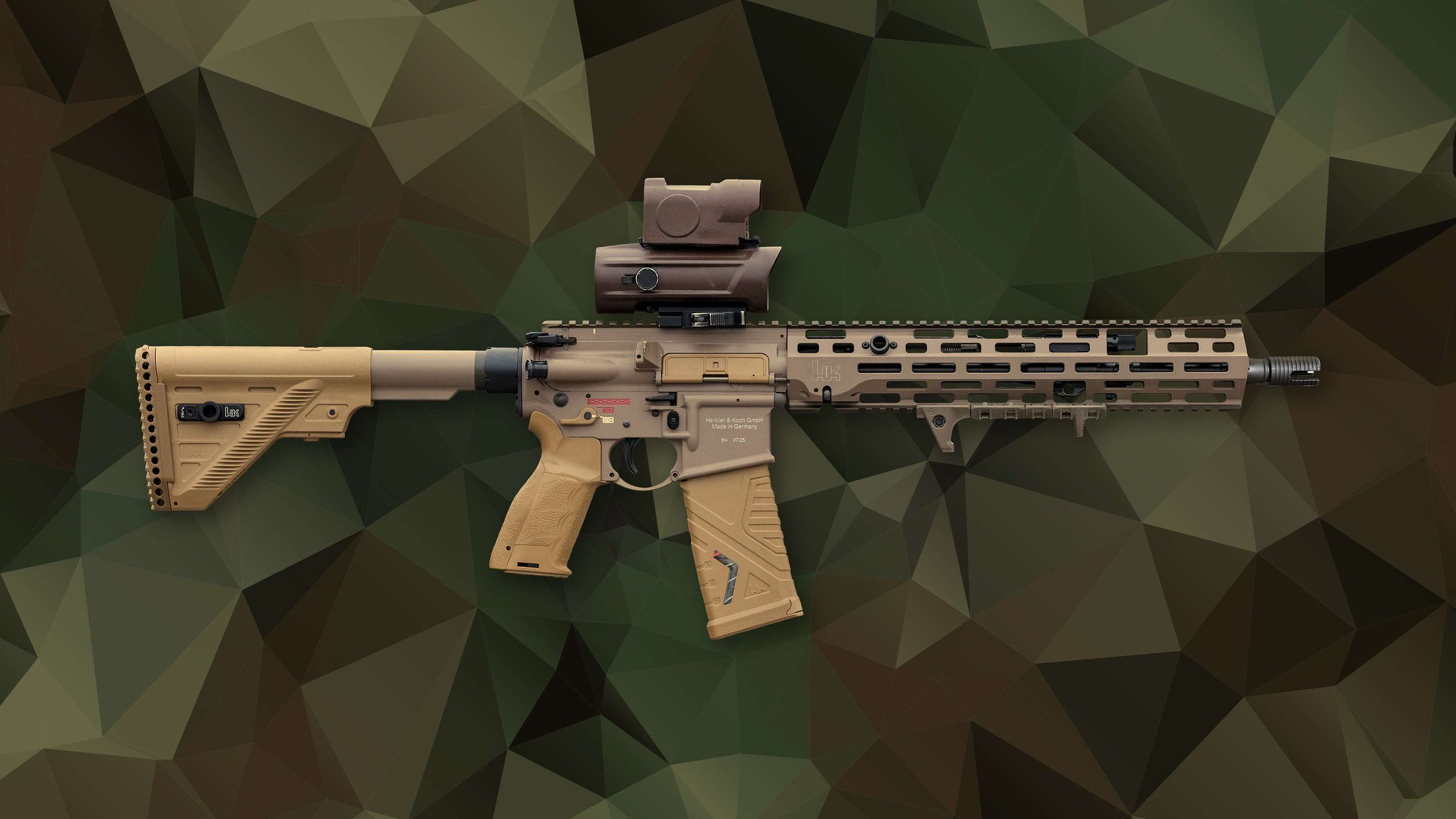
The Heckler & Koch G95 is a German 5.56 mm assault-rifle family based on the HK416 and adopted by the Bundeswehr. The initial G95K entered service with German special-operations forces in 2017. The later G95A1 and shorter G95KA1 were selected as the standard rifles intended to replace the G36 across the wider armed forces.
Heckler & Koch developed the HK416 by combining an AR-15-type bolt and receiver layout with a proprietary short-stroke gas-piston operating system. The arrangement retained familiar controls and magazine compatibility while reducing the amount of propellant gas and fouling entering the receiver compared with a direct-gas system.
Germany began its competition for a new general-service assault rifle in 2017. Legal disputes and repeated evaluation extended the procurement process, which was concluded in favour of a Bundeswehr-specific HK416 A8 configuration. G95A1 and G95KA1 were designed in 2021 and entered general Bundeswehr service in 2025.
Procurement
The Bundeswehr initially planned to procure nearly 120,000 rifles. Parliament subsequently increased the framework ceiling, and the procurement authority exercised an order for 250,000 G95A1 and G95KA1 weapons in July 2026. Deliveries under the approximately €800 million rifle contract were scheduled through 2032.
The first 300 G95KA1 rifles were delivered to Panzergrenadierbataillon 122 at Grafenwöhr in December 2025. The battalion belongs to Germany's armoured brigade established for service in Lithuania. Initial issue allowed troops to begin training, qualification, maintenance, and integration of the complete sight and accessory system.
Reports in August 2026 stated that Germany was considering a second package of up to 250,000 rifles. Such an order could raise the planned inventory to about 500,000 and provide weapons for an expanded active force, reserves, training establishments, maintenance stocks, and replacements. The reported follow-on purchase had not been officially confirmed.
Replacement of the G36
G95A1 and G95KA1 provide a rigid metal receiver, modern accessory interfaces, ambidextrous controls, and a gas setting intended for routine suppressor use. The weapons are heavier than a comparably equipped G36 and their telescoping stocks cannot fold because the recoil spring extends into the stock.
The shorter KA1 is intended for most Army users. Its reduced length with the stock extended is useful in Puma infantry fighting vehicles, buildings, vegetation, and field fortifications. The longer A1 retains additional barrel length for roles that place more emphasis on velocity and open-ground engagements.
Design
G95 uses a gas-operated short-stroke piston above the barrel and a multi-lug rotating bolt. Propellant gas drives a separate piston and operating rod, which cycles the bolt carrier. The rifle fires the 5.56×45 mm NATO cartridge from detachable 30-round STANAG magazines.
Controls and furniture
The selector provides safe, semi-automatic, and automatic settings. Principal controls are ambidextrous so the rifle can be operated from either shoulder. A telescoping stock adjusts length of pull but does not fold.
STANAG 4694 accessory rails on the receiver and handguard accept optical sights, laser-light modules, night-vision equipment, thermal sights, grips, hand stops, and bipods. The muzzle can carry a flash suppressor or an approved sound and signature suppressor.
Gas system
An adjustable regulator provides settings for normal and suppressed operation. A suppressor increases gas back pressure, so the alternative setting regulates the energy delivered to the moving components. Correct adjustment can reduce excessive bolt speed, wear, recoil impulse, and fouling while maintaining reliable cycling.
Sights
The standard German sight package combines an ELCAN Specter DR optic with one-power and four-power settings and an Aimpoint ACRO P-2 reflex sight. This gives the soldier a rapid close-range aiming system and magnification for target identification and engagement at intermediate distance.
A Rheinmetall LLM-VarioRay laser-light module provides white illumination, a visible aiming laser, an infrared laser, and an adjustable infrared illuminator. Infrared functions support aiming with night-vision equipment. Folding mechanical sights remain available if electronic or optical sights are damaged.
Operational history
The original G95K has served with German special-operations units since 2017. General issue of G95KA1 began in December 2025, with early rifles supporting conversion training before larger deliveries. The G95A1 and KA1 had not yet replaced every G36 by August 2026.
The planned inventory supports Germany's expansion of active and reserve forces and the establishment of deeper wartime stocks. Common weapons, magazines, optics, accessories, spares, and training can simplify mobilisation compared with maintaining separate rifle systems for active and homeland-defence units.
Variants
- G95K — German special-operations version based on HK416A7, adopted in 2017.
- G95A1 — Bundeswehr HK416 A8 configuration with a 419 mm barrel.
- G95KA1 — compact general-service version with a 355 mm barrel, intended as the principal German Army rifle.
Operators
- Germany — Bundeswehr special-operations forces and general service units; G95A1 and G95KA1 are replacing G36 rifles in stages.
Specifications (G95KA1)
General characteristics
- Cartridge: 5.56×45 mm NATO.
- Action: Gas-operated short-stroke piston with rotating bolt.
- Weight: Approximately 3.3 kg (7.3 lb) without accessories; approximately 4.3 kg (9.5 lb) with standard optic, laser-light module, and loaded magazine.
- Length: 796–878 mm (31.3–34.6 in), depending on stock position.
- Barrel length: 355 mm (14 in).
- Feed system: 30-round STANAG detachable magazine.
- Fire modes: Semi-automatic and automatic.
- Standard sight: ELCAN Specter DR 1–4× with Aimpoint ACRO P-2 reflex sight.
Performance
- Cyclic rate: Approximately 850 rounds per minute.
- Muzzle velocity: Approximately 790 m/s (2,590 ft/s) with specified DM11 ammunition; varies with load and conditions.
- Declared effective combat distance: Approximately 450 m (490 yd).
Related equipment
- Heckler & Koch HK416 — parent rifle platform from which G95 configurations were developed.
- Heckler & Koch G36 — previous standard Bundeswehr rifle being replaced.
- Heckler & Koch G27 and G28 — German service rifles with related control layouts and training considerations.
 Argentina
 Armenia
 Australia
 Austria
 Austria-Hungary
 Belgium
 Brazil
 United Kingdom
 United States
 Brunei
 Bulgaria
 Canada
 Chile
Chile China
China Colonial America
 Colombia
 Confederate States
 Croatia
 Czech
Czech Denmark
 Egypt
Egypt Finland
 France
 Georgia
 German Imperial
 Greece
 Holland
 Hungary
 India
India Indonesia
 Iran
Iran Iraq
Iraq Ireland
 Israel
 Italy
Italy Japan
Japan Japan (1940)
 Jordan
 Kingdom of Italy
 Malaysia
 Mexico
 Myanmar
 Nazi Germany
 Netherlands
 New Zealand
 North Korea
 Norway
 Pakistan
 Peru
Peru Philippines
 Poland
 Portugal
 Prussia
 Romania
 Russia
 Saudi Arabia
 Serbia
 Singapore
 Slovakia
 Slovenia
 South Africa
 South Korea
 Soviet Union
 Spain
Spain Sweden
 Switzerland
 Syria
Syria Taiwan
 Thailand
 Turkey
 UAE
UAE Ukraine
 Vietnam
 Yugoslavia